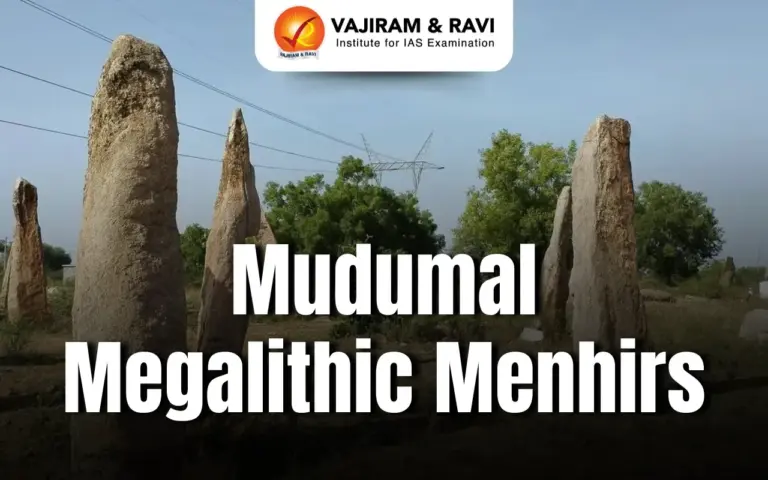
Mudumal Megalithic Menhirs Latest News
Recently, Telangana’s Mudumal Megalithic Menhirs were added to India’s tentative UNESCO World Heritage list, highlighting their historical and archaeological significance.
About Menhirs
- Menhirs are large upright standing stones, often part of megalithic burial or ritual sites.
- Found across Europe, Africa, and Asia, they are most numerous in Western Europe.
- They vary in size, are often uneven and squared, and sometimes taper towards the top.
- Menhirs are arranged in circles, semicircles, ellipses, or parallel rows.
- The most famous alignment is the Carnac Stones in France, with 2,935 menhirs.
- Some menhirs feature engravings, possibly linked to fertility rites and seasonal cycles.




What are Megaliths?
- Megaliths are stone structures used as burial sites or commemorative (non-sepulchral) memorials.
- Burial Megaliths:
- Dolmenoid cists (box-shaped burial chambers).
- Cairn circles (stone circles marking graves).
- Capstones (mushroom-shaped burial chambers, mainly in Kerala).
- Non-burial Megaliths: Menhirs serve as memorials or astronomical markers.
- Megalithic Culture in India: Most megaliths in India date back to the Iron Age (1500–500 BCE).
- Concentrated in Maharashtra, Karnataka, Tamil Nadu, Kerala, Andhra Pradesh, and Telangana.
Significance of Mudumal Menhirs
- Archaeological importance: Considered one of South India’s largest megalithic-era burial sites.
- The site covers 80 acres and contains:
- 80 tall menhirs (10-14 feet high).
- 3,000 alignment stones in rows (20-25 feet apart), likely linked to ancient funerary rites.
- The site covers 80 acres and contains:
- Astronomical Significance: Likely served as an ancient astronomical observatory.
- Menhir alignments coincide with solar events such as:
- Equinoxes (day and night are equal).
- Solstices (longest and shortest days of the year).
- A unique menhir with cup marks is considered the earliest known depiction of a constellation in South Asia (Ursa Major/Saptarshi Mandal).
- Menhir alignments coincide with solar events such as:
- Cultural and Religious Significance: The local population worships some menhirs, calling them “Niluralla Thimmappa” (Thimmappa of the Standing Stones).
- A particular menhir is revered as Goddess Yellamma, reflecting living cultural traditions.
Mudumal’s UNESCO Tentative List Status
- Telangana currently has only one UNESCO World Heritage Site—Ramappa Temple, inscribed in 2021.
- Added to the UNESCO Tentative List in 2025, along with:
- Kanger Valley National Park (Chhattisgarh).
- Ashokan Edict Sites (Multiple States).
- Chausath Yogini Temples (Madhya Pradesh & Odisha).
- Gupta Temples (Multiple States).
- Palace-Fortresses of the Bundelas (Madhya Pradesh & Uttar Pradesh).
- India now has 62 sites on its Tentative UNESCO List, a mandatory step before full inscription.
Mudumal Megalithic Menhirs FAQs
Q1. What are Mudumal Megalithic Menhirs?
Ans. They are ancient standing stones in Telangana dating back 3,500–4,000 years with significant astronomical and cultural importance.
Q2. Why are the Mudumal Menhirs significant?
Ans. They showcase advanced prehistoric knowledge of astronomy and mathematics while being deeply rooted in local cultural traditions.
Q3. What is the latest development regarding Mudumal Menhirs?
Ans. They were added to India’s UNESCO Tentative World Heritage List in 2025, marking a step toward full recognition.
Source: IE

 Last updated on March, 2026
→ UPSC Final Result 2025 is now out.
→ UPSC has released UPSC Toppers List 2025 with the Civil Services final result on its official website.
→ Anuj Agnihotri secured AIR 1 in the UPSC Civil Services Examination 2025.
→ UPSC Marksheet 2025 is now out.
→ UPSC Notification 2026 & UPSC IFoS Notification 2026 is now out on the official website at upsconline.nic.in.
→ UPSC Calendar 2026 has been released.
→ Check out the latest UPSC Syllabus 2026 here.
→ UPSC Prelims 2026 will be conducted on 24th May, 2026 & UPSC Mains 2026 will be conducted on 21st August 2026.
→ The UPSC Selection Process is of 3 stages-Prelims, Mains and Interview.
→ Prepare effectively with Vajiram & Ravi’s UPSC Prelims Test Series 2026 featuring full-length mock tests, detailed solutions, and performance analysis.
→ Enroll in Vajiram & Ravi’s UPSC Mains Test Series 2026 for structured answer writing practice, expert evaluation, and exam-oriented feedback.
→ Join Vajiram & Ravi’s Best UPSC Mentorship Program for personalized guidance, strategy planning, and one-to-one support from experienced mentors.
→ Shakti Dubey secures AIR 1 in UPSC CSE Exam 2024.
→ Also check Best UPSC Coaching in India