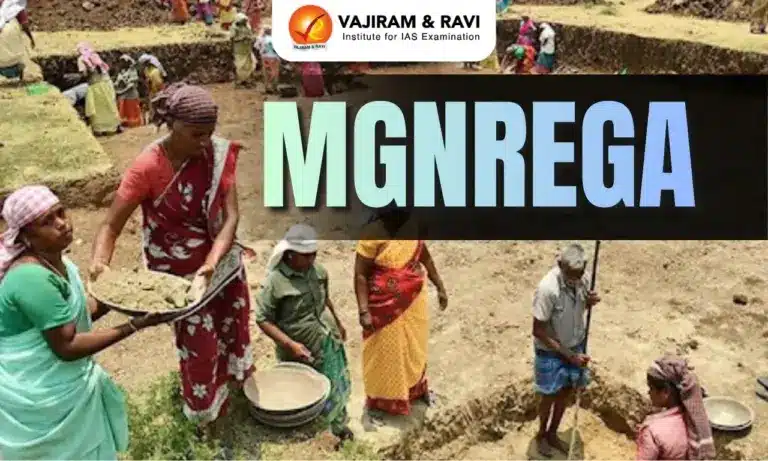
MGNREGA Latest News
- Recently, Parliament passed the Viksit Bharat Guarantee For Rozgar and Ajeevika Mission (Gramin) or VB-G RAM G Bill, just three days after it was circulated, replacing MGNREGA (2005).
- The move drew strong protests from the Opposition and civil society, who accused the government of pushing the legislation without prior consultation or adequate debate.
Origins of MGNREGA: From Civil Society Vision to Law
- In 2005, Parliament passed a national rural employment guarantee law, which was expanded to all districts by 2008.
- After 2009, it was renamed the Mahatma Gandhi National Rural Employment Guarantee Act (MGNREGA).
Role of the National Advisory Council (NAC)
- In 2004, the National Advisory Council (NAC) brought together civil society leaders, retired officials, and intellectuals.
- At its very first meetings, Aruna Roy and economist Jean Drèze proposed two landmark ideas: the Right to Information Act and a rural employment guarantee.
- The initial MGNREGA draft was prepared swiftly, emerging from the NAC’s August 19, 2004 meeting.
Dilution and Pushback
- The Bill sent to Parliament diluted the NAC’s vision—removing universal coverage, weakening the “guarantee,” and limiting benefits to below-poverty-line families.
- This prompted widespread protests by civil society groups, especially the Right to Food Campaign.
Parliamentary Review and Restoration
- The weakened Bill was examined by the Parliamentary Standing Committee on Rural Development.
- The committee recommended restoring most original provisions.
- The government accepted these changes, leading to the Bill’s passage in 2005—cementing MGNREGA as a rights-based employment guarantee.






Why MGNREGA Was Unique: Rights, Reach, and Resilience
- MGNREGA guaranteed 100 days of paid unskilled work per rural household on demand, making it a legal entitlement rather than a welfare dole.
- Wages in 2025–26 ranged from ₹241 to ₹400, offering a basic safety net against extreme poverty.
- Universal and Non-Targeted Design – Unlike most schemes, MGNREGA was universal—not restricted by caste, category, or Below Poverty Line status. Anyone willing to work could access it, avoiding exclusion errors tied to disputed poverty metrics.
- Scale and Inclusion – About 12.61 crore active workers depend on the scheme. Women account for nearly 58% participation over the past five years, many entering paid work for the first time. SCs and STs form 35% of the workforce, with studies showing up to 30% higher consumption for Dalit and Adivasi households during lean seasons.
- Crisis Buffer During COVID-19 – MGNREGA proved crucial during the pandemic. A survey led by Azim Premji University found that in Karnataka, over 60% of households felt the scheme contributed to village development and stability.
- Reducing Distress Migration – Avoiding migration emerged as the top reason for continuing MGNREGA. A large majority recommended expanding support to 100 days per person, not just per household.
- Building Citizenship and Collective Action – Beyond incomes, MGNREGA fostered civic engagement and rights awareness, strengthening worker organisation and unionisation in States like Rajasthan and Karnataka—an impact rare among welfare programmes.
Government’s Rationale for Introducing a New Rural Employment Bill
- The government argues that MGNREGA suffers from serious flaws, citing widespread corruption and misuse of funds by State governments, as stated by the Union Rural Development Minister in Parliament.
- However, critics note that these were largely implementation challenges, not design failures.
- MGNREGA already had strong safeguards, including social audits and a transparent IT-based system tracking work demand, execution, and wage payments.
How the New Bill Differs from MGNREGA
- From Demand-Driven to Supply-Driven – MGNREGA guaranteed work on demand. The new Bill shifts to a supply-driven model, with employment capped by a fixed Union budget and provided only in Centre-notified rural areas, ending the scheme’s universal character.
- Funding Pattern and State Burden – While MGNREGA effectively operated on a 90:10 Centre–State cost share, the new Bill raises States’ burden. Funding will be 60:40 for most States, and 90:10 for northeastern and Himalayan States, increasing fiscal pressure on State governments.
- More Days, Less Autonomy – The guaranteed workdays rise from 100 to 125, but the Centre gains greater control—deciding State-wise allocations using unspecified parameters and notifying eligible rural areas each year.
- Selective Coverage and Blackout Periods – Unlike MGNREGA’s universal access, implementation will be selective. The Bill also allows blackout periods during peak agricultural seasons, temporarily suspending work to ensure farm labour availability—another major departure from the original Act.
Source: TH

 Last updated on March, 2026
→ UPSC Final Result 2025 is now out.
→ UPSC has released UPSC Toppers List 2025 with the Civil Services final result on its official website.
→ Anuj Agnihotri secured AIR 1 in the UPSC Civil Services Examination 2025.
→ UPSC Marksheet 2025 is now out.
→ UPSC Notification 2026 & UPSC IFoS Notification 2026 is now out on the official website at upsconline.nic.in.
→ UPSC Calendar 2026 has been released.
→ Check out the latest UPSC Syllabus 2026 here.
→ UPSC Prelims 2026 will be conducted on 24th May, 2026 & UPSC Mains 2026 will be conducted on 21st August 2026.
→ The UPSC Selection Process is of 3 stages-Prelims, Mains and Interview.
→ Prepare effectively with Vajiram & Ravi’s UPSC Prelims Test Series 2026 featuring full-length mock tests, detailed solutions, and performance analysis.
→ Enroll in Vajiram & Ravi’s UPSC Mains Test Series 2026 for structured answer writing practice, expert evaluation, and exam-oriented feedback.
→ Join Vajiram & Ravi’s Best UPSC Mentorship Program for personalized guidance, strategy planning, and one-to-one support from experienced mentors.
→ Shakti Dubey secures AIR 1 in UPSC CSE Exam 2024.
→ Also check Best UPSC Coaching in India
MGNREGA FAQs
Q1. Why does the government want an MGNREGA replacement?+
Q2. How was MGNREGA different from other welfare schemes?+
Q3. What are the key changes in the new rural employment Bill?+
Q4. How does the new Bill change Centre–State funding?+
Q5. Why is the MGNREGA replacement controversial?+
Tags: mains articles mgnrega upsc current affairs upsc mains current affairs