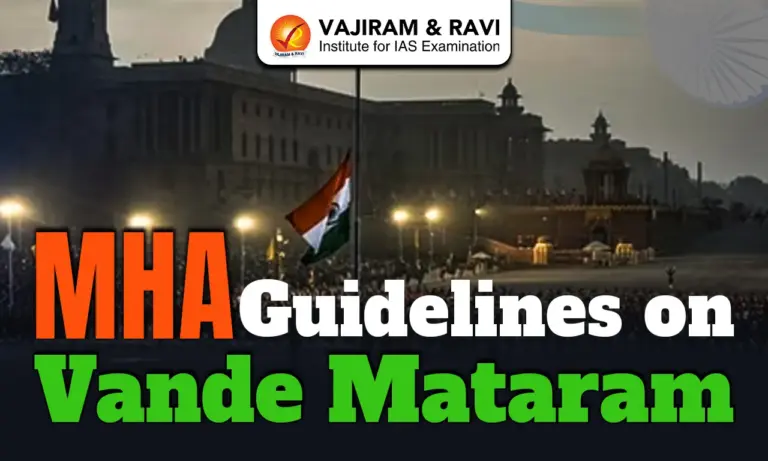
The Union Ministry of Home Affairs (MHA) has released new guidelines requiring that all six stanzas of the National Song must be performed, and when both are played together, Vande Mataram should be rendered before the National Anthem.
The directive has been introduced to mark the 150th anniversary of the national song’s composition, highlighting its historical and patriotic importance.
Occasions for Playing the National Song
- The official version of Vande Mataram must be performed during civil investiture ceremonies conducted by the government.
- It is required to be played during the arrival and departure of the President of India at formal state functions and other government-organised events.
- The National Song must be played immediately before and after the President delivers an address to the nation through All India Radio and television broadcasts.
- The rendition is also mandatory during the arrival and departure of Governors or Lieutenant Governors at official state functions within their respective States or Union Territories.
- Vande Mataram must be played during ceremonial events when the National Flag is brought on parade.
- The Government of India may direct the performance of the National Song on additional occasions as required.
- When Vande Mataram is performed by a ceremonial band, it must begin with a drumroll lasting seven slow marching paces, unless another clear signal is given indicating the start of the song.
Mass Singing of the National Song
- The guidelines encourage mass singing of the official version during the unfurling of the National Flag at cultural or ceremonial events, excluding parade ceremonies.
- The National Song should also be sung collectively during the arrival of the President at public or government functions, other than formal state ceremonies, and immediately before his departure.
- The Ministry has clarified that on all such occasions, the complete six-stanza official version of Vande Mataram must be used and group participation should be promoted wherever possible.
- Schools have been advised to begin the day with community singing of Vande Mataram to encourage patriotism among students.
- Educational institutions are also encouraged to create awareness and promote respect for the National Song, National Anthem, and National Flag among students.





About Vande Mataram
Vande Mataram is India’s National Song, written by Bankim Chandra Chatterjee, which celebrates the nation as a motherland and symbolizes patriotism and unity. The song played a crucial role during India’s freedom struggle and continues to represent national pride and cultural heritage.
- Year of Composition: Composed in the 1870s and later published in the novel Anandamath in 1882.
- Adoption as National Song: Officially adopted by the Constituent Assembly on 24 January 1950.
- Language: Originally written in Sanskrit and Bengali.
- Total Stanzas: The complete song contains six stanzas.
- Theme and Meaning: The song praises India as a divine mother and highlights the country’s natural beauty, strength, and cultural richness.
- Role in Freedom Movement: It served as a patriotic slogan and inspired freedom fighters during British rule.
- Cultural Importance: Vande Mataram remains a symbol of national unity, patriotism, and respect for the motherland.
- Official Recognition: It holds the status of the National Song, while Jana Gana Mana is recognized as the National Anthem.
- Modern Usage: The song is performed at government ceremonies, cultural events, educational institutions, and patriotic programs.
About National Anthem
The National Anthem of India, “Jana Gana Mana,” was written by Nobel Laureate Rabindranath Tagore and officially adopted on 24 January 1950. It reflects the unity, diversity, and sovereignty of India and is sung on important national and international occasions.
- First Performance: First sung on 27 December 1911 at the Calcutta Session of the Indian National Congress.
- Adoption: Officially adopted as the National Anthem of India on 24 January 1950.
- Language: Written in highly Sanskritised Bengali.
- Duration:
- Full version takes 52 seconds to sing.
- Short version takes about 20 seconds and includes the first and last lines.
- Meaning and Theme:
- The anthem praises India and highlights unity among different regions, cultures, and communities.
- It represents national integrity and pride.
- Occasions of Performance:
- National celebrations like Republic Day and Independence Day
- Official government ceremonies
- International sporting and diplomatic events
- School assemblies and patriotic programs
- Legal Protection:
- Protected under the Prevention of Insults to National Honour Act, 1971.
- Disrespect or interruption during the anthem is punishable by law.
- Protocol During Anthem:
- Citizens must stand in attention posture while the anthem is played or sung.
- The anthem must be performed with dignity and without alteration.
- National Significance:
- The National Anthem represents India’s identity, sovereignty, and unity, making it one of the most respected national symbols of the country.
Legal Provisions and Acts Related to National Honour
India has established specific legal provisions to protect the dignity and respect of its national symbols, including the National Flag, National Anthem, Constitution of India, and National Song.
- The Prevention of Insults to National Honour Act, 1971 is the main law that protects India’s national symbols such as the National Flag, National Anthem, and Constitution of India from disrespect or misuse.
- The Act prohibits any deliberate insult, damage, or disrespect toward the National Flag, including burning, defacing, defiling, or trampling it in public or private places.
- Any person found guilty of insulting national symbols under this Act can face punishment that includes imprisonment for up to three years, a monetary fine, or both.
- The Flag Code of India, 2002 provides detailed rules and guidelines regarding the correct display, use, and handling of the Indian National Flag by citizens, government bodies, and private organizations.
- The Flag Code allows citizens to hoist the National Flag on any day, provided it is displayed with dignity, honour, and proper respect.
- The National Flag should never touch the ground, floor, water, or be used as clothing, costume, decoration, or commercial promotional material.
- The Flag must always be displayed in the correct proportion, colour combination, and design as specified under the Flag Code.
- The Ministry of Home Affairs (MHA) has issued official guidelines regulating the performance and usage of the National Anthem, ensuring it is sung or played with dignity and uniformity across the country.
- The full version of the National Anthem must be sung within 52 seconds, while a shorter version of approximately 20 seconds may be used on specific occasions.
- Citizens are required to stand in an attention posture whenever the National Anthem is played or sung, except in certain exceptional circumstances permitted by law or court orders.
- The National Anthem cannot be dramatized, distorted, parodied, or used for commercial entertainment purposes.
- The Constitution of India promotes respect for national symbols through Article 51A, which outlines the Fundamental Duties of citizens.
- The Supreme Court of India has repeatedly emphasized the importance of respecting national symbols and has clarified that such respect is linked to maintaining national unity and integrity.

 Last updated on March, 2026
→ UPSC Final Result 2025 is now out.
→ UPSC has released UPSC Toppers List 2025 with the Civil Services final result on its official website.
→ Anuj Agnihotri secured AIR 1 in the UPSC Civil Services Examination 2025.
→ UPSC Marksheet 2025 is now out.
→ UPSC Notification 2026 & UPSC IFoS Notification 2026 is now out on the official website at upsconline.nic.in.
→ UPSC Calendar 2026 has been released.
→ Check out the latest UPSC Syllabus 2026 here.
→ UPSC Prelims 2026 will be conducted on 24th May, 2026 & UPSC Mains 2026 will be conducted on 21st August 2026.
→ The UPSC Selection Process is of 3 stages-Prelims, Mains and Interview.
→ Prepare effectively with Vajiram & Ravi’s UPSC Prelims Test Series 2026 featuring full-length mock tests, detailed solutions, and performance analysis.
→ Enroll in Vajiram & Ravi’s UPSC Mains Test Series 2026 for structured answer writing practice, expert evaluation, and exam-oriented feedback.
→ Join Vajiram & Ravi’s Best UPSC Mentorship Program for personalized guidance, strategy planning, and one-to-one support from experienced mentors.
→ Shakti Dubey secures AIR 1 in UPSC CSE Exam 2024.
→ Also check Best UPSC Coaching in India
MHA Guidelines on Vande Mataram FAQs
Q1. What are the MHA Guidelines on Vande Mataram?+
Q2. What is the official version of Vande Mataram as per MHA guidelines?+
Q3. What is the official duration of Vande Mataram?+
Q4. Is Vande Mataram mandatory in schools?+
Q5. Are people required to stand when Vande Mataram is played?+
Tags: mha guidelines on vande mataram