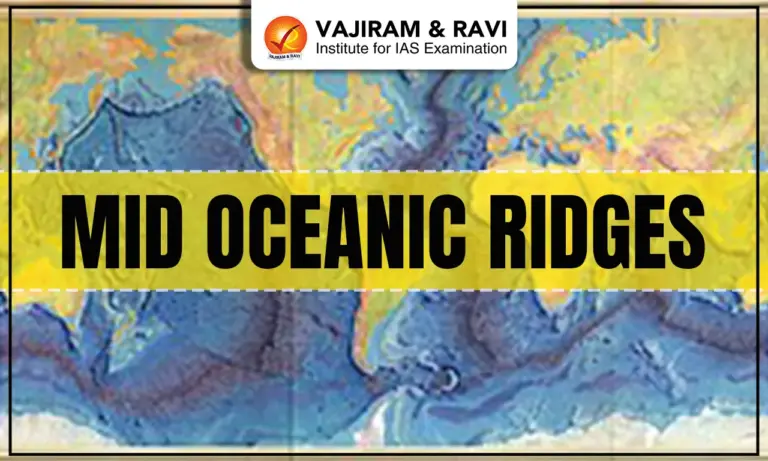
Mid-Oceanic Ridges are important for the study of plate tectonics and ocean relief. They mark divergent boundaries, where new ocean floors are continuously created. The ridges rise to heights of 2,500 metres, some breaching the ocean surface as volcanic islands. Seafloor spreading rates vary globally, from as little as 1 cm per year to as much as 20 cm per year, influencing oceanic geography and even global climate patterns. In this article, we are going to cover Mid-Oceanic Ridges, its formation, types and major distributions.
Mid-Oceanic Ridges
Plate tectonics has created one of the most striking underwater features of our planet that is the Mid-Oceanic Ridge. This global submarine mountain system is composed of two parallel chains separated by a deep central depression. Some peaks rise nearly 2,500 metres from the ocean floor, and in certain locations, even emerge above the sea surface to form islands.
Explorations of the ocean floor have shown extraordinary geological structures and processes linked to these ridges. Most underwater earthquakes, some capable of triggering tsunamis, occur along plate boundaries in these regions. Modern seafloor mapping has improved our understanding of tectonic activity, ocean relief features, and the dynamic processes shaping Earth’s crust.
Mid-Oceanic Ridges Formation
Mid-Oceanic Ridges represent some of the most distinctive structures on Earth’s surface. Located predominantly in the middle of ocean basins, these ridges coincide with divergent plate boundaries, where tectonic plates move apart.
According to the Theory of Plate Tectonics, convection currents in the mantle drive this movement, leading to the upwelling of magma that solidifies to form a new oceanic crust. This process, called seafloor spreading, is continuous and has been central to reshaping Earth’s geology over millions of years. The birth of ridges, growth of ocean basins, and recycling of crust are ongoing processes that define the dynamic nature of our planet.





Mid-Indian Ridge
The Mid-Indian Ridge is an important section of the global mid-ocean ridge system. Spreading northwards from the South Atlantic Ocean, it continues into the Indian Ocean and eventually reaches near Rodrigues Island, where it splits into two branches:
- One branch runs northward toward the Gulf of Aden, linking with the East African Rift System.
- The other moves southeast toward the Macquarie Islands.
- An important feature of this system is the Carlsberg Ridge, lying in between the Gulf of Aden and Rodrigues Island. This ridge is seismically active, marked by frequent earthquakes due to its association with tectonic fault zones.
Mid-Ocean Ridges Types
The morphology of mid-ocean ridges varies depending on their spreading rates, volcanic activity, and tectonic faulting. Mid- Oceanic Ridges are of two types:
1. Fast-Spreading Mid-Ocean Ridges
-
- Found at locations such as the East Pacific Rise, these ridges spread at rapid rates.
- High magma supply makes them geologically “hot,” resulting in frequent volcanic eruptions.
- The crust at the ridge crest is ductile, responding to tension much like hot taffy being stretched.
2. Slow-Spreading Mid-Ocean Ridges
-
-
- Seen at ridges like the Mid-Atlantic Ridge, where spreading occurs at slower rates.
- The crust behaves more rigidly, fracturing into ridges and valleys, resembling cold chocolate breaking apart.
- These ridges display rugged topography with deep rift valleys.
-
Mid-Ocean Ridges Principal Characteristics
Mid-Oceanic Ridges are not only visually beautiful but also geologically important. These characteristics include:
- Formation of new crust: At ridge crests, fresh basaltic lava emerges, creating new oceanic crust, which later gets buried under sediments.
- Heat flow: Ridges show abnormally high geothermal activity compared to other regions, indicating mantle upwelling.
- Seismicity: Frequent earthquakes and transform faults reveal the tension and fracturing in the crust.
- Depth-age relationship: As the newly formed crust moves away from the ridge, it cools and sinks deeper. Oceanic crust reaches depths of 5–5.5 km after about 70–80 million years.
- Width and spreading rate: Fast-spreading ridges such as the East Pacific Rise are wider and smoother, while slow-spreading ridges like the Mid-Atlantic Ridge are narrow with rougher topography.
- Global sea-level connection: Variations in spreading rates influence ocean basin depths, indirectly affecting continental sea levels.
Mid-Ocean Ridges Major Distribution
Mid-ocean ridges are present in all ocean basins. The Mid-Oceanic Ridges are distributed in the following types:
Atlantic Ocean
- The Mid-Atlantic Ridge runs from Iceland to about 60° S latitude in the South Atlantic.
- Initially identified in the mid-19th century, it was later mapped in detail during the 20th century by oceanographers Bruce Heezen and Maurice Ewing.
- The ridge crest displays axial highs at fast-spreading sections.
- Slow-spreading flanks are rugged and faulted, whereas fast-spreading sections are smoother.
- Iceland’s unique geology results from its position above both a spreading ridge and a mantle hotspot.
Indian Ocean
- The Southwest Indian Ridge, located between Africa and Antarctica, is among the slowest-spreading ridges.
- The Carlsberg Ridge, at the northern end of the Mid-Indian Ridge, connects to spreading centres in the Gulf of Aden and the Red Sea.
- The Southeast Indian Ridge, spreading at moderate rates, runs between Australia and Antarctica.
- Asymmetric seafloor spreading near Australia shows unequal spreading rates over the last 50-60 million years.
- Topography varies from rugged, rifted crests in the Southwest Indian Ridge to smoother forms in the Southeast Indian Ridge.
Pacific Ocean
- The Pacific-Antarctic Ridge extends northeastward before merging with the East Pacific Rise.
- The East Pacific Rise is the fastest-spreading ridge on Earth, with rates exceeding 150 mm per year off South America.
- Instead of a deep rift valley, this ridge has a low topographic rise, reflecting intense volcanic activity.
- Oceanographic studies in the 20th century showed overlapping spreading centres due to interruptions in magma supply.
- More spreading centres occur near the Galapagos Islands, Woodlark Basin, Fiji Plateau, and Scotia Sea.
Spreading Centre Zones and Discoveries
Since the 1970s, detailed surveys of spreading centres using sonar, photography, and submersibles have provided new insights. Key discoveries include:
- Hydrothermal vents: Also called “black smokers,” these mineral-rich vents occur where seawater interacts with hot magma beneath ridges.
Unique ecosystems: Entire biological communities thrive around hydrothermal vents, independent of sunlight, relying on chemosynthesis.
These findings have transformed our understanding of seafloor geology and life in extreme environments.

 Last updated on March, 2026
→ UPSC Final Result 2025 is now out.
→ UPSC has released UPSC Toppers List 2025 with the Civil Services final result on its official website.
→ Anuj Agnihotri secured AIR 1 in the UPSC Civil Services Examination 2025.
→ UPSC Marksheet 2025 is now out.
→ UPSC Notification 2026 & UPSC IFoS Notification 2026 is now out on the official website at upsconline.nic.in.
→ UPSC Calendar 2026 has been released.
→ Check out the latest UPSC Syllabus 2026 here.
→ UPSC Prelims 2026 will be conducted on 24th May, 2026 & UPSC Mains 2026 will be conducted on 21st August 2026.
→ The UPSC Selection Process is of 3 stages-Prelims, Mains and Interview.
→ Prepare effectively with Vajiram & Ravi’s UPSC Prelims Test Series 2026 featuring full-length mock tests, detailed solutions, and performance analysis.
→ Enroll in Vajiram & Ravi’s UPSC Mains Test Series 2026 for structured answer writing practice, expert evaluation, and exam-oriented feedback.
→ Join Vajiram & Ravi’s Best UPSC Mentorship Program for personalized guidance, strategy planning, and one-to-one support from experienced mentors.
→ Shakti Dubey secures AIR 1 in UPSC CSE Exam 2024.
→ Also check Best UPSC Coaching in India
Mid Oceanic Ridges FAQs
Q1. What is the mid-ocean ridge?+
Q2. What is a mid-Indian ridge?+
Q3. How are Mid-Oceanic ridges formed?+
Q4. What are the types of Mid-Oceanic Ridges?+
Q5. How are plate tectonics created?+
Tags: mid oceanic ridges