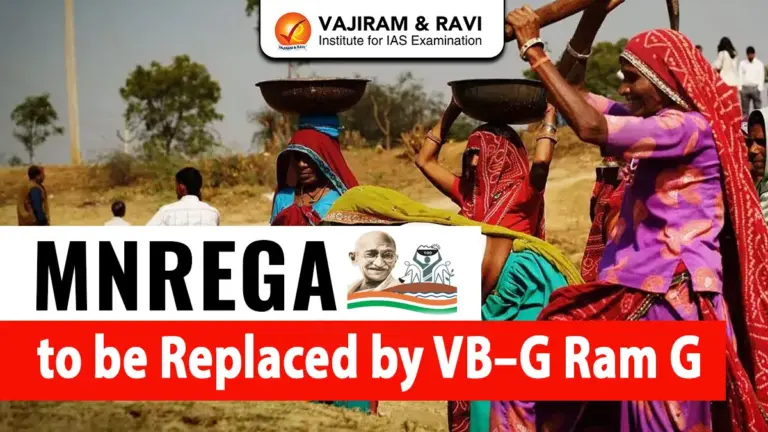
The Viksit Bharat Guarantee for Rozgar and Ajeevika Mission (Gramin) VB-G Ram G Bill, 2025 is set to replace the Mahatma Gandhi National Rural Employment Guarantee Act (MGNREGA), 2005, bringing major reforms to rural employment programs in India. This bill proposes increased employment days, new funding patterns, weekly wage payments, and a pause during peak agricultural seasons.
About MNREGA Act, 2005
The MGNREGA Act, 2005 was launched to provide at least 100 days of wage employment per financial year to rural households whose adults volunteer for unskilled manual labor. Key features included:
- Full funding by the central government for unskilled wages.
- States contributed to material costs, administrative expenses, and unemployment allowances.
- Provision of additional workdays in case of drought, natural calamities, or for tribal households in forest areas.
- Payments within 15 days of work completion with compensation for delays.
Why VB-G Ram G Bill, 2025 Was Proposed?
- Provide More Jobs – Give rural households 125 days of work every year.
- Ensure Faster Payments – Pay workers every week to make income timely and reliable.
- Share Costs Between Centre and States – Both government levels will fund the scheme to make it more sustainable.
- Support Farmers – Stop work during busy sowing and harvesting times so farmers have enough labor.
- Better Planning – Allocate funds based on state requirements to use money efficiently.
- Secure Rural Livelihoods – Help rural families earn a steady income and reduce migration.
- Consider Local Needs – Take local farming and regional conditions into account for fair work distribution.
- Make the Scheme Work Smoothly – Ensure proper execution, monitoring, and payments for better results.





Changes Under VB-G Ram G Bill, 2025
The VB-G Ram G Bill, 2025 introduces important changes to improve rural employment programs. It aims to make wage payments faster, plan resources better, and ensure work is available when needed, while also supporting farmers during busy agricultural seasons. The changes under VB-G Ram G Bill, 2025, have been shared below in detail:
1. Guaranteed 125 Days of Wage Employment
- Every rural household whose adults volunteer for work is now entitled to 125 days of employment per year, up from 100 days under MGNREGA.
- Additional workdays beyond 100 are available for special cases like drought-affected areas or tribal households.
2. Funding Responsibility: Shared Between Centre and States
- Northeastern & Himalayan States, and certain UTs: 90:10 Centre-State share
- Other States with Legislature: 60:40 Centre-State share
- UTs without Legislature: Centre bears the full cost
This is a major change from MGNREGA, where the Centre funded the entire wage bill, making states more accountable for their rural employment schemes.
3. Normative Allocation Replaces Labour Budget
- The Centre determines a state-wise normative allocation for each financial year.
- Any expenditure exceeding the allocation must be borne by the state government.
- This replaces the previous labour budget system, which allowed open-ended funding based on anticipated demand.
4. Pause During Peak Agricultural Seasons
- Employment guarantee will be paused for 60 days in a financial year during sowing and harvesting seasons.
- States can notify these periods based on agro-climatic zones and local farming patterns.
- Ensures availability of agricultural labor while slightly reducing the window to avail full employment days.
5. Weekly Wage Payments
- Weekly Wage Payments – Under VB-G Ram G Bill, workers will receive their daily wages every week, unlike MGNREGS which has a 15-day payment limit.
- Delayed payments will still attract compensation, ensuring timely income for rural workers.
Benefits of VB-G Ram G Bill 2025
- Increased Employment Days – The bill raises the guaranteed workdays from 100 under MGNREGA to 125 days per rural household per year, providing additional income opportunities for millions of rural families.
- Timely Wage Payments – Wages will be disbursed weekly or at most within 15 days, unlike the earlier 15-day limit, ensuring workers have quicker access to income and reducing financial stress.
- Shared Funding Responsibility – Funding will now be shared between the Centre and States: 60:40 for most states and 90:10 for northeastern and Himalayan states, promoting financial sustainability and accountability at the state level.
- Better Planning with Normative Allocation – Each state will receive a pre-determined annual allocation from the Centre, reducing uncertainty in funding and allowing more efficient planning of rural employment projects.
- Support to Agriculture – By pausing work for 60 days during peak sowing and harvesting seasons, the bill ensures adequate labor is available for farming, supporting agricultural productivity.
- Strengthening Rural Livelihoods – The increase in workdays and timely payments help reduce rural distress, prevent seasonal migration, and provide a steady income source for households dependent on unskilled labor.
Challenges
- Higher Financial Burden on States – Since states now share a portion of the funding (60:40 or 90:10), some states may face budgetary pressures to meet their share of wage payments.
- Reduced Work Availability During Peak Farming – The 60-day pause during sowing and harvesting may shorten the window for rural households to avail all 125 days of guaranteed work.
- Implementation Challenges – Effective execution will require strong coordination between Centre and States, especially for fund allocation, monitoring, and wage disbursement.
- Risk of Delayed Payments – Despite weekly payments being mandated, delays can still occur due to administrative or technical issues at the local level.
- Regional Disparities – Different agro-climatic zones may face unequal work opportunities due to variations in local notifications for peak seasons.
- Dependence on Accurate Normative Allocation – Over- or under-estimation of allocations could affect the number of workdays provided and disrupt employment plans.
Way Forward
- Better Coordination Between Centre and States – With states sharing funding (60:40 or 90:10), smooth planning and fund transfer are needed to avoid delays in wages.
- Increase Awareness Among Rural Workers – Over 8 crore households benefit under MGNREGA; informing them about 125 guaranteed workdays and weekly payments is important.
- Use Technology Effectively – Digital systems can help track work, ensure weekly wage payments, and monitor projects efficiently.
- Plan According to Local Needs – Peak farming periods differ across regions; pausing work for 60 days should match local sowing and harvesting seasons.
- Regular Monitoring – Timely audits and supervision can prevent delays in wage payments and ensure proper use of allocated funds.
- Support States Financially – States need guidance to manage their share of funding without affecting work availability.

 Last updated on March, 2026
→ UPSC Final Result 2025 is now out.
→ UPSC has released UPSC Toppers List 2025 with the Civil Services final result on its official website.
→ Anuj Agnihotri secured AIR 1 in the UPSC Civil Services Examination 2025.
→ UPSC Marksheet 2025 is now out.
→ UPSC Notification 2026 & UPSC IFoS Notification 2026 is now out on the official website at upsconline.nic.in.
→ UPSC Calendar 2026 has been released.
→ Check out the latest UPSC Syllabus 2026 here.
→ UPSC Prelims 2026 will be conducted on 24th May, 2026 & UPSC Mains 2026 will be conducted on 21st August 2026.
→ The UPSC Selection Process is of 3 stages-Prelims, Mains and Interview.
→ Prepare effectively with Vajiram & Ravi’s UPSC Prelims Test Series 2026 featuring full-length mock tests, detailed solutions, and performance analysis.
→ Enroll in Vajiram & Ravi’s UPSC Mains Test Series 2026 for structured answer writing practice, expert evaluation, and exam-oriented feedback.
→ Join Vajiram & Ravi’s Best UPSC Mentorship Program for personalized guidance, strategy planning, and one-to-one support from experienced mentors.
→ Shakti Dubey secures AIR 1 in UPSC CSE Exam 2024.
→ Also check Best UPSC Coaching in India
MNREGA to be Replaced by VB-G Ram G FAQs
Q1. What is VB-G Ram G Bill, 2025?+
Q2. How many days of work will be guaranteed under VB-G Ram G?+
Q3. Will wages be paid on time under the new scheme?+
Q4. How will the scheme be funded?+
Q5. What is the pause in employment guarantee?+
Tags: mnrega to be replaced by vb g ram g