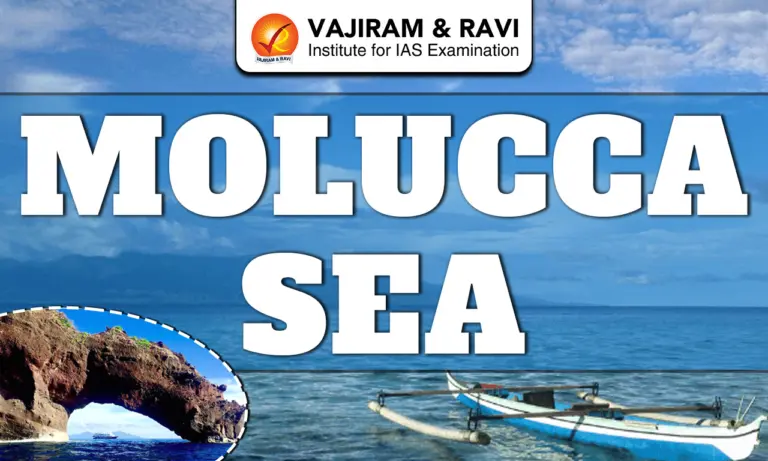
An earthquake of magnitude 7.6 struck the Northern Molucca Sea in Indonesia, causing damage, one death, tsunami waves, and multiple aftershocks.
About Molucca Sea
- The Molucca Sea, also known as Laut Maluku in Indonesia, is a part of the western Pacific Ocean.
- It is bounded by Sulawesi (Celebes) to the west, Halmahera to the east, and the Sula Islands to the south, and opens towards the Pacific Ocean through the Molucca Passage in the northeast.
- It has a surface area of 77,000 square miles or 200,000 square kilometres and a maximum depth of 4810 m.
- The Molucca Sea is divided into three zones based on depth and ocean currents:
- Northern zone: Located north of the Sula Islands, it is shallow and receives warm waters from the Pacific through ocean currents.
- Central zone: Situated between the Sula and Banggai-Sula Islands, it has intermediate depths (up to around 800 m) and acts as a mixing zone for warm and cooler waters.
- Southern zone: Found south of the Banggai-Sula Islands, it is the deepest region (over 1000 m in places) and experiences upwelling of cool, nutrient-rich waters, making it biologically productive.
- Batjan (Bacan) Basin is the deepest part of the Molucca Sea, reaching about 4,810 m (15,780 ft), and is a sediment-filled basin formed on oceanic crust. The basin developed due to tectonic interactions among the Eurasian, Philippine Sea, and Australian plates, and lies in an active collision zone.
- The Molucca Sea supports abundant marine life and is an important fishing ground for local communities. Key fisheries include tuna, snapper, grouper, shrimp, and lobster, with tuna being the most commercially significant.
- The Molucca Sea region has several important seaports that support trade and economic activity. The major seaports in the Molucca Sea region include Bitung, Tubang, Ternate, Ambon, and Namlea port.
- The Moluccas, also known as the Spice Islands, were historically important for valuable spices like nutmeg, cloves, and mace, attracting traders from Asia and later European powers.
- Their strategic location made the Molucca Sea a key route for trade, leading to conflicts among the British, Portuguese, Spanish, and Dutch, who established military and trading bases to control these routes.
- The Molucca Sea region experiences a tropical climate with high temperatures and humidity, making it suitable for tourism.
The Molucca Sea lies over the Molucca Sea Plate, where major tectonic plates interact, making it geologically active.






 Last updated on March, 2026
→ UPSC Final Result 2025 is now out.
→ UPSC has released UPSC Toppers List 2025 with the Civil Services final result on its official website.
→ Anuj Agnihotri secured AIR 1 in the UPSC Civil Services Examination 2025.
→ UPSC Marksheet 2025 is now out.
→ UPSC Notification 2026 & UPSC IFoS Notification 2026 is now out on the official website at upsconline.nic.in.
→ UPSC Calendar 2026 has been released.
→ Check out the latest UPSC Syllabus 2026 here.
→ UPSC Prelims 2026 will be conducted on 24th May, 2026 & UPSC Mains 2026 will be conducted on 21st August 2026.
→ The UPSC Selection Process is of 3 stages-Prelims, Mains and Interview.
→ Prepare effectively with Vajiram & Ravi’s UPSC Prelims Test Series 2026 featuring full-length mock tests, detailed solutions, and performance analysis.
→ Enroll in Vajiram & Ravi’s UPSC Mains Test Series 2026 for structured answer writing practice, expert evaluation, and exam-oriented feedback.
→ Join Vajiram & Ravi’s Best UPSC Mentorship Program for personalized guidance, strategy planning, and one-to-one support from experienced mentors.
→ Shakti Dubey secures AIR 1 in UPSC CSE Exam 2024.
→ Also check Best UPSC Coaching in India
Molucca Sea FAQs
Q1. Where is the Molucca Sea located?+
Q2. Why is the Molucca Sea geologically active?+
Q3. What is the depth of the Molucca Sea?+
Q4. What is the economic importance of the Molucca Sea?+
Q5. What is the historical significance of the Molucca Sea?+
Tags: geography molucca sea