What’s in today’s article?
- Why in News?
- What are El Nino and La Nina?
- What is Indian Ocean Dipole (IOD)?
- Prediction by IMD
- Factors indicating above normal rainfall
Why in News?
India is likely to experience an “above normal” monsoon rainfall between June and September this year. This was predicted by the India Meteorological Department (IMD) in its long-range forecast.
This is the first time in a decade that the IMD has predicted “above normal” rainfall at the first stage itself, nearly 45 days ahead of the beginning of the four-month monsoon season.


What are El Nino and La Nina?
- El Nino:
- A warming of the ocean surface, or above-average sea surface temperatures (SST), in the central and eastern tropical Pacific Ocean.
- It is associated with lower than normal monsoon rainfall in India.
- La Nina:
- A cooling of the ocean surface, or below-average SSTs, in the central and eastern tropical Pacific Ocean.
- It is associated with a comparatively better monsoon rainfall in India.
- Neutral:
- Neither El Nino nor La Nina.
- Often tropical Pacific SSTs are generally close to average.
What is Indian Ocean Dipole (IOD)?
- The Indian Ocean Dipole (IOD) is defined by the difference in sea surface temperature between two areas (or poles, hence a dipole) – a western pole in the Arabian Sea (western Indian Ocean) and an eastern pole in the eastern Indian Ocean south of Indonesia.
- In scientific terms, the IOD is a coupled ocean and atmosphere phenomenon, similar to ENSO but in the equatorial Indian Ocean.
- A ‘positive IOD’ — or simply ‘IOD’ — is associated with cooler than normal sea-surface temperatures in the eastern equatorial Indian Ocean and warmer than normal sea-surface temperatures in the western tropical Indian Ocean.
- The opposite phenomenon is called a ‘negative IOD’, and is characterised by warmer than normal SSTs in the eastern equatorial Indian Ocean and cooler than normal SSTs in the western tropical Indian Ocean.
- The IOD was identified as an independent system only in 1999.
Prediction by IMD
- Above normal rainfall in 2024
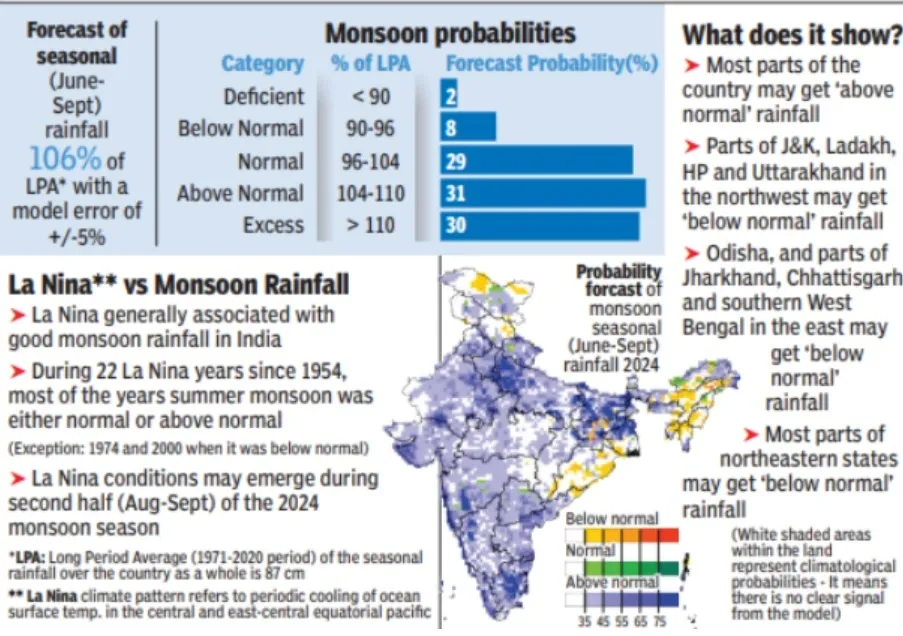
- The country as a whole is expected to get 106 per cent of the long period average (LPA) rainfall.
- All forecasts are percentages of long-period average (LPA). LPA is the average rainfall received in the past 50 years (currently, the average of 1971-2020 period).
- The rainfall between 96 per cent and 104 per cent of this 50-year average is considered normal; less than 90 per cent is considered deficient; 90-95 per cent is below normal; and 105-110 per cent is above normal.
- Nearly the entire country, except some pockets in the northwest, east and northeast, was likely to get good rainfall.
- India’s normal rainfall
- India, as a whole, normally receives 870 mm of rainfall during the monsoon season.
Factors indicating above normal rainfall
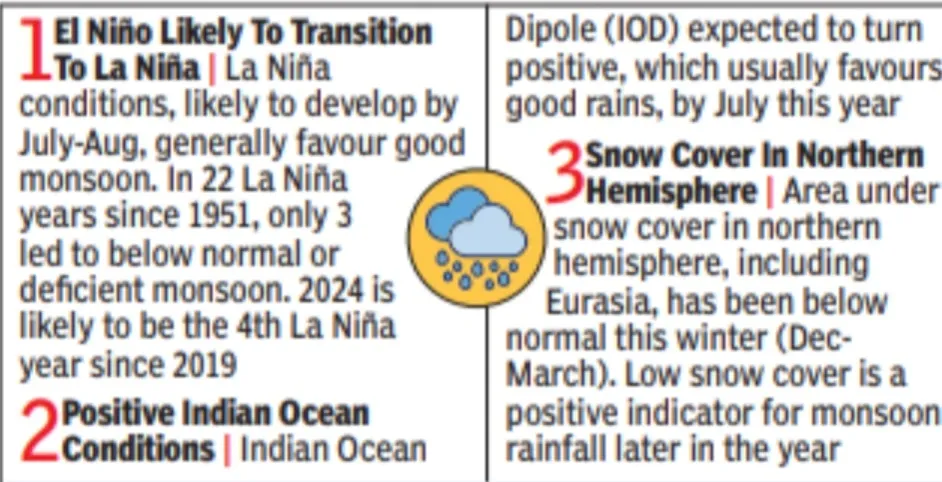
- Forecast of ‘good rainfall’ is attributed to weakening of El Nino, eventual development of the La Nina conditions during the second half of the season (Aug-Sep) and a positive Indian Ocean Dipole (IOD).
Q.1. What is sea surface temperature (SST)?
Sea surface temperature (SST) is the temperature of the ocean near the surface. It’s a key component of the climate system and a key indicator of global climate change. SST is measured using thermal infrared (IR) bands from optical satellites.
Q.2. What is India Meteorological Department (IMD)?
The India Meteorological Department (IMD) is the country’s national meteorological service, responsible for weather forecasting, seismology, and other related subjects. The IMD was established in 1875, and its headquarters are in New Delhi.

 Last updated on Oct, 2026
→ UPSC 2027 Notification will be released on 13 January 2027 at upsconline.nic.in.
→ Check Nobel Prize 2026 Winners List here.
→ Download PIB PRiSM Monthly Magazine 2026 here.
→ Check UPSC Monthly Current Affairs Magazine The Recitals here.
→ Check out the latest UPSC Syllabus here.
→ Download UPSC Model Answers for Mains 2026
→ UPSC Mains Question Paper 2026 is out now for Essay & GS Paper 1, 2, 3 & 4.
→ UPSC Calendar 2027 has been released.
→ Enroll in Vajiram & Ravi’s UPSC Mains Test Series 2027 for structured answer writing practice, expert evaluation, and exam-oriented feedback.
→ Join Vajiram & Ravi’s UPSC Mentorship Program 2027 for personalized guidance, strategy planning, and one-to-one support from experienced mentors.
→ Go through the UPSC Mains Previous Year Papers to enhance your preparation.
→ UPSC has released UPSC Toppers List 2025 with the Civil Services final result on its official website.
→ Also check Best UPSC Coaching in India