The Moon is Earth’s only natural satellite and influences many natural phenomena. Its phases change as it orbits Earth, creating new, crescent, quarter, gibbous, and full moons. Lunar and solar eclipses occur when the Sun, Earth, and Moon align, blocking light. The Moon’s gravity also causes tides in Earth’s oceans and helps stabilize the planet’s climate.
Geological Features of the Moon
The Moon, Earth’s only natural satellite, has a fascinating surface marked by craters, plains, and mountains. Its geological features tell the story of its violent past and the processes shaping it.
- Craters: The Moon’s surface is dotted with impact craters formed by collisions with asteroids and meteoroids. Famous craters include Tycho, Copernicus, and Aristarchus.
- Maria (Lunar Plains): These are dark, flat regions formed by ancient volcanic activity. The largest lunar maria is Oceanus Procellarum.
- Highlands: Light-colored, heavily cratered areas are older than the maria. They are composed mainly of anorthosite rocks.
- Rilles: Long channels or valleys formed by volcanic activity or surface collapse.
- Regolith: A layer of loose dust and fragmented rock covering the Moon’s surface, created by continuous meteorite impacts.
Also Read: Interior of the Earth
Phases of the Moon
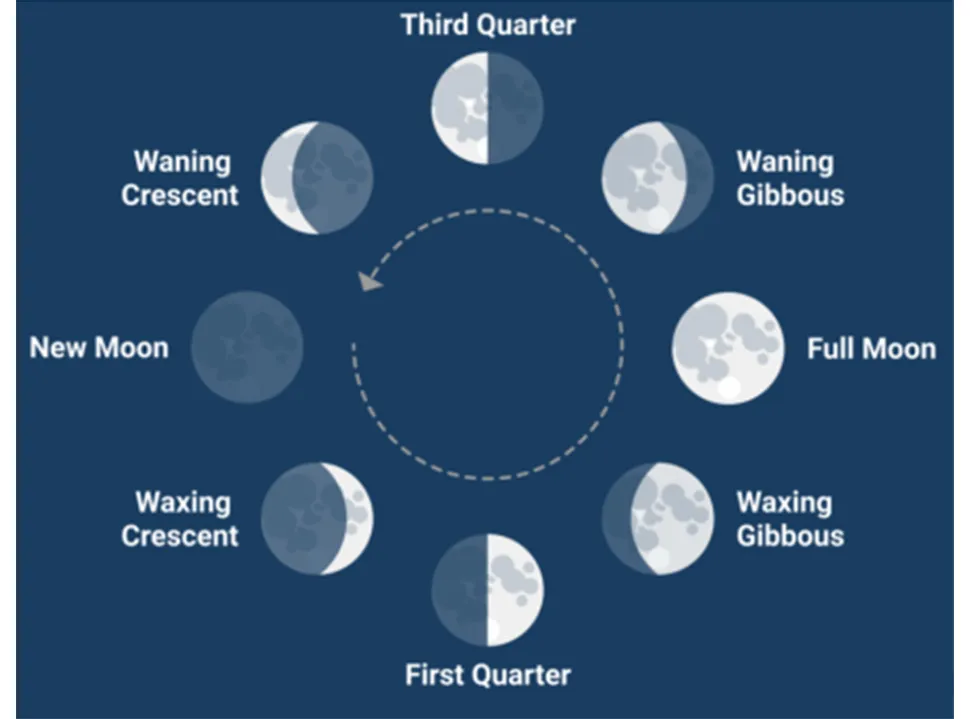
The Moon does not produce its own light; it reflects sunlight. The changing positions of the Sun, Earth, and Moon create different phases, which repeat every 29.5 days, forming the lunar cycle.
1. New Moon
During the new moon, the Moon is positioned between Earth and the Sun, so the side facing Earth is completely dark.
- The Moon is not visible from Earth.
- Marks the beginning of the lunar month.
- Gravitational pull contributes to spring tides.
- Often used in traditional calendars for setting festivals.
2. Waxing Crescent
A thin crescent becomes visible after the new moon, gradually increasing in illumination.
- Appears as a sliver of light on the Moon’s right side (in the Northern Hemisphere).
- Symbolizes growth and new beginnings in cultural contexts.
- The crescent increases daily until the first quarter.
- Early evening visibility makes it ideal for skywatching.
3. First Quarter
Half of the Moon is illuminated, appearing as a semi-circle.
- Occurs about 7–8 days after the new moon.
- The right half is visible in the Northern Hemisphere.
- Tidal forces start to stabilize after the new moon.
- Popular phase for observing lunar surface details.
4. Waxing Gibbous
More than half of the Moon is visible as it approaches full illumination.
- The Moon appears larger and brighter each night.
- Marks a period of growth and fruition in cultural symbolism.
- Provides longer visibility in the evening sky.
- The Moon’s surface features are easier to observe with a telescope.
5. Full Moon
The entire face of the Moon is illuminated by sunlight.
- Occurs when Earth is between the Sun and the Moon.
- Most visible and brightest phase of the lunar cycle.
- Causes spring tides due to the combined Sun-Moon gravitational pull.
- Associated with cultural festivals and rituals worldwide.
6. Waning Gibbous
The Moon starts decreasing in illumination after the full moon.
- More than half of the Moon is still visible.
- Light gradually shifts from the left side (Northern Hemisphere).
- Marks a period of reflection and release in symbolism.
- Evening visibility decreases gradually.
7. Last (Third) Quarter
Half of the Moon is visible again, opposite to the first quarter.
- Occurs about 21–22 days after the new moon.
- The left half is illuminated in the Northern Hemisphere.
- Tidal effects decrease compared to the full moon.
- Important for observing lunar surface features with minimal shadows.
8. Waning Crescent
Only a small crescent remains visible before returning to the new moon.
- Appears as a thin crescent on the left side (Northern Hemisphere).
- Marks the end of the lunar cycle.
- Low visibility, best seen early morning.
- Symbolizes closure and preparation for a new lunar month.






Eclipses of the Moon
An eclipse occurs when a planet or a moon blocks the Sun’s light. When the light of the Sun or the Moon is obstructed by another celestial body, it is called an eclipse.
On Earth, we can observe two main types of eclipses: solar eclipses, when the Sun is obscured, and lunar eclipses, when the Moon is covered by Earth’s shadow.
Solar Eclipse

A Solar Eclipse occurs when the Moon comes between the Sun and the Earth, blocking sunlight either partially or completely. Solar eclipses can only happen during a new moon, and their visibility depends on the alignment of the three celestial bodies.
- Total Solar Eclipse
- In a total solar eclipse, the Moon completely covers the Sun as seen from a specific region on Earth.
- The sky becomes dark as if it were twilight.
- The Sun’s corona (outer atmosphere) becomes visible.
- Lasts for a few minutes in a given location.
- Observers must be within the path of totality to witness it fully.
- Partial Solar Eclipse
- During a partial solar eclipse, only a part of the Sun is obscured by the Moon.
- The Sun appears as a crescent shape.
- Can be seen from a wider area compared to a total eclipse.
- Safe viewing still requires protective glasses.
- Occurs when the alignment is not perfectly straight.
- Annular Solar Eclipse
- An annular solar eclipse happens when the Moon covers the center of the Sun, but its edges remain visible as a bright ring.
- Creates the famous “ring of fire” effect.
- Happens when the Moon is farther from Earth and appears smaller.
- Does not cause complete darkness.
- Requires special eye protection to observe safely.
- Hybrid Solar Eclipse
- A hybrid solar eclipse is a rare combination of a total and an annular eclipse.
- Appears as total in some locations and annular in others along the path of the eclipse.
- Occurs due to Earth’s curvature and varying distances of the Moon.
- Very rare compared to other types of eclipses.
- Can be partially observed outside the main path.
Lunar Eclipse

A lunar eclipse occurs when the Earth comes between the Sun and the Moon, blocking sunlight from directly reaching the Moon. This happens only during a full moon, when the Sun, Earth, and Moon are nearly in a straight line.
- Total Lunar Eclipse
- In a total lunar eclipse, the entire Moon passes through Earth’s umbra (the darkest part of its shadow).
- The Moon appears reddish or copper-colored, often called a “blood moon.”
- Occurs when Earth’s shadow completely covers the Moon.
- Can last for a few hours, depending on the Moon’s path.
- Safe to observe with the naked eye.
- Partial Lunar Eclipse
- In a partial lunar eclipse, only a part of the Moon enters Earth’s umbra.
- Part of the Moon appears dark while the rest remains bright.
- The shadow gradually moves across the lunar surface.
- Less dramatic than a total lunar eclipse but still noticeable.
- Visibility depends on the observer’s location.
- Penumbral Lunar Eclipse
- A penumbral lunar eclipse occurs when the Moon passes through the Earth’s penumbral shadow, which is the lighter outer part.
- The Moon appears slightly dimmed, often hard to notice.
- No red color or sharp shadow is visible.
- Can be observed with careful observation or photography.
- Happens more frequently than total or partial lunar eclipses.
Also Read: Asteroid
Moon in Earth’s Tides and Climate
The Moon plays a crucial role in shaping Earth’s tides and stabilizing its climate. Its gravitational pull on Earth causes the oceans to bulge, resulting in the regular rise and fall of sea levels known as tides.
Role in Tides
- The Moon’s gravity creates high tides in the areas of Earth facing toward and away from the Moon.
- Low tides occur in regions perpendicular to the Moon’s position.
- The combined effect of the Moon and the Sun produces spring tides and neap tides.
- Tides influence coastal ecosystems, marine life, and human activities such as fishing and navigation.
Types of Tides

- Spring Tides
- Occur during full moon and new moon phases.
- The Sun, Moon, and Earth are in a straight line (syzygy).
- Result in higher high tides and lower low tides.
- Represent the maximum tidal range.
- Neap Tides
- Occur during first and last quarter moon phases.
- The Sun and Moon are at right angles relative to Earth.
- Result in lower high tides and higher low tides.
- Represent the minimum tidal range.
- Diurnal Tides
- Characterized by one high tide and one low tide per day.
- Common in certain shallow seas and bays.
- Semidiurnal Tides
- Characterized by two high tides and two low tides per day of roughly equal height.
- Most common along continental coasts.
- Mixed Tides
- Characterized by two high tides and two low tides per day of unequal height.
- Observed in many parts of the Pacific coast.
Role in Climate
- The Moon stabilizes Earth’s axial tilt, maintaining a relatively stable climate over long periods.
- Without the Moon, Earth would experience extreme seasonal variations and irregular weather patterns.
- The Moon’s gravitational influence indirectly affects ocean currents, which play a key role in regulating global climate.

 Last updated on March, 2026
→ UPSC Final Result 2025 is now out.
→ UPSC has released UPSC Toppers List 2025 with the Civil Services final result on its official website.
→ Anuj Agnihotri secured AIR 1 in the UPSC Civil Services Examination 2025.
→ UPSC Marksheet 2025 is now out.
→ UPSC Notification 2026 & UPSC IFoS Notification 2026 is now out on the official website at upsconline.nic.in.
→ UPSC Calendar 2026 has been released.
→ Check out the latest UPSC Syllabus 2026 here.
→ UPSC Prelims 2026 will be conducted on 24th May, 2026 & UPSC Mains 2026 will be conducted on 21st August 2026.
→ The UPSC Selection Process is of 3 stages-Prelims, Mains and Interview.
→ Prepare effectively with Vajiram & Ravi’s UPSC Prelims Test Series 2026 featuring full-length mock tests, detailed solutions, and performance analysis.
→ Enroll in Vajiram & Ravi’s UPSC Mains Test Series 2026 for structured answer writing practice, expert evaluation, and exam-oriented feedback.
→ Join Vajiram & Ravi’s Best UPSC Mentorship Program for personalized guidance, strategy planning, and one-to-one support from experienced mentors.
→ Shakti Dubey secures AIR 1 in UPSC CSE Exam 2024.
→ Also check Best UPSC Coaching in India
Moon FAQs
Q1. How far is the Moon from Earth?+
Q2. Does the Moon have an atmosphere?+
Q3. What is the Moon made of?+
Q4. Can humans live on the Moon?+
Q5. Why does the Moon appear red during a total lunar eclipse?+
Tags: moon