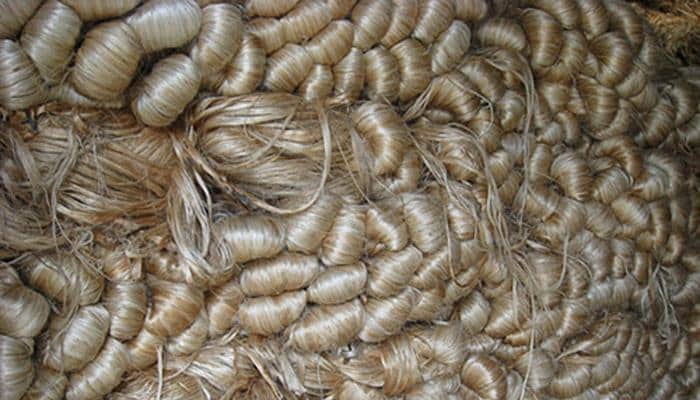
About Jute:
- Jute is one of the most important natural fibres after cotton in terms of cultivation and usage
- Climatic conditions required for its growth
- Temperature: Between 25-35°C
- Rainfall: Around 150-250 cm
- Soil Type: Well-drained alluvial soil.
- India is the largest producer of jute followed by Bangladesh and China.
- It is mainly grown in eastern India because of the rich alluvial soil of the Ganga-Brahmaputra delta.
- In India, major jute-producing states include West Bengal, Bihar, Odisha, Assam, Andhra Pradesh, Meghalaya and Tripura.
What is the Minimum support price?
- A minimum support price (MSP) is a minimum price for any crop that the Government considers as remunerative for farmers and hence deserving of “support”.
- It is also the price that Government agencies pay whenever they procure a particular crop from the farmers.
- There is currently no statutory backing for these prices, nor any law mandating their enforcement.
- Crops covered under MSP: At present, the Central Government sets MSP for 23 crops.
- 7 cereals (Bajra, wheat, maize, paddy barley, ragi and jowar);
- 5 pulses (tur, chana, Masur, urad and moong);
- 7 oilseeds (sunflower, mustard, niger seed, soya bean, groundnut, sesame and sunflower);
- 4 commercial crops (raw jute, cotton, copra and sugarcane).
How does the Government decide on the MSP?
- The Government announces the MSP at the start of each cropping season (Rabi and Kharif).
- The MSP is decided after the Government exhaustively studies the recommendations made by the Commission for Agricultural Costs and Prices (CACP).
- CACP is an attached office of the Ministry of Agriculture and Farmers Welfare.
Q1) What is Commission for Agricultural Costs & Prices?
The Commission for Agricultural Costs & Prices (CACP) is an attached office of the Ministry of Agriculture and Farmers Welfare, Government of India. It came into existence in January 1965. Currently, the Commission comprises a Chairman, Member Secretary, one Member (Official) and two Members (Non-Official). The non-official members are representatives of the farming community and usually have an active association with the farming community.
Source: Cabinet approves Minimum Support Price (MSP) for Raw Jute for 2023 -24 season






 Last updated on March, 2026
→ UPSC Final Result 2025 is now out.
→ UPSC has released UPSC Toppers List 2025 with the Civil Services final result on its official website.
→ Anuj Agnihotri secured AIR 1 in the UPSC Civil Services Examination 2025.
→ UPSC Marksheet 2025 is now out.
→ UPSC Notification 2026 & UPSC IFoS Notification 2026 is now out on the official website at upsconline.nic.in.
→ UPSC Calendar 2026 has been released.
→ Check out the latest UPSC Syllabus 2026 here.
→ UPSC Prelims 2026 will be conducted on 24th May, 2026 & UPSC Mains 2026 will be conducted on 21st August 2026.
→ The UPSC Selection Process is of 3 stages-Prelims, Mains and Interview.
→ Prepare effectively with Vajiram & Ravi’s UPSC Prelims Test Series 2026 featuring full-length mock tests, detailed solutions, and performance analysis.
→ Enroll in Vajiram & Ravi’s UPSC Mains Test Series 2026 for structured answer writing practice, expert evaluation, and exam-oriented feedback.
→ Join Vajiram & Ravi’s Best UPSC Mentorship Program for personalized guidance, strategy planning, and one-to-one support from experienced mentors.
→ Shakti Dubey secures AIR 1 in UPSC CSE Exam 2024.
→ Also check Best UPSC Coaching in India