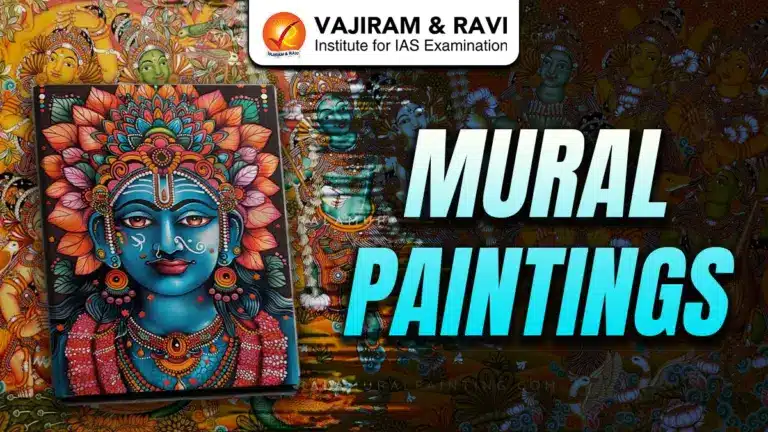
Mural Paintings are the artforms which are painted or integrated directly on walls or caves or ceiling. The art of mural painting has been practiced since ancient times, which usually revolves around religious themes and daily life activities. In India Mural Paintings are usually found in caves, temples and palaces.
Mural Paintings Historical Background
- The existence of the mural painting dates back to 2nd century BC to 8th-10th century AD.
- The Ajanta cave murals are considered as the peak of the mural paintings, which dates back to 2nd century BC to 7th century BC.
- Other notable places, where mural paintings were found were Ellora caves, Sittanavasal caves, Bagh Caves, Armamalai cave, Ravan Chhaya rock shelter, Lepakshi temple etc.
- Most of the mural paintings were found in natural or rock-cut chambers.
- The most common themes of the paintings were Hinduism, Buddhism and Jainism.
- The mural paintings were patronized by Pallavas, Cholas, Chalukyas of Badami, Satavahanas, Vijayanagara empire and Nayakas.
Mural Paintings Features
- They are large scale paintings often drawn on Walls, Ceilings and Caves.
- Usually natural pigments which are derived from vegetables, rock-minerals and plant-extracts were used in the paintings.
- The theme of the paintings revolve around Hinduism, Buddhism and Jainism.
- Stories from the Buddhist “Jataka”, hunting scenes, family scenes and human and animal figures were the common subjects of painting.
- The most common technique was Fresco technique, in which the painting was done on dry to semi-dry plasters.
- The stories are narrated in continuous panels, with expressive gestures and postures.
- Colours were used to reflect emotional and spiritual meanings.
- The style of mural paintings vary across regions like Ajanta, Ellora, Badami etc.





Mural Paintings Technique
- The Sanskrit text Vishnudharamotaram, written in 5th-6th CE contains a special chapter in which the art of wall paintings has been discussed in detail. It provides guidance on the art of painting. It is believed to be written by Markandeya Muni.
- The wall was prepared by applying a thin layer of lime plaster mixed with sand and organic matter is applied, over which colour would be applied.
- Most of the colours were obtained locally from available materials and brushes were prepared from animal hairs.
- In a true Fresco method, the painting is done when the wall is still wet, so that the pigments can penetrate deep into the walls.
- In the other method the limed surface is first allowed to dry then it is drenched with the lime water, this method is called Fresco-Secco.
- At first the figures are drawn using red or black outlines before the filling of the colours.
- Colours are applied on various layers to ensure depth and durability.
- The major colors to be used were ochre, red colour from Vermillion, indigo blue, lapis lazuli, chalk white etc.
Ajanta Caves Paintings
- It is one of the oldest surviving mural paintings in the Indian subcontinent, which were created around 2nd century BC to 5th Century AD out of Volcanic rocks, located near Aurangabad, Maharashtra.
- They were created during the Satavahana and Vakataka rule.
- It is a set of 29 caves carved in Horseshoe shape.
- The major theme of the paintings revolve around Buddhist teachings, Buddha’s previous and future birth and Jataka stories.
- Most of the cave paintings belonged to Gupta Period with only exception with cave no 9 and 10 which belong to Shunga Period. While the most recent paintings are in the cave in 1 and 2
- The wall murals were majorly created using fresco-secco techniques.
- Natural and organic pigments are used like red ochre, yellow ochre, white lime etc.
- The paintings are known for naturalism, soft modelling, shading, and depth, showing advanced understanding of anatomy and emotions.
- Human figures have elegant postures, expressive eyes, detailed ornaments, and flowing drapery.
- It is considered the finest achievement of Indian classical mural tradition and a major influence on later Indian art.
- Paintings provide valuable information on contemporary social life, costumes, musical instruments, trade, and administration.
- It was declared a UNESCO World Heritage Site in 1983
- Some of the notable paintings of Ajanta caves are:
- Padmapani Bodhisattva (Avalokiteshwara) (Cave 1): The painting depicts compassion and grace, holding a lotus symbolizing mercy and purity.
- Vajrapani Bodhisattva (Cave 1): Holding a thunder symbolizing power and protection.
- Dying Princess (Cave 16): reflecting human suffering and emotional depth.
- Shibi Jataka depicts King Shibi giving his flesh to save the pigeon.
- Some caves have paintings of Hinduism like the painting of Indra flying amidst clouds.
Ellora Cave Paintings
- The Ellora caves located in Aurangabad district of Maharashtra dates back to 6th-10th century CE.
- The caves have three major religious representations.
- 17 Hindu caves (13-29)
- 12 Buddhist caves (1-12)
- 5 Jain caves (30-34)
- Among all the most famous is the Kailasha Temple in cave no 16 and some of the Buddhist caves.
- The famous Kailasha temple was patronized under Rashtrakuta king Krishna I, dedicated to Lord Shiva.
- The murals were created in two phases, first was done during the carving of the caves and secondly it was done after many centuries.
- Images of Lord Vishnu and Goddess Laxmi are one of the famous paintings of the cave.
- Painting of Lord Shiva surrounded by his devotees and Apsara is another prominent painting of the cave.
- Some of the other significant paintings are:
- Cave 10: Vishvakarma cave (Buddhist cave)
- Also known as “Carpenter’s cave”.
- In this painting Buddha is seated Vyakhyana Mudra and a Bodhi tree is carved at his back.
- Cave 14: Raavan ki khai
- The theme is Ravan shaking Mount Kailash. It is associated with Shavite mythology.
- Signifies movement and power.
- Cave 15: Dashavatara Temple
- Dedicated to Lord Vishu, depicting his ten incarnations. Most of the mural paintings are lost, only some outlines are remaining.
- Cave 32: Indra Sabha (Jain Cave)
- It is one of most prominent Jain caves, where paintings of Tirthankaras, celestial beings and decorative motifs are painted.
- Cave 33: Jagannath Sabha (Jain Cave)
- It depicts significant Jain themes.
- Cave 10: Vishvakarma cave (Buddhist cave)
Sittanavasal Cave (Arivar Koil)
- The paintings are located at Sittanavasal, Tamil Nadu.
- They date back to 1st Century BC to 10th Century AD.
- They are mainly associated with Jainism. The theme of the paintings is Jain Samavarsarana (Preaching Hall).
- There is division of thoughts among scholars regarding its origin, some believe they belong to the Pallava period, patronized by King Mahendravarman I. while others believe that they were rebuilt by Pandya rulers (7th Century).
- They executed Fresco-secco technique (painted on dry plaster).
- Paintings were made using mineral dyes and vegetable colours, where the most common colours were yellow, green, orange, blue, black and white.
- Artistic features: Graceful and rhythmic with minimal facial expressions.
- The most prominent painting is the Pond with the lotuses (Samavasarana concept), where monks are collecting the flowers and depictions of swans, fishes, ducks are also there.
- The ceiling and pillars are also carved with dancing figures and celestial beings.
- Samavasarna is a special hall, where tirthankaras deliver sermons after they have attained realisation (Kevala-jnana). The painting depicts elephants, bulls, apsaras and gods, who all have gathered in the audience hall.
Bagh Caves
- Located in the Vindhyas, Bagh town of Dhar district of Madhya Pradesh. It is an extension of Ajanta cave paintings.
- They were primarily Viharas (monasteries), intended for the residence of the monks (cave 3 and 4)
- Cave 2 is known as the “Pandava cave”
- The paintings are mostly similar to Ajanta caves but the major difference is that the figures are tightly drawn, have stronger outlines and sharper contour and are more earthly and human.
- Cave no 4 known as the “Rang Mahal” showcases one of the most prominent paintings of Bagh caves, depicting Buddhist Jataka tales.
- Most of the paintings are largely damaged and only a few have survived in fragments. They depict religious narratives in the light of contemporary social life, thus making them more secular as compared to Ajanta cave paintings.
Armamalai Cave Paintings
- The caves are located in the Vellore district of Tamil Nadu, dating back to the 8th century, when they were adapted to Jain Temple, reflecting a strong Jain presence in medieval Tamil Nadu.
- Inside the cave there are unbaked mud platforms and structure for resting, meditation and preaching for the Jain monks.
- Major theme: tales of Asthadik palakas (guardian deities of eight directions) and other Jainism themes and religious motifs.
- Paintings are created combining the Fresco and Tempera techniques.
- Mainly use of natural and organic pigment having vibrant and bright colours.
- They have stylistic similarities with the Bagh cave and Sittanavasal cave paintings.
Ravan Chhaya Rock Shelter
- Located near Keonjhar district of Odisha. Which dates back to 6th-7th century CE
- It is one of the earliest mural paintings of Eastern India.
- They are also called as Sitabhinji group of rock shelters.
- They are in the shape of a Half-opened Umbrella.
- The most remarkable painting depicts a royal procession, dated back to the 7th century.
- Paintings were executed using fresco-tempera methods.
- It also consists of remains from the Chola period of the 11th century.
Lepakshi Temple Paintings
- Located at Lepakshi, Anantpur district of Andhra Pradesh.
- Painted on the walls of Veerbhadra temple at Leepakshi, which was built in the 16th Century during Vijayanagar period. They represent the late medieval phase of Indian mural paintings.
- The theme of the painting is around Ramayana. Mahabharata and incarnations of Vishnu and puranic themes.
- Paintings are mainly found on the ceilings of Natya Mandapa, Ardha Mandapa and the inner halls of the temple.
- The dominant colours in the paintings were red, yellow, green, black and white. The paintings have a complete absence of blue colour and other primary colours.
Jogimara Cave Paintings
- Located in the Ramgarh hills of Chattisgarh. They are part of twin cave complexes: Jogimara caves and Sita Bengara caves.
- It is one of the earliest mural paintings in India, dating back to the 3rd century BC.
- The cave depicts a love story in Brahmi script and other paintings.
- The cave served as resting or recreational space and was an addition of an amphitheater and paintings were to decorate the cave.
- Paintings were largely secular and depicted dancing couples, animals like elephants and fishes and other floral and decorative motifs.
- The painting was executed using natural pigments and have a distinct red outline and the dominant colours were yellow, white and black.
Badami Cave Paintings
- Located in Badami, Bagalkot district of northern Karnataka.
- They were patronized by the early Chalukyan Dynasty (543-753 CE).
- Badami has four main rock-cut caves (cave 1-4)
- Cave 3, which is the Vaishnavite cave, has the most significant mural paintings.
- The paintings were completed during the period of Mangalishwara (son of Puleksin I).
- The major theme of painting is Vaishvavism and others inspired from Puranas.
- The well survived painting is that of Shiva and Parvathi.
- The cave paintings include:
- Cave 1: It is the oldest of all the four and contains paintings of Lord Shiva, Parvati and Lord Shiva asNataraja. The paintings are on the ceiling of the cave.
- Cave 2: It is mainly dedicated to Lord Vishnu and his incarnations.
- Cave 3: It depicts figures of Lord Vishnu as Paravasudeva, Bhuvaraha, Narasimha and Harihara.
- Cave 4: It is dedicated to Jainism and has a huge image of Lord Mahavira.
Evolution of Mural Paintings under different rulers
Mural painting in India evolved over time under the patronage of different rulers and dynasties. Each ruling power contributed its own themes, techniques, and styles, reflecting the religious beliefs, cultural values, and artistic traditions of its period.
Under Pallavas
- The Pallava period (6th–9th century CE) saw early development of mural painting in South India.
- It was patronised by Pallava rulers like Narasimhavarman I and Mahendravarman I.
- Traces of murals are found at Mahabalipuram, Kanchipuram (Kailasanatha Temple) and Panamalai cave.
- The paintings were of Shaivite and Vaishnavite religious themes.
- They were painted using the fresco-secco (tempera) technique with natural colours.
- They show strong influence of Ajanta paintings, adapted to local Tamil traditions.
- Figures were graceful, calm, and decorative.
- Pallava murals form a link between Gupta Ajanta art and later Chola temple paintings.
Under Pandyas
- It flourished during the early Pandya period (6th–9th century CE) in Tamil Nadu, reflecting strong royal support.
- Best reflected by Sittanavasal Cave (Arivar Koil); traces were also found in Thirumalapuram cave and other Pandya rock-cut shrines.
- They were closely linked with Jainism (and later Shaivism), reflecting the religious diversity under Pandya rule.
- Dominantly symbolic and non-narrative, such as the lotus pond motif, nature elements, and spiritual ideals.
Under Cholas
- It mainly flourished during the 9th–13th centuries CE under the Imperial Cholas in Tamil Nadu.
- Examples are- Brihadeeswara (Rajarajeswaram) Temple, Thanjavur and also traces at Gangaikonda Cholapuram and Darasuram.
- Mostly Shaivite, depicting Lord Shiva, Nataraja, saints (Nayanars), and stories from Puranas and also include royal portraits of Chola rulers.
- Executed in fresco-secco technique using natural mineral pigments
- Represent a distinct South Indian mural tradition, showing continuity from Pallava art and influence on later Vijayanagara paintings.
Under Vijayanagara
- After the decline of the Cholas, the Vijayanagara Empire (14th–16th century CE) extended control from Hampi to the Trichy region, supporting a new phase of mural art.
- Hampi was the capital, though important mural sites also developed in Tamil Nadu and Andhra Pradesh.
- Early Vijayanagara murals (14th century) can be seen at Thiruparankundram near Trichy, mostly on the ceilings of mandapas, showing the formative style of the school.
- Major themes include stories from the Ramayana and Mahabharata, events from dynastic history, and Vaishnavite subjects such as the incarnations of Vishnu.
- A notable mural depicts Vidyaranya, the spiritual guide of Harihara and Bukka, being carried in a palanquin procession, reflecting royal religious linkage.
- Lepakshi Shiva Temple (Andhra Pradesh) contains the most significant Vijayanagara murals which are painted on walls and ceilings.
- Images are shown mostly in profile, large frontal eyes, slender waists, decorative costumes, and firm yet flowing lines.
- Vijayanagara murals represent a combination of Chola traditions and regional styles, marking a mature phase of South Indian mural painting.
Under Nayaka
- Nayaka murals developed between the 14th and 17th centuries CE, largely as a continuation and regional expansion of the Vijayanagara painting tradition.
- Important sites were Thiruparankundram, Srirangam, Tiruvarur, Thiruvalanjuli, and the Sri Krishna Temple at Chengam (Arcot region).
- Paintings depict stories from the Ramayana, Mahabharata, and Krishna Leela.
- Some of the early murals at Thiruparankundram (14th century) display scenes from the life of Mahavira, reflecting religious pluralism.
- The Sri Krishna Temple at Chengam has an extensive Ramayana series in about 60 panels, reflecting strong narrative continuity.
- A famous panel at Tiruvarur depicts the legend of Muchukunda, while the Nataraja painting at Thiruvalanjuli is a classic Nayaka masterpiece.
- Images are mostly shown in profile, with thin waists, lighter abdomens, large expressive eyes, and bold yet flowing lines.
- Nayaka murals mark the late medieval phase of South Indian mural painting, blending Vijayanagara aesthetics with strong local Tamil elements.
Under Kerala
- Kerala mural tradition contains elements of Vijayanagara and Nayaka styles, adapted to local aesthetic and religious needs.
- Strongly influenced by Kathakali (facial expressions, colour symbolism) and Kalam Ezhuthu ritual floor art traditions.
- Images are rendered in a three-dimensional form with bold contours, rhythmic lines, and bright, vivid colours.
- Subject matter includes Hindu mythological themes, regional versions of the Ramayana and Mahabharata, and local oral legends.
- Paintings are executed on temple shrine walls, cloister corridors, and palace interiors.
- Prominent murals are found in the Dutch Palace (Mattancherry) in Kochi, Krishnapuram Palace (Kayamkulam), and Padmanabhapuram Palace (former Travancore capital, now in Tamil Nadu).
- Some of the important temple murals include Vadakkunnathan Temple (Thrissur), Panayannarkavu Temple (Pundareekapuram), and Thrikodithanam Sri Rama Temple.
Previous Years Questions
Que. Consider the following historical places: (2013)
- Ajanta Caves
- Lepakshi Temple
- Sanchi Stupa
Which of the above places is/are also known for mural paintings?
(a) 1 only
(b) 1 and 2 only
(c) 1, 2 and 3
(d) None
[Ans – (b)]
Que. There are only two known examples of cave paintings of the Gupta period in ancient India. One of these is paintings of Ajanta caves. Where is the other surviving example of Gupta paintings? (2010)
(a) Bagh caves
(b) Ellora caves
(c) Lomas Rishi cave
(d) Nasik caves
[Ans- (b)]

 Last updated on March, 2026
→ UPSC Final Result 2025 is now out.
→ UPSC has released UPSC Toppers List 2025 with the Civil Services final result on its official website.
→ Anuj Agnihotri secured AIR 1 in the UPSC Civil Services Examination 2025.
→ UPSC Marksheet 2025 is now out.
→ UPSC Notification 2026 & UPSC IFoS Notification 2026 is now out on the official website at upsconline.nic.in.
→ UPSC Calendar 2026 has been released.
→ Check out the latest UPSC Syllabus 2026 here.
→ UPSC Prelims 2026 will be conducted on 24th May, 2026 & UPSC Mains 2026 will be conducted on 21st August 2026.
→ The UPSC Selection Process is of 3 stages-Prelims, Mains and Interview.
→ Prepare effectively with Vajiram & Ravi’s UPSC Prelims Test Series 2026 featuring full-length mock tests, detailed solutions, and performance analysis.
→ Enroll in Vajiram & Ravi’s UPSC Mains Test Series 2026 for structured answer writing practice, expert evaluation, and exam-oriented feedback.
→ Join Vajiram & Ravi’s Best UPSC Mentorship Program for personalized guidance, strategy planning, and one-to-one support from experienced mentors.
→ Shakti Dubey secures AIR 1 in UPSC CSE Exam 2024.
→ Also check Best UPSC Coaching in India
Mural Paintings FAQs
Q1. What are Mural Paintings?+
Q2. What were the main religious themes of mural paintings in India?+
Q3. What techniques were commonly used in mural paintings?+
Q4. Why are Ajanta cave paintings considered the peak of mural art?+
Q5. Which dynasties patronised mural paintings in India?+
Tags: mural paintings