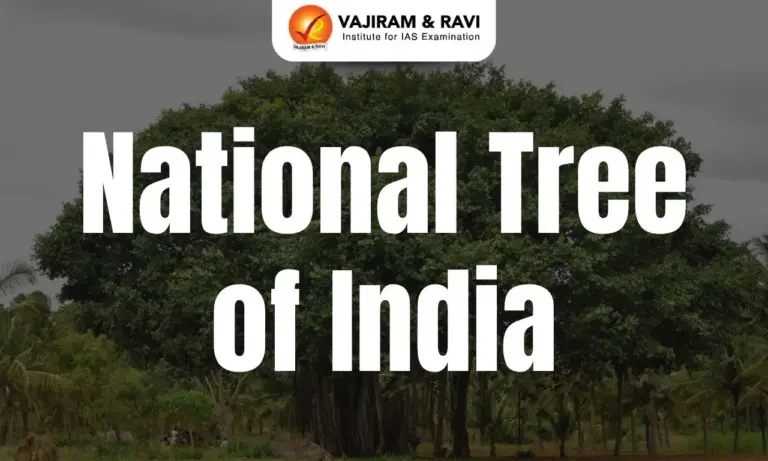
National Tree of India: The Banyan Tree, scientifically known as Ficus benghalensis, holds the prestigious title of National Tree of India, a recognition bestowed by the government in 1950. This iconic tree is found across India, adapting to a variety of climates and terrains, making it a symbol of the country’s diverse geography. Known as the “Kalpavriksha” or “wish-fulfilling tree,” the Banyan is revered not only for its physical presence but also for its cultural and spiritual significance. In Hinduism, it is regarded as sacred, often associated with longevity and prosperity.
National Tree of India
The Banyan tree (Ficus bengalensis), National Tree of India, symbolizes the nation’s pride and cultural identity. Known for its unique growth, the tree’s branches extend and root themselves, forming new trunks. This process gives the tree an immortal character, symbolizing longevity in Hindu philosophy and often associated with the ‘Kalpa Vriksha’ or ‘Tree of Wish Fulfillment.’ Revered in Indian myths, the Banyan tree also serves as a vital part of village life, offering shade for councils and gatherings. Native to India, its medicinal properties and role in village communities reinforce its status as a national symbol, deeply embedded in the country’s traditions and natural heritage.
National Tree of India Overview
Below in the table is the National Tree of India Overview to learn on tips the keywords that can be useful during the exams in general awareness section:
| National Tree of India Overview | |
|
Kingdom |
Plantae |
|
Name |
Banyan Tree |
|
Family |
Moraceae |
|
Adopted in |
1950 |
|
Genus |
Ficus |
|
Order |
Urticales |
|
Found in |
Indian Subcontinent |
|
Type |
Figs |
|
Dimensions |
Height: 10-25 m; Spread: as far as 100 m |
|
Division |
Magnoliophyta |
|
Class |
Magnoliopsida |
|
Found in |
Native to Indian Subcontinent |
|
Habitat |
Terrestrial |
|
Conservation Status |
Not-threatened |
|
Scientific Name |
Ficus benghalensis |





National Tree of India Importance
- The banyan tree is revered in Hinduism as a symbol of eternal life. Lord Krishna refers to it as “I am the banyan tree among trees” in the Bhagavad Gita.
- Known as Ashwath Vriksha, the banyan tree represents the concept of ever-expanding life, symbolizing growth and continuity.
- The banyan is also called Kalpavriksha, meaning “wish-fulfilling divine tree,” signifying its power to grant blessings and desires.
- The banyan tree appears in the national coat of arms of Indonesia, symbolizing unity with its extensive roots connecting the country’s many islands.
- In Brian Aldiss’ novel Hothouse, the banyan tree is imagined to cover half of Earth in the future, where trees merge and grow together with adventitious roots.
- Famous for the banyan trees growing around and through the walls, Ta Prohm at the Angkor Wat temple complex in Cambodia is an iconic example of nature merging with ancient architecture.
- Older banyan trees are recognized for their aerial prop roots, which grow downward and develop into woody trunks, creating a vast, interconnected structure.
- With age, the banyan’s roots spread laterally, covering wide areas, making it one of the largest trees in terms of coverage.
- The largest banyan tree, located in Kolkata, India, has an expansive canopy and is a major tourist attraction.
- A famous banyan tree in Lahaina, Hawaii, planted in 1873, has grown to cover nearly two-thirds of an acre, highlighting the tree’s immense size and growth potential.

 Last updated on April, 2026
→ UPSC Final Result 2025 is now out.
→ UPSC has released UPSC Toppers List 2025 with the Civil Services final result on its official website.
→ Anuj Agnihotri secured AIR 1 in the UPSC Civil Services Examination 2025.
→ UPSC Marksheet 2025 is now out.
→ UPSC Notification 2026 & UPSC IFoS Notification 2026 is now out on the official website at upsconline.nic.in.
→ UPSC Calendar 2026 has been released.
→ Check out the latest UPSC Syllabus 2026 here.
→ UPSC Prelims 2026 will be conducted on 24th May, 2026 & UPSC Mains 2026 will be conducted on 21st August 2026.
→ The UPSC Selection Process is of 3 stages-Prelims, Mains and Interview.
→ Prepare effectively with Vajiram & Ravi’s UPSC Prelims Test Series 2026 featuring full-length mock tests, detailed solutions, and performance analysis.
→ Enroll in Vajiram & Ravi’s UPSC Mains Test Series 2026 for structured answer writing practice, expert evaluation, and exam-oriented feedback.
→ Join Vajiram & Ravi’s Best UPSC Mentorship Program for personalized guidance, strategy planning, and one-to-one support from experienced mentors.
→ Shakti Dubey secures AIR 1 in UPSC CSE Exam 2024.
→ Also check Best UPSC Coaching in India
National Tree of India FAQs
Q1. Which is the national tree of India?+
Q2. What is the scientific name of the National Tree of India?+
Q3. Where is the National Tree of India found?+
Q4. What is the family of Banyan Tree?+
Q5. What is the class of Banyan Tree?+
Tags: national tree of india