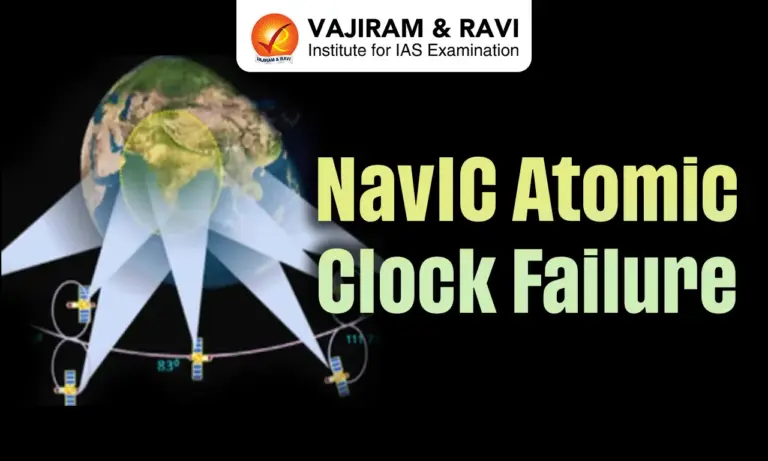
NavIC Atomic Clock Failure Latest News
- India’s regional navigation system NavIC has faced another setback after the atomic clock onboard the IRNSS-1F satellite stopped functioning, leading to the loss of its positioning data.
- Although the satellite will still provide messaging services, atomic clocks are essential for accurate navigation signals used in mapping, vehicle navigation, and infrastructure planning.
- The issue is compounded by the NVS-02 replacement satellite failing to reach its final orbit, further affecting the system’s positioning capability.
About IRNSS or NavIC
- The Indian Regional Navigation Satellite System (IRNSS), also known as Navigation with Indian Constellation (NavIC), is India’s satellite-based navigation system designed to provide positioning services over India and up to 1,500 km beyond its borders.
- NavIC was planned as a seven-satellite constellation, similar in concept to the U.S. Global Positioning System (GPS), to deliver reliable navigation and timing information across the region.
- When fully operational, NavIC is designed to provide location accuracy of about 10 metres over India and neighbouring areas.
- Because its satellites are positioned directly above the region, signals are stronger and more reliable in challenging terrains such as valleys and forests.
- Despite its strategic importance, the NavIC system has faced technical issues since its inception, affecting the consistent availability of accurate positioning services.





Status of NavIC Satellites Providing Positioning Data
- After the 2023 launch, five satellites in the NavIC constellation were capable of providing positioning data: IRNSS-1B, IRNSS-1C, IRNSS-1F, IRNSS-1I, and NVS-01 (a new-generation NavIC satellite).
- With the failure of the atomic clock on IRNSS-1F, the satellite can no longer provide positioning data, reducing the number of operational satellites in the system.
- Many early NavIC satellites are approaching or exceeding their design life.
- IRNSS-1A (2013) is almost defunct due to earlier atomic clock failures.
- IRNSS-1B and IRNSS-1C, launched in 2014, have also crossed their 10-year mission life.
- ISRO attempted to maintain the constellation through replacement missions:
- IRNSS-1H (2017) failed to reach orbit after the heat shield did not open.
- IRNSS-1I (2018) was successfully launched later as a replacement satellite.
NVS-02 Satellite and Its Failure
- NVS-02, the second satellite of the new-generation NavIC series, was launched in January 2025 aboard GSLV-F15 during ISRO’s 100th mission and placed in a highly elliptical transfer orbit.
- The satellite failed to move into its intended operational orbit due to an electrical malfunction that prevented the engine from igniting.
- A review committee found that the signal required to activate the pyro valve in the oxidiser line did not reach the engine.
- This likely occurred because a connector contact disengaged, breaking the electrical circuit.
Delays in Developing the User Segment
- The NavIC programme has also faced criticism for delays in developing user receivers.
- A 2018 CAG report noted that although funding was approved in 2006, work began only in 2017, by which time several satellites had already been launched.
- Despite these setbacks, NavIC services are already used in aviation, shipping, and railways, and many modern smartphones support NavIC signals alongside GPS and GLONASS.
Advancements in New-Generation NavIC Satellites
- Indigenous Atomic Clocks – A key upgrade is the development of indigenous atomic clocks by ISRO, reducing dependence on foreign systems and addressing earlier failures that affected positioning accuracy.
- Importance of Atomic Clocks – Satellite navigation relies on precise time measurement to calculate location. Failures in atomic clocks previously disrupted accurate positioning, making this upgrade crucial for reliability.
- Extended Mission Life – The new-generation satellites have an extended lifespan of 12 years, compared to 10 years for earlier satellites, ensuring longer operational stability.
- Addition of L1 Frequency Band – Along with existing L5 and S bands, new satellites transmit in the L1 frequency, which is widely used by global systems like GPS.
- Improved Interoperability and Usability – The inclusion of the L1 band enhances compatibility with global navigation systems and enables usage in low-power devices like smartphones and smartwatches, expanding NavIC’s applications.
Global Satellite Navigation Systems
- There are four primary global navigation satellite systems (GNSS):
- US – GPS (Global Positioning System)
- Russia – GLONASS
- Europe – Galileo
- China – BeiDou
- These systems provide worldwide positioning, navigation, and timing services.
Regional Navigation Systems
- Some countries operate regional systems:
- India – NavIC (IRNSS) with 7 satellites
- Japan – QZSS (Quasi-Zenith Satellite System) with 4 satellites, mainly augmenting GPS over Japan
Orbital Configurations
- GPS, GLONASS, Galileo: Over 20 satellites each in Medium Earth Orbit (~20,000 km)
- BeiDou: Over 40 satellites in mixed orbits (Medium Earth + Geosynchronous ~35,000 km)
- India and Japan systems: Fewer satellites placed in Geosynchronous orbits, optimised for regional coverage
- Global systems ensure worldwide coverage, while regional systems like NavIC and QZSS are designed for higher accuracy within specific geographic areas.

 Last updated on March, 2026
→ UPSC Final Result 2025 is now out.
→ UPSC has released UPSC Toppers List 2025 with the Civil Services final result on its official website.
→ Anuj Agnihotri secured AIR 1 in the UPSC Civil Services Examination 2025.
→ UPSC Marksheet 2025 is now out.
→ UPSC Notification 2026 & UPSC IFoS Notification 2026 is now out on the official website at upsconline.nic.in.
→ UPSC Calendar 2026 has been released.
→ Check out the latest UPSC Syllabus 2026 here.
→ UPSC Prelims 2026 will be conducted on 24th May, 2026 & UPSC Mains 2026 will be conducted on 21st August 2026.
→ The UPSC Selection Process is of 3 stages-Prelims, Mains and Interview.
→ Prepare effectively with Vajiram & Ravi’s UPSC Prelims Test Series 2026 featuring full-length mock tests, detailed solutions, and performance analysis.
→ Enroll in Vajiram & Ravi’s UPSC Mains Test Series 2026 for structured answer writing practice, expert evaluation, and exam-oriented feedback.
→ Join Vajiram & Ravi’s Best UPSC Mentorship Program for personalized guidance, strategy planning, and one-to-one support from experienced mentors.
→ Shakti Dubey secures AIR 1 in UPSC CSE Exam 2024.
→ Also check Best UPSC Coaching in India
NavIC Atomic Clock Failure FAQs
Q1. What is the NavIC Atomic Clock Failure issue?+
Q2. How has NavIC Atomic Clock Failure affected the constellation?+
Q3. What improvements are being made despite NavIC Atomic Clock Failure?+
Q4. What happened to the NVS-02 satellite?+
Q5. How does NavIC compare with global navigation systems?+
Tags: mains articles NavIC Atomic Clock Failure upsc current affairs upsc mains current affairs