About Non-invasive formaldehyde sensor
- Materials used: Tin oxide-reduced graphene oxide composite (rGO- SnO2).
- While reduced graphene oxide (rGO) has been used to detect various toxic gases and VOCs, tin oxide (SnO2) has been extensively investigated for formaldehyde detection in pristine form and by incorporating it with various compounds, including graphene, due to its high stability and high sensitivity toward low concentrations of formaldehyde.
- Process: The Graphene oxide (GO) was processed through wet chemical approach and tin oxide-reduced graphene oxide composite (rGO- SnO2) was synthesized by hydrothermal route followed by calcination of the obtained product.
- They found that the sensor made of tin oxide decorated with reduced graphene oxide effectively sensed formaldehyde vapor at room temperature.
- The sensor shows long-term stability with a low detection limit.
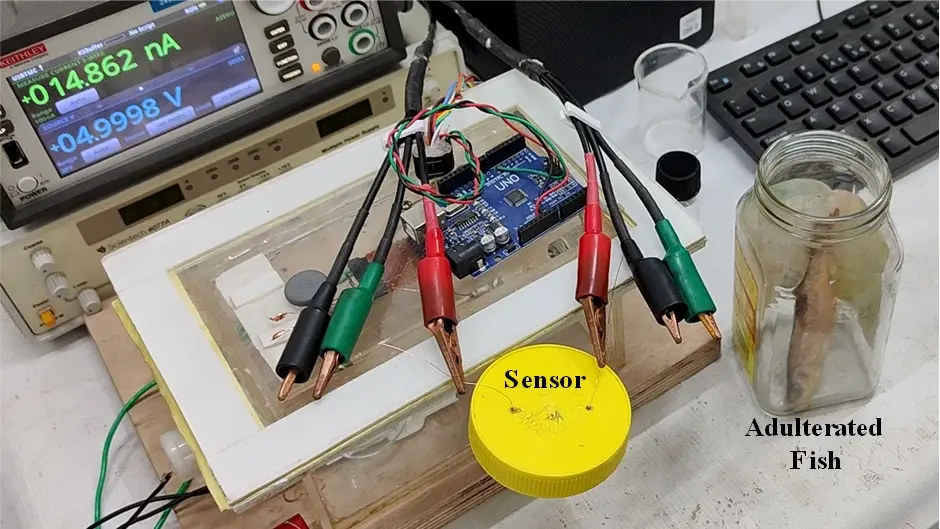
- A new low-cost sensor made of metal oxide nanoparticles reduced graphene oxide composite can detect formalin adulteration in fishes at room temperature in a non-invasive way.
- The research for this is supported by DST-PURSE (Promotion of University Research and Scientific Excellence).
- Existing sensors
- Commercial formalin sensors for fish are primarily electrochemical-based or colorimetric-based. Electrochemical sensors are extensively used but are expensive.
- The calorimetric sensors are less expensive. But both methods are invasive in nature.
- Issue: Low-level detection and selective detection are two major issues with these sensors.
- Significance of new sensor
- The development of 2D materials-based gas sensors has created a new avenue of effective detection of toxic vapors at room temperature.
- These sensors have the potential to detect the formalin evaporated from adulterated food products.
What is Formaldehyde?
- It is a colourless, pungent gas that is used in a variety of industrial processes, including as a preservative in some foods, commonly in fish in developing countries.
Q1) What is Promotion of University Research and Scientific Excellence (PURSE)?
It is one of the Flagship Infrastructure programs of the Department of Science and Technology, which commenced in the year 2009 exclusively for the University sector. The main objective of the scheme is to strengthen the research capacity of performing Indian Universities and provide support for nurturing the research ecosystem and strengthening the R&D base of the Universities in the country.
Source: New non-invasive formaldehyde sensor can detect adulterated fish at room temperature


 Last updated on Oct, 2026
→ UPSC 2027 Notification will be released on 13 January 2027 at upsconline.nic.in.
→ Check Nobel Prize 2026 Winners List here.
→ Download PIB PRiSM Monthly Magazine 2026 here.
→ Check UPSC Monthly Current Affairs Magazine The Recitals here.
→ Check out the latest UPSC Syllabus here.
→ Download UPSC Model Answers for Mains 2026
→ UPSC Mains Question Paper 2026 is out now for Essay & GS Paper 1, 2, 3 & 4.
→ UPSC Calendar 2027 has been released.
→ Enroll in Vajiram & Ravi’s UPSC Mains Test Series 2027 for structured answer writing practice, expert evaluation, and exam-oriented feedback.
→ Join Vajiram & Ravi’s UPSC Mentorship Program 2027 for personalized guidance, strategy planning, and one-to-one support from experienced mentors.
→ Go through the UPSC Mains Previous Year Papers to enhance your preparation.
→ UPSC has released UPSC Toppers List 2025 with the Civil Services final result on its official website.
→ Also check Best UPSC Coaching in India