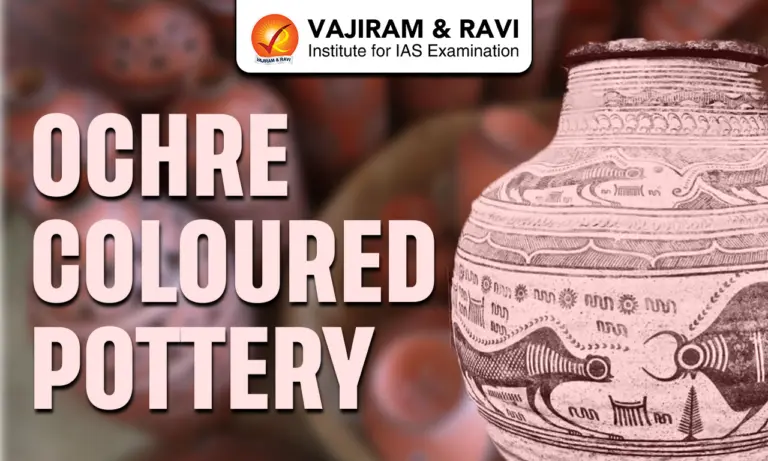
Ochre Coloured Pottery is an early type of pottery known for its light reddish or ochre colour. It was mainly used by early farming communities and is considered one of the simpler forms of pottery in ancient India. The pots were usually not very strong and were made using basic techniques, showing that pottery-making skills were still developing at that time.
About Ochre Coloured Pottery
- Meaning: Ochre Coloured Pottery (OCP) is an early type of pottery from the Bronze Age, known for its light reddish or ochre colour. It gets this colour because of poor firing techniques, which give it a dull and uneven appearance.
- Time Period: It is generally dated between 2000-1500 BCE, placing it in the later phase of the Bronze Age in India.
- Region / Distribution: It was mainly found in the Indo-Gangetic Plain, especially in areas from eastern Punjab to northeastern Rajasthan and western Uttar Pradesh, showing its spread across early settlement regions.
- Cultural Association: OCP shows similarities with both the Late Harappan culture and the early Vedic culture, which means it represents a transitional phase between these two important cultural periods.
- Features: It is usually light red or ochre in colour, has a rough and porous texture, and appears weak and poorly fired, indicating that pottery-making techniques were still developing. The edges of broken pieces (sherds) are often worn out due to weathering.
- Technique: The pottery was made using simple methods with low firing temperatures and less control over the kiln, which resulted in fragile and unevenly coloured pots.
- Decoration: Although mostly plain, some OCP pieces were decorated with simple black painted bands or incised (carved) patterns, showing early attempts at artistic expression.
- Association with Copper Hoards: OCP is often found along with copper hoards, which include copper tools, weapons, and sometimes human-shaped (anthropomorphic) figures, suggesting the presence of metal-using communities.
- Uses: It was mainly used for basic daily purposes such as storage, cooking, and household activities, reflecting the simple lifestyle of early agricultural communities.
- Significance: OCP is important because it helps us understand a transitional cultural phase in Indian history, showing the shift from the Indus Valley traditions to early Vedic society. It also provides evidence of early farming settlements and developing technology in pottery and metal use.
Also Read: Manamadurai






 Last updated on April, 2026
→ UPSC Final Result 2025 is now out.
→ UPSC has released UPSC Toppers List 2025 with the Civil Services final result on its official website.
→ Anuj Agnihotri secured AIR 1 in the UPSC Civil Services Examination 2025.
→ UPSC Marksheet 2025 is now out.
→ UPSC Notification 2026 & UPSC IFoS Notification 2026 is now out on the official website at upsconline.nic.in.
→ UPSC Calendar 2026 has been released.
→ Check out the latest UPSC Syllabus 2026 here.
→ UPSC Prelims 2026 will be conducted on 24th May, 2026 & UPSC Mains 2026 will be conducted on 21st August 2026.
→ The UPSC Selection Process is of 3 stages-Prelims, Mains and Interview.
→ Prepare effectively with Vajiram & Ravi’s UPSC Prelims Test Series 2026 featuring full-length mock tests, detailed solutions, and performance analysis.
→ Enroll in Vajiram & Ravi’s UPSC Mains Test Series 2026 for structured answer writing practice, expert evaluation, and exam-oriented feedback.
→ Join Vajiram & Ravi’s Best UPSC Mentorship Program for personalized guidance, strategy planning, and one-to-one support from experienced mentors.
→ Shakti Dubey secures AIR 1 in UPSC CSE Exam 2024.
→ Also check Best UPSC Coaching in India
Ochre Coloured Pottery FAQs
Q1. What is Ochre Coloured Pottery (OCP)?+
Q2. What is the time period of OCP?+
Q3. Where was OCP mainly found?+
Q4. What are the main features of OCP?+
Q5. What techniques were used to make OCP?+
Tags: history history notes ochre coloured pottery