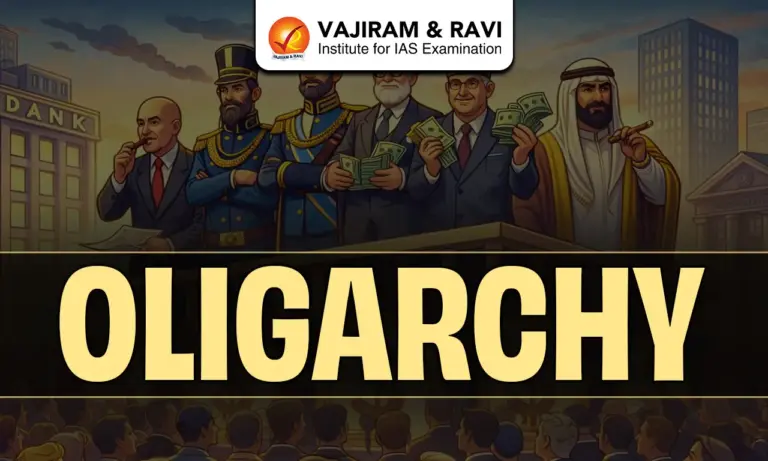
Oligarchy is a form of government in which power is concentrated in the hands of a small group of people. The word “oligarchy” comes from the Greek words oligos (few) and arkhein (to rule), meaning “rule by a few.” In an oligarchic system, political authority, economic power, or both are controlled by a limited number of individuals, families, corporations, military leaders, or elites.
Oligarchy Characteristics
Oligarchy has several distinct features that differentiate it from other forms of government like democracy, monarchy, or dictatorship. Below are the major characteristics:
- Rule by a Small Group: Political power is held by a limited number of individuals rather than the general population.
- Concentration of Wealth and Power: Economic and political authority are usually controlled by wealthy elites, influential families, or powerful groups.
- Limited Public Participation: Ordinary citizens have little or no role in decision-making processes.
- Control Over Key Institutions: The ruling group often controls major institutions such as the military, judiciary, media, and large industries.
- Lack of Transparency: Decisions are typically made behind closed doors, with minimal public accountability.
- Restricted Political Competition: Elections, if conducted, are often manipulated or limited to ensure continued dominance of the elite group.
- Inheritance or Elite Selection: Power may be passed through family lines (aristocracy) or selected from within elite circles.
- Policy Favoring the Elite: Laws and policies are generally designed to protect the interests of the ruling minority.
- Social and Economic Inequality: A large gap usually exists between the ruling elite and the common population.
Oligarchy Types
Oligarchy can take different forms depending on who holds power within the small ruling group. Below are the major types of oligarchy:
- Plutocracy
- A form of government controlled by the rich and wealthy individuals.
- Power may be exercised directly (wealthy people holding official positions) or indirectly (influencing those in authority).
- Political decisions mainly serve economic and financial interests.
- Aristocracy
- Government ruled by an elite or noble class, often including royal families.
- Power is usually hereditary, passed down through generations.
- The ruling class enjoys social prestige, economic privilege, and political authority.
- Theocracy
- A system in which supreme power is held by a religious authority.
- Governance is carried out by members of religious institutions.
- Example: The rule of the Pope in Vatican City or the Supreme Leader in Iran.
- Stratocracy
- A government where the military officially exercises ruling power.
- Unlike a military dictatorship, officials in a stratocracy are formally and legally granted authority to govern.
- The armed forces play a central administrative role.
- Kraterocracy (Kratocracy)
- A system where those with superior physical strength or force rule over others.
- Political power is seized or maintained through force or threat.
- It follows the principle of “might makes right.”
- Timocracy
- A system where political power is based on honor, property ownership, or military achievement.
- Only individuals who meet certain property or status qualifications can participate in governance.
- Leadership is often linked to reputation and social standing.





Other Different Types of Government
- Monarchy
- Hereditary Rule: Power is passed down through a royal family lineage, usually from parent to child.
- Head of State: The king, queen, or emperor serves as the supreme authority of the nation.
- Types of Monarchy: Can be Absolute (full control), Constitutional (limited by constitution), or Ceremonial (symbolic role only).
- Examples: Absolute monarchy in Brunei and constitutional monarchy in United Kingdom.
- Theocracy
- Religious Authority: Political power is held by religious leaders or institutions.
- Divine Law: Laws are based on religious scriptures and doctrines.
- Spiritual Leadership: The ruler is considered divinely guided or a representative of God.
- Example: Vatican City, governed by the Pope.
- Democracy
- Popular Sovereignty: Power ultimately rests with the people.
- Free and Fair Elections: Citizens elect representatives through a voting system.
- Rule of Law: Government functions under a constitution protecting fundamental rights.
- Examples: India and United States.
- Republic
- Elected Head of State: The President or leader is elected, not hereditary.
- Constitutional Framework: Governance operates strictly under a written constitution.
- Public Accountability: Leaders are answerable to the citizens and legislature.
- Examples: France and India.
- Anarchy
- Absence of Government: No central authority or formal governing body exists.
- Lack of Law Enforcement: No structured system to enforce laws or regulations.
- Political Instability: Often arises during state collapse or civil conflict.
- Historical Example: Somalia experienced prolonged instability after 1991.
- Dictatorship
- Single Ruler Control: One individual holds absolute political power.
- Suppression of Opposition: Political dissent and opposition parties are restricted or banned.
- Limited Civil Liberties: Media freedom and fundamental rights are often controlled or censored.
- Example: North Korea is widely regarded as a dictatorship.

 Last updated on March, 2026
→ UPSC Final Result 2025 is now out.
→ UPSC has released UPSC Toppers List 2025 with the Civil Services final result on its official website.
→ Anuj Agnihotri secured AIR 1 in the UPSC Civil Services Examination 2025.
→ UPSC Marksheet 2025 is now out.
→ UPSC Notification 2026 & UPSC IFoS Notification 2026 is now out on the official website at upsconline.nic.in.
→ UPSC Calendar 2026 has been released.
→ Check out the latest UPSC Syllabus 2026 here.
→ UPSC Prelims 2026 will be conducted on 24th May, 2026 & UPSC Mains 2026 will be conducted on 21st August 2026.
→ The UPSC Selection Process is of 3 stages-Prelims, Mains and Interview.
→ Prepare effectively with Vajiram & Ravi’s UPSC Prelims Test Series 2026 featuring full-length mock tests, detailed solutions, and performance analysis.
→ Enroll in Vajiram & Ravi’s UPSC Mains Test Series 2026 for structured answer writing practice, expert evaluation, and exam-oriented feedback.
→ Join Vajiram & Ravi’s Best UPSC Mentorship Program for personalized guidance, strategy planning, and one-to-one support from experienced mentors.
→ Shakti Dubey secures AIR 1 in UPSC CSE Exam 2024.
→ Also check Best UPSC Coaching in India
Oligarchy FAQs
Q1. What is oligarchy?+
Q2. What does the term “oligarchy” mean?+
Q3. How is oligarchy different from democracy?+
Q4. Is oligarchy the same as dictatorship?+
Q5. What are common types of oligarchy?+
Tags: oligarchy political science