Online Content Latest News
- The Centre has proposed amendments to the IT Rules, 2021, to expand regulation over social media users and independent news creators.
Regulation of Online Content in India
- India regulates online content primarily through the Information Technology Act, 2000 and the Information Technology (Intermediary Guidelines and Digital Media Ethics Code) Rules, 2021.
- Key Features of IT Rules, 2021
- Provide a framework for the regulation of digital media and intermediaries.
- Introduce a three-tier grievance redressal mechanism.
- Require social media platforms to exercise due diligence.
- Enable government oversight over digital news and OTT platforms.
- Safe Harbour Provision
- Section 79 of the IT Act grants “safe harbour” protection to intermediaries.
- Platforms are not liable for user-generated content if due diligence is followed.
- Failure to comply with government directions can result in loss of this protection.
- Role of Government
- Ministry of Electronics and Information Technology (MeitY) regulates intermediaries.
- Ministry of Information and Broadcasting (MIB) oversees digital news and content.
- Blocking orders are issued under Section 69A of the IT Act.
- Significance
- Helps tackle misinformation, fake news, and harmful content.
- Strengthens the accountability of digital platforms.
- Enables faster grievance redressal mechanisms.





Proposed Amendments to IT Rules
- The Centre has proposed significant changes to expand regulatory control over online content.
- Inclusion of Individual Users
- The rules may now apply to individual users posting news or current affairs content.
- Previously, regulation was limited to publishers and platforms.
- Direct Takedown and Blocking Powers
- MIB may be empowered to issue direct blocking orders to users and platforms.
- It can also require users to modify or apologise for content.
- Expansion of the Inter-Departmental Committee
- The Inter-Departmental Committee (IDC) will have broader powers.
- It can now hear a wider range of grievances beyond code violations.
- Legal Status of Advisories
- Government advisories to platforms may become legally binding.
- Non-compliance could affect safe harbour protection.
News Summary
- The recent reports highlight a major shift in India’s approach to regulating online content.
- Expansion of Regulatory Scope
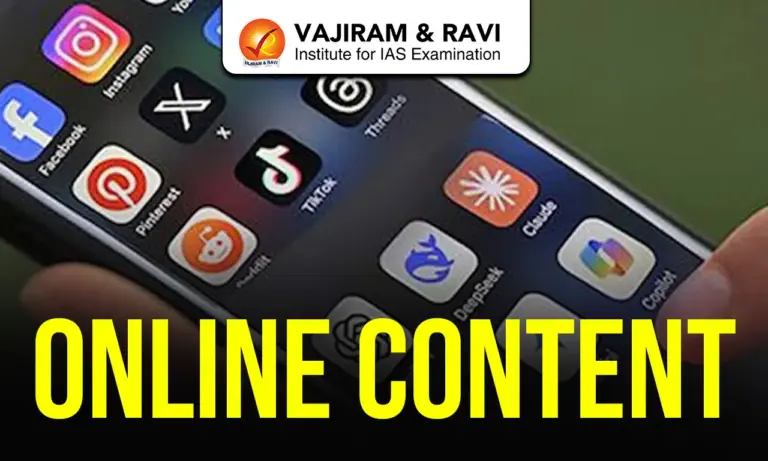
- Independent news creators on platforms such as YouTube, Instagram, and X may be brought under the regulatory framework.
- This includes individuals who may not be professional journalists but create content related to current affairs.
- Increased Government Oversight
- The proposed amendments empower the Ministry of Information and Broadcasting to:
- Issue blocking orders directly.
- Seek information about creators from platforms.
- Enforce compliance through regulatory mechanisms.
- This marks a shift from platform-based regulation to direct regulation of users.
- The proposed amendments empower the Ministry of Information and Broadcasting to:
- Changes in Takedown Mechanism
- The government plans to allow takedown notices to be sent directly to individual users.
- Earlier, such notices were limited to online news publishers.
- Additionally, the time window for compliance has reportedly been reduced significantly, increasing pressure on platforms to act quickly.
- Impact on Social Media Platforms
- Advisories will become part of due diligence obligations.
- Non-compliance could lead to legal liability.
- Platforms may take down content more aggressively to retain safe harbour.
- Concerns Over Freedom of Expression
- The proposed changes have raised concerns among civil society groups.
- Critics argue it may lead to excessive censorship.
- The Internet Freedom Foundation has termed it a major expansion of regulatory power.
- There are also concerns about potential misuse against dissenting or satirical content.
- Recent Enforcement Trends
- The reports indicate an increase in takedown orders in recent weeks.
- Content related to political criticism and satire has been targeted.
- AI-generated deepfakes and misinformation are cited as key concerns.
- This reflects a tightening regulatory environment for digital content.
Challenges and Issues
- Balancing Regulation and Free Speech: Ensuring regulation does not infringe Article 19(1)(a).
- Ambiguity in Definitions: Broad definitions may include unintended users.
- Over-compliance by Platforms: Fear of liability may lead to excessive content removal.
- Judicial Scrutiny: Some provisions of the IT Rules are already under court review.

 Last updated on March, 2026
→ UPSC Final Result 2025 is now out.
→ UPSC has released UPSC Toppers List 2025 with the Civil Services final result on its official website.
→ Anuj Agnihotri secured AIR 1 in the UPSC Civil Services Examination 2025.
→ UPSC Marksheet 2025 is now out.
→ UPSC Notification 2026 & UPSC IFoS Notification 2026 is now out on the official website at upsconline.nic.in.
→ UPSC Calendar 2026 has been released.
→ Check out the latest UPSC Syllabus 2026 here.
→ UPSC Prelims 2026 will be conducted on 24th May, 2026 & UPSC Mains 2026 will be conducted on 21st August 2026.
→ The UPSC Selection Process is of 3 stages-Prelims, Mains and Interview.
→ Prepare effectively with Vajiram & Ravi’s UPSC Prelims Test Series 2026 featuring full-length mock tests, detailed solutions, and performance analysis.
→ Enroll in Vajiram & Ravi’s UPSC Mains Test Series 2026 for structured answer writing practice, expert evaluation, and exam-oriented feedback.
→ Join Vajiram & Ravi’s Best UPSC Mentorship Program for personalized guidance, strategy planning, and one-to-one support from experienced mentors.
→ Shakti Dubey secures AIR 1 in UPSC CSE Exam 2024.
→ Also check Best UPSC Coaching in India
Online Content FAQs
Q1. What are IT Rules, 2021?+
Q2. What is safe harbour protection?+
Q3. What change is proposed for individual users?+
Q4. What is the role of the Inter-Departmental Committee?+
Q5. Why are the amendments controversial?+
Tags: mains articles online content upsc current affairs upsc mains current affairs