Ordinarily Resident Latest News
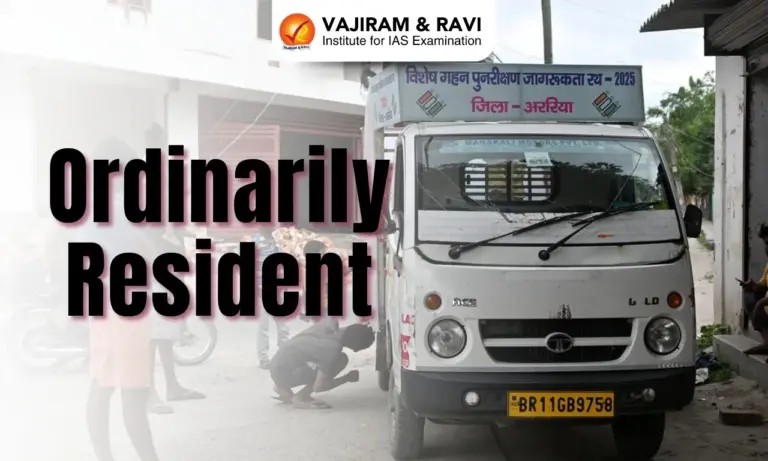
Recently, the Election Commission’s Special Intensive Revision (SIR) in Bihar has sparked discussions on electoral inclusion, particularly for migrant populations, focusing on the balance between electoral roll integrity and inclusive democratic participation.
Who is an ‘Ordinarily Resident’?
- According to Section 19 of the RP Act, only a person who is an ‘ordinarily resident’ in a constituency can be enrolled in its electoral roll.
- Section 20 of the RP Act defines the term ‘ordinarily resident’. It states that merely owning or possessing a house in a constituency does not qualify a person as an ordinarily resident.
- A person temporarily absent from their regular residence (for work, travel, etc.) is still considered ordinarily resident in that location.
- Specific categories covered under Section 20:
- Armed forces personnel.
- Members of the State armed police serving outside the State.
- Central government employees posted abroad.
- Persons holding a constitutional office declared by the President in consultation with the EC.
- Their spouses are also considered ordinarily resident in the original constituency.
- Section 20A (added in 2010) allows Non-Resident Indians (NRIs) to register and vote from the address mentioned in their passport, even if they live abroad for extended periods.
- The Election Commission of India (ECI) is responsible for preparing electoral rolls under the Representation of the People Act, 1950 (RP Act).
Rules Governing Electoral Rolls
- The Registration of Electors Rules, 1960 (RER), framed by the Central Government in consultation with the ECI, govern the:
- Preparation of electoral rolls.
- Inclusion and exclusion of names.
- Process of verification and changes in voter lists.
Why ‘Ordinarily Resident’ Status Matters
- The requirement ensures that the voter has a genuine and habitual connection with the constituency.
- It maintains electoral integrity, reduces fraudulent registrations, and ensures accountability in representation.
- The Gauhati High Court (1999, Manmohan Singh Case) ruled that:
- The person should be a habitual and permanent resident.
- There must be an intention to dwell in that place.
- A reasonable person must accept the individual as a resident.
Source: TH






 Last updated on March, 2026
→ UPSC Final Result 2025 is now out.
→ UPSC has released UPSC Toppers List 2025 with the Civil Services final result on its official website.
→ Anuj Agnihotri secured AIR 1 in the UPSC Civil Services Examination 2025.
→ UPSC Marksheet 2025 is now out.
→ UPSC Notification 2026 & UPSC IFoS Notification 2026 is now out on the official website at upsconline.nic.in.
→ UPSC Calendar 2026 has been released.
→ Check out the latest UPSC Syllabus 2026 here.
→ UPSC Prelims 2026 will be conducted on 24th May, 2026 & UPSC Mains 2026 will be conducted on 21st August 2026.
→ The UPSC Selection Process is of 3 stages-Prelims, Mains and Interview.
→ Prepare effectively with Vajiram & Ravi’s UPSC Prelims Test Series 2026 featuring full-length mock tests, detailed solutions, and performance analysis.
→ Enroll in Vajiram & Ravi’s UPSC Mains Test Series 2026 for structured answer writing practice, expert evaluation, and exam-oriented feedback.
→ Join Vajiram & Ravi’s Best UPSC Mentorship Program for personalized guidance, strategy planning, and one-to-one support from experienced mentors.
→ Shakti Dubey secures AIR 1 in UPSC CSE Exam 2024.
→ Also check Best UPSC Coaching in India
Ordinarily Resident FAQs
Q1. Who is an Ordinarily Resident in India?+
Q2. Can NRIs become ordinarily resident?+
Q3. Is citizenship required to be an ordinarily resident?+
Tags: ordinarily resident prelims pointers upsc current affairs upsc prelims current affairs