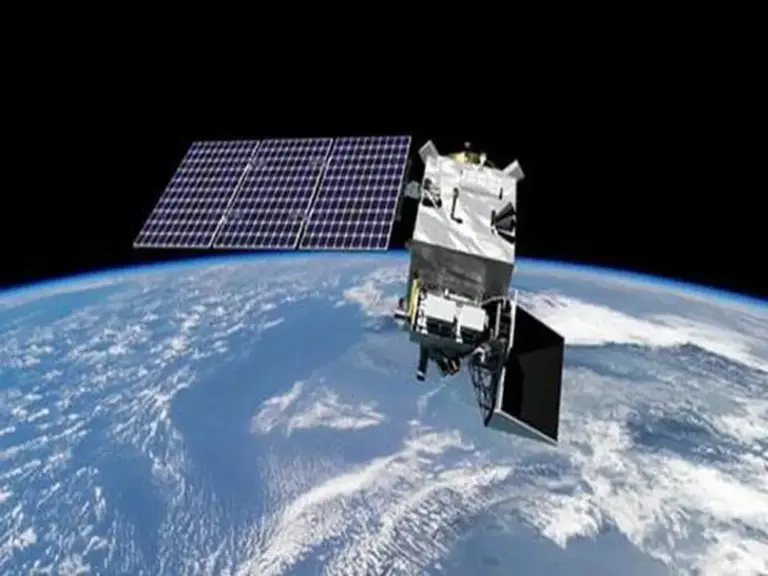
About PACE Satellite
- The Plankton, Aerosol, Cloud, ocean Ecosystem (PACE) satellite is placed in Sun-synchronous orbit.
- The primary science instrument for PACE is the Ocean Colour Instrument (OCI) which is designed to measure the ocean’s colour across a spectrum from ultraviolet to shortwave infrared.
- It features two polarimeters – the Spectro-polarimeter for Planetary Exploration (SPEXone) and the Hyper Angular Research Polarimeter (HARP2).
- These two working together will offer complementary spectral and angular sampling, polarimetric accuracy, and spatial coverage.
- This combination aims to provide improved atmospheric correction and a comprehensive range of aerosol and cloud science data beyond what the OCI alone could achieve.
- The synergistic payload of OCI, SPEXone and HARP2 is poised to make significant breakthroughs in aerosol-cloud-ocean research.
- The OCI observes the ocean, land, and atmosphere across a spectrum of ultraviolet, visible, and near infrared light. With this extensive spectral range, scientists can identify specific communities of phytoplankton.
- Significance: The data will allow researchers to study microscopic life in the ocean and particles in the air, advancing the understanding of issues including fisheries health, harmful algal blooms, air pollution, and wildfire smoke.
- With PACE, scientists also can investigate how the ocean and atmosphere interact with each other and are affected by a changing climate.
Q1: What is a plankton?
An organism is considered plankton if it is carried by tides and currents and cannot swim well enough to move against these forces. The most basic categories divide plankton into two groups: phytoplankton (plants) and zooplankton (animals).
Source: NASA’s PACE Data on Ocean, Atmosphere, Climate Now Available






 Last updated on March, 2026
→ UPSC Final Result 2025 is now out.
→ UPSC has released UPSC Toppers List 2025 with the Civil Services final result on its official website.
→ Anuj Agnihotri secured AIR 1 in the UPSC Civil Services Examination 2025.
→ UPSC Marksheet 2025 is now out.
→ UPSC Notification 2026 & UPSC IFoS Notification 2026 is now out on the official website at upsconline.nic.in.
→ UPSC Calendar 2026 has been released.
→ Check out the latest UPSC Syllabus 2026 here.
→ UPSC Prelims 2026 will be conducted on 24th May, 2026 & UPSC Mains 2026 will be conducted on 21st August 2026.
→ The UPSC Selection Process is of 3 stages-Prelims, Mains and Interview.
→ Prepare effectively with Vajiram & Ravi’s UPSC Prelims Test Series 2026 featuring full-length mock tests, detailed solutions, and performance analysis.
→ Enroll in Vajiram & Ravi’s UPSC Mains Test Series 2026 for structured answer writing practice, expert evaluation, and exam-oriented feedback.
→ Join Vajiram & Ravi’s Best UPSC Mentorship Program for personalized guidance, strategy planning, and one-to-one support from experienced mentors.
→ Shakti Dubey secures AIR 1 in UPSC CSE Exam 2024.
→ Also check Best UPSC Coaching in India