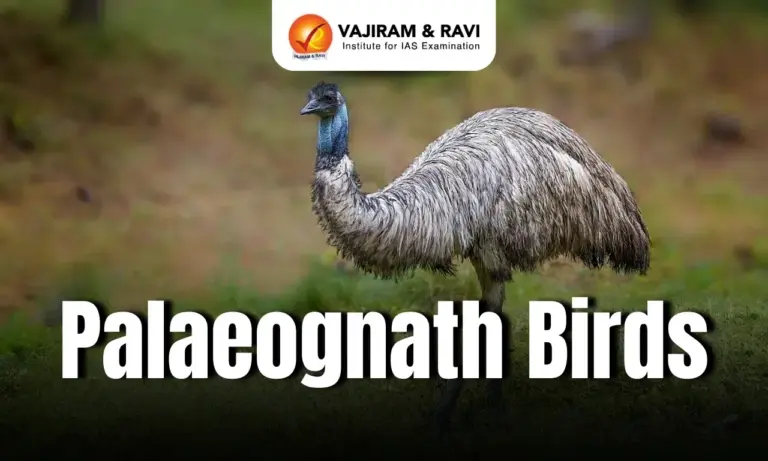
Palaeognath Birds Latest News
A new study by scientists from the University of Bristol in the United Kingdom has found that Palaeognath Birds like Emus and rheas are not exactly ‘dumb’ as assumed to be.
About Palaeognath Birds
- These are grouped together on the basis of their distinctive palate morphology, from which they receive their name (“old jaw”).
- Most of the birds classified in the Palaeognathae are also flightless, but not all flightless birds are classified in the Palaeognathae.
- These 50 bird species are very different from the other birds on the planet.
- They are the largest and heaviest avian specimens on Earth and may represent some of the first birds to evolve from dinosaurs.
- These birds are classified into two groups:
- Tinamiformes: These species have a keeled sternum and can fly (weakly), which include the tinamous of South and Central America; and the
- Ratitae, or ratite birds: They have flat sterna and reduced wings, and cannot fly at all. Examples: The African ostrich, the rhea of South America the Australian emu and New Guinea cassowary; and the kiwi of New Zealand.




Palaeognath Birds FAQs
Q1. What is a Palaeognathae in zoology?
Ans. Palaeognaths (Palaeognathae) comprise the large, flightless living ratites (emu, ostrich, cassowary and rhea) and their smaller, flying cousins; tinamou.
Q2. What is the difference between ratitae and carinatae birds?
Ans. Ratitae are running birds but they do not help in flying whereas carinate have well developed wings and are flying birds.
Source: DTH

 Last updated on March, 2026
→ UPSC Final Result 2025 is now out.
→ UPSC has released UPSC Toppers List 2025 with the Civil Services final result on its official website.
→ Anuj Agnihotri secured AIR 1 in the UPSC Civil Services Examination 2025.
→ UPSC Marksheet 2025 is now out.
→ UPSC Notification 2026 & UPSC IFoS Notification 2026 is now out on the official website at upsconline.nic.in.
→ UPSC Calendar 2026 has been released.
→ Check out the latest UPSC Syllabus 2026 here.
→ UPSC Prelims 2026 will be conducted on 24th May, 2026 & UPSC Mains 2026 will be conducted on 21st August 2026.
→ The UPSC Selection Process is of 3 stages-Prelims, Mains and Interview.
→ Prepare effectively with Vajiram & Ravi’s UPSC Prelims Test Series 2026 featuring full-length mock tests, detailed solutions, and performance analysis.
→ Enroll in Vajiram & Ravi’s UPSC Mains Test Series 2026 for structured answer writing practice, expert evaluation, and exam-oriented feedback.
→ Join Vajiram & Ravi’s Best UPSC Mentorship Program for personalized guidance, strategy planning, and one-to-one support from experienced mentors.
→ Shakti Dubey secures AIR 1 in UPSC CSE Exam 2024.
→ Also check Best UPSC Coaching in India