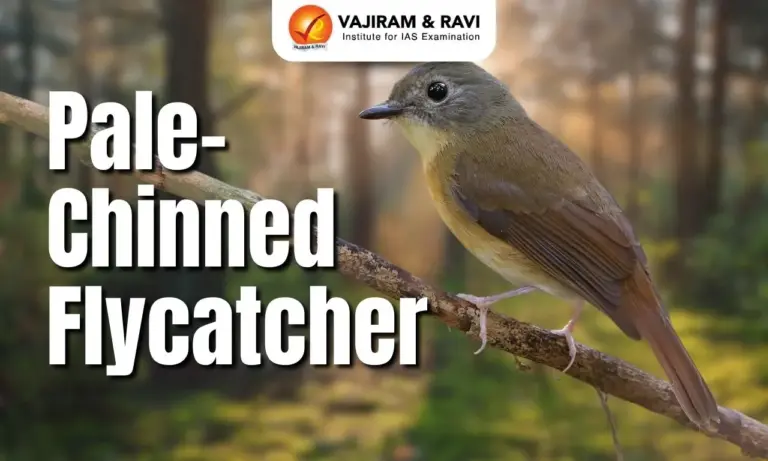
Pale-Chinned Flycatcher Latest News
In a remarkable addition to Arunachal Pradesh’s rich avian diversity, the rare Pale-chinned Flycatcher (Cyornis poliogenys) was recently sighted in the Nong Loung (Bor Beel) forest area of Namsai district.
About Pale-Chinned Flycatcher
- It is a small, insectivorous songbird known for its subtle charm, discrete behavior, and preference for shady forest interiors.
- It belongs to the family Muscicapidae. It is a sparrow-sized bird.
- Scientific Name: Cyornis poliogenys
- Distribution Range Includes:
- India (Eastern Ghats, NE states, Eastern Himalayas, and West Bengal).
- Bangladesh, Bhutan, Myanmar, and parts of Southeast Asia.
- Sundarbans (fringe forests and quiet forest trails) – Rare but possible in suitable undisturbed patches.
- Habitat: It prefers dense, moist forest habitats, especially evergreen and semi-evergreen forests with rich undergrowth.
- Conservation Status:
- IUCN Red List: Least Concern





Pale-Chinned Flycatcher Features
- Size: Small, about 13–14 cm (5.1–5.5 inches) in length.
- Weight: Approximately 10–12 grams.
- Males: Dull blue upperparts with a greyish throat and chin, light olive or brownish wash on flanks.
- Females: Similar but duller, with more brown tones and less distinct bluish hues.
- Pale chin or throat patch separating the dull blue-grey head and breast.
- Fine black bill, ideal for insect foraging.
- Frequently tail-flicking and flitting low among vegetation.
Pale-Chinned Flycatcher FAQs
Q1. What is the scientific name of the Pale-Chinned Flycatcher?
Ans. Cyornis poliogenys
Q2. What is the conservation status of the Pale-Chinned Flycatcher according to the IUCN Red List?
Ans. Least Concern
Q3. What type of habitat does the Pale-Chinned Flycatcher prefer?
Ans. It prefers dense, moist forest habitats, especially evergreen and semi-evergreen forests with rich undergrowth.
Source: NET

 Last updated on March, 2026
→ UPSC Final Result 2025 is now out.
→ UPSC has released UPSC Toppers List 2025 with the Civil Services final result on its official website.
→ Anuj Agnihotri secured AIR 1 in the UPSC Civil Services Examination 2025.
→ UPSC Marksheet 2025 is now out.
→ UPSC Notification 2026 & UPSC IFoS Notification 2026 is now out on the official website at upsconline.nic.in.
→ UPSC Calendar 2026 has been released.
→ Check out the latest UPSC Syllabus 2026 here.
→ UPSC Prelims 2026 will be conducted on 24th May, 2026 & UPSC Mains 2026 will be conducted on 21st August 2026.
→ The UPSC Selection Process is of 3 stages-Prelims, Mains and Interview.
→ Prepare effectively with Vajiram & Ravi’s UPSC Prelims Test Series 2026 featuring full-length mock tests, detailed solutions, and performance analysis.
→ Enroll in Vajiram & Ravi’s UPSC Mains Test Series 2026 for structured answer writing practice, expert evaluation, and exam-oriented feedback.
→ Join Vajiram & Ravi’s Best UPSC Mentorship Program for personalized guidance, strategy planning, and one-to-one support from experienced mentors.
→ Shakti Dubey secures AIR 1 in UPSC CSE Exam 2024.
→ Also check Best UPSC Coaching in India