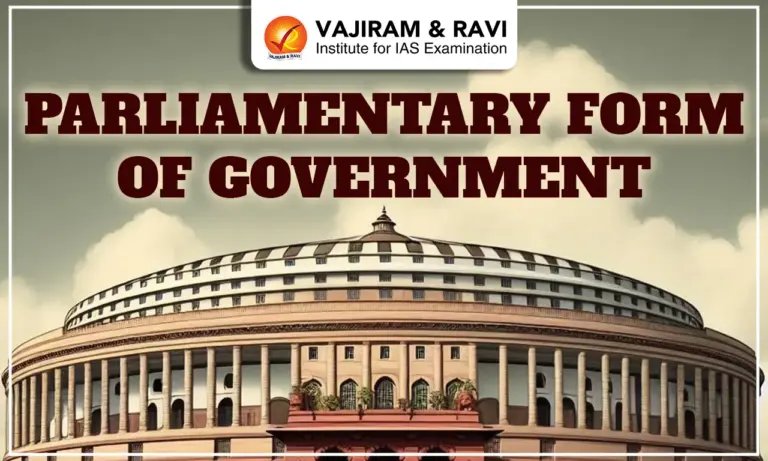
A Parliamentary Form of Government is a form of democracy in which the political party that wins the most seats in a national election forms the ruling government. In this system, the executive is drawn from the legislature and is accountable to it. India follows a parliamentary system similar to that of the United Kingdom.
In a parliamentary system, there is a close relationship between the executive and legislative branches, with the executive being dependent on the confidence of the legislature. This arrangement ensures greater accountability and makes the Parliament the central institution of governance.
Parliamentary Form of Government History
Since ancient times, councils of headmen, whose decisions were guided by village elders, existed in tribal societies. These early consultative bodies gradually evolved into modern parliamentary institutions. In 1188, King Alfonso IX of León (Spain) convened the Cortes of León, considered one of Europe’s first parliaments. A proto-parliamentary system also emerged during the Dutch Revolt (1581), when the States-General assumed power from King Philip II of Spain. The modern parliamentary framework developed in the United Kingdom (1707-1800) and Sweden (1721-1772), gaining broader acceptance across Europe after World War I.
- Adoption in the Indian Constitution: India adopted the parliamentary system from Britain after thorough deliberations. During the Constituent Assembly debates, different models including Presidential and Parliamentary systems were discussed. The parliamentary model was preferred for its capacity to provide strong leadership while ensuring accountability to the elected legislature.
- Notable Opinions
-
- Professor K. T. Shah emphasized that parliamentary government connects the Executive, Legislature, and Judiciary effectively.
- Shri K. Hanumanthaiya argued that the parliamentary system was better suited to India’s needs than a Presidential system.
Parliamentary Form of Government Features
- Real and Nominal Executives: The President acts as the formal or nominal executive, while the Prime Minister serves as the actual (de facto) executive. In this arrangement, the President represents the State, whereas the Prime Minister runs the government’s day-to-day affairs.
- Dual Membership: The executive (Prime Minister and Council of Ministers) is drawn from the legislature (Parliament). Members of Parliament elect the Prime Minister and other cabinet ministers, linking the executive and legislative branches closely.
- Collective Responsibility: The Council of Ministers is collectively accountable to the legislature. This principle ensures that all ministers share responsibility for government policies and decisions, even if individual ministers are directly responsible for their departments.
- Secret Procedure: Cabinet discussions and deliberations are conducted in private and are not disclosed publicly, allowing for open and candid decision-making among ministers.
- Leadership under the Prime Minister: The Prime Minister heads the government and exercises leadership over the Council of Ministers, guiding policy and administration.
- Majority Party Rule: The Prime Minister is usually the leader of the party that holds a majority in the lower house of the legislature, ensuring stability and alignment between the executive and legislative branches.
- Bicameral Legislature: Most parliamentary democracies have a bicameral legislature, consisting of two chambers, typically an upper house and a lower house, which provide checks and balances on lawmaking.
- Political Homogeneity: Members of the Council of Ministers usually share similar political ideologies, as they belong to the same party. In coalition governments, ministers are bound by coalition agreements to maintain unity.
- No Fixed Term: The government’s tenure depends on maintaining the confidence of the lower house. If a motion of no-confidence succeeds, the Council of Ministers must resign, triggering elections and the formation of a new government.




Parliamentary Form of Government Constitutional Provision
The Indian Constitution contains specific provisions that establish and support the parliamentary system of governance at both the central and state levels. The following table summarizes the key articles, their scope, and the way they define the roles, responsibilities, and accountability of the executive in relation to the legislature.
| Parliamentary Form of Government Constitutional Provision | ||||
|
Article |
Level |
Provision |
Key Features |
Accountability |
|
74 |
Central |
Council of Ministers to aid and advise the President |
President acts on advice of the Cabinet headed by PM; advice can be reconsidered but must be adopted |
Not subject to judicial review |
|
75 |
Central |
Appointment and responsibility of the Council of Ministers |
President appoints PM; PM recommends other ministers; ministers hold office during President’s pleasure |
Council of Ministers is collectively responsible to Lok Sabha |
|
163 |
State |
State Council of Ministers to aid and advise the Governor |
Governor acts on advice of Council headed by CM; discretionary powers in certain matters |
Not subject to judicial review |
|
164 |
State |
Appointment and responsibility of State Ministers |
Governor appoints CM; CM recommends other ministers; ministers hold office during Governor’s pleasure |
Council of Ministers is collectively responsible to State Legislative Assembly |
Parliamentary Form of Government Advantages
The Parliamentary Form of Government Advantages that contribute to effective governance and political stability. Its structure ensures cooperation between branches, accountability of the executive, prevention of despotism, and broad representation of diverse interests. The key merits are summarized below.
| Parliamentary Form of Government Advantages | |
|
Merit |
Description |
|
Cooperation Between Legislative and Executive Branches |
The parliamentary system fosters close coordination between the legislature and the executive, ensuring smooth policy-making and implementation. |
|
Responsible Government |
Ministers are accountable to Parliament, and their actions are scrutinized through tools such as question periods, debates, adjournment motions, and no-confidence motions. |
|
Prevents Despotism |
Executive power is vested in a council of ministers rather than a single individual, decentralizing authority and reducing the risk of authoritarianism. |
|
Wide Representation |
The council of ministers represents diverse regions, communities, and interests, enabling the government to reflect the country’s varied demographic and cultural composition. |
Parliamentary Form of Government Disadvantages
While the Parliamentary Form of Government has several advantages, it is not without shortcomings. Certain structural and political factors can lead to instability, inefficiency, and limited accountability. The key demerits are summarized below.
| Parliamentary Form of Government Disadvantages | |
|
Demerit |
Description |
|
No Separation of Powers |
When the ruling party has a strong majority, the legislature may struggle to check the executive. Anti-defection laws further restrict MPs from voting independently, reducing legislative oversight. |
|
Unqualified Lawmakers |
Legislators often aim to join the executive rather than focus on lawmaking, resulting in a lack of expertise in drafting effective laws. |
|
Instability |
Governments depend on maintaining a parliamentary majority. Coalition governments can be short-lived and unstable, forcing the administration to prioritize staying in power over public welfare. |
|
Ministers |
Ministers are typically chosen from the ruling party, limiting the inclusion of subject-matter experts in governance. |
|
Failure to Make Quick Decisions |
The absence of fixed tenure can delay significant long-term policy decisions, as the Council of Ministers often prioritizes political considerations. |
|
Party Politics |
Parliamentary systems can accentuate party interests over national concerns, leading to partisan decision-making. |
|
Bureaucratic Control |
Civil servants wield significant influence over ministers and policy, yet they are not directly accountable to the legislature. |
Parliamentary Form of Government vs Presidential Form of Government
The Parliamentary Form of Government and Presidential Form of Government are two prominent forms of democratic governance. While both aim to uphold democracy, they differ significantly in structure, powers, and functioning. The table below highlights the key Differences Between the Parliamentary Form of Government and the Presidential Form of Government in India.
| Parliamentary Form of Government vs Presidential Form of Government | ||
|
Feature |
Parliamentary Form of Government |
Presidential Form of Government |
|
Head of State |
President (formal executive) |
President (both head of state and government) |
|
Head of Government |
Prime Minister (real executive) |
President |
|
Executive-Legislature Relationship |
Executive is drawn from the legislature and is accountable to it |
Executive and legislature are separate; President is not responsible to legislature |
|
Collective Responsibility |
Council of Ministers is collectively responsible to the legislature |
No concept of collective responsibility; President acts independently |
|
Tenure |
Depends on parliamentary confidence; no fixed term for government |
Fixed tenure for the President and government officials |
|
Decision-Making |
Cabinet decisions are made collectively |
President can make independent decisions |
|
Stability |
Can be unstable if no clear parliamentary majority |
Generally more stable due to fixed tenure |
|
Political Homogeneity |
Ministers usually belong to the majority party or coalition |
Cabinet may include members from different political affiliations if allowed |
|
Removal of Executive |
By parliamentary vote of no-confidence |
Impeachment through constitutional procedure |
|
Role of Legislature |
Strong oversight and accountability of executive |
Legislature and executive function independently |
| Also Check Other Posts | |
| Important Articles of Indian Constitution | 9th Schedule |
| Schedules of Indian Constitution | Anti Defection Law |
| 5th Schedule | Preamble of the Indian Constitution |
| 6th Schedule | |

 Last updated on March, 2026
→ UPSC Final Result 2025 is now out.
→ UPSC has released UPSC Toppers List 2025 with the Civil Services final result on its official website.
→ Anuj Agnihotri secured AIR 1 in the UPSC Civil Services Examination 2025.
→ UPSC Marksheet 2025 is now out.
→ UPSC Notification 2026 & UPSC IFoS Notification 2026 is now out on the official website at upsconline.nic.in.
→ UPSC Calendar 2026 has been released.
→ Check out the latest UPSC Syllabus 2026 here.
→ UPSC Prelims 2026 will be conducted on 24th May, 2026 & UPSC Mains 2026 will be conducted on 21st August 2026.
→ The UPSC Selection Process is of 3 stages-Prelims, Mains and Interview.
→ Prepare effectively with Vajiram & Ravi’s UPSC Prelims Test Series 2026 featuring full-length mock tests, detailed solutions, and performance analysis.
→ Enroll in Vajiram & Ravi’s UPSC Mains Test Series 2026 for structured answer writing practice, expert evaluation, and exam-oriented feedback.
→ Join Vajiram & Ravi’s Best UPSC Mentorship Program for personalized guidance, strategy planning, and one-to-one support from experienced mentors.
→ Shakti Dubey secures AIR 1 in UPSC CSE Exam 2024.
→ Also check Best UPSC Coaching in India
Parliamentary Form of Government FAQs
Q1. Which is the best definition of a parliamentary form of government?+
Q2. Which country is a parliamentary form of government?+
Q3. What is the difference between parliamentary and presidential government?+
Q4. Why is India a parliamentary form of government?+
Q5. What are the two types of parliamentary form of government?+
Tags: parliamentary form of government