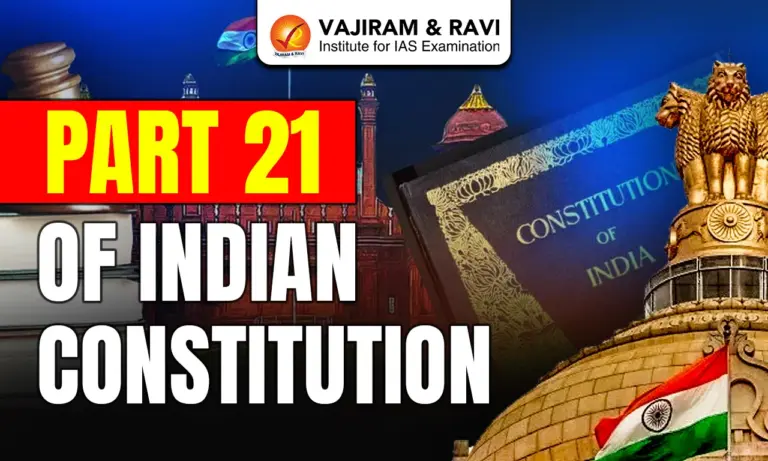
Part XXI of the Indian Constitution is titled “Temporary, Transitional and Special Provisions.” It covers Articles 369 to 392 and deals with unique arrangements made for certain States and transitional situations after the Constitution came into force. This Part was designed to address regional aspirations, protect tribal customs, manage disturbed law and order conditions, and ensure balanced development of backward regions. Many provisions under Part 21 of Indian Constitution were added later through constitutional amendments, especially Articles 371 to 371J, to respond to state reorganisation and specific regional needs.
Articles under Part 21 of Indian Constitution
Part 21 of Indian Constitution contains Articles 369 to 392 covering temporary, transitional and special arrangements for States and governance matters.
- Article 369: It granted Parliament temporary authority to legislate on certain State List subjects as if they were in the Concurrent List, ensuring administrative continuity during the early constitutional phase.
- Article 370 (Omitted): It provided temporary provisions for the State of Jammu and Kashmir, granting it special constitutional arrangements within the Union framework.
- Article 371: It contains special provisions for Maharashtra and Gujarat, empowering the President to assign special responsibilities to Governors for balanced regional development.
- Article 371A: It grants special protection to Nagaland regarding religious and social practices, customary law, land ownership, and administration of justice based on Naga traditions.
- Article 371B: It empowers the President to create a committee of the Assam Legislative Assembly consisting of members elected from Tribal Areas.
- Article 371C: It provides for a committee of the Manipur Legislative Assembly from Hill Areas and gives the Governor special responsibility, including annual reporting to the President.
- Article 371D: It ensures equitable opportunities in public employment and education in Andhra Pradesh and later extended to Telangana in 2014.
- Article 371E: It enables Parliament to establish a Central University in Andhra Pradesh to promote higher education development.
- Article 371F: Inserted by the 36th Amendment Act 1975, it lays down special provisions for Sikkim, including Assembly strength and representation in the Lok Sabha.
- Article 371G: It protects Mizoram’s religious practices, customary law, land ownership, and requires State Assembly consent for related Parliamentary laws.
- Article 371H: It gives the Governor of Arunachal Pradesh special responsibility for law and order and fixes Assembly strength at not less than 30 members.
- Article 371-I: It specifies that the Goa Legislative Assembly shall consist of not less than 30 members.
- Article 371J: It empowers the President to assign special responsibility to the Governor of Karnataka for Hyderabad-Karnataka region development and reservations.
- Article 372: It continues existing laws in force after commencement of the Constitution, subject to adaptation and modification.
- Article 372A: It authorises the President to adapt laws for bringing them in conformity with constitutional provisions.
- Article 373: It empowers the President to make orders regarding persons under preventive detention in certain transitional cases.
- Article 374: It deals with Judges of the Federal Court and proceedings pending before the Federal Court or His Majesty in Council.
- Article 375: It ensures courts, authorities and officers continue functioning subject to constitutional provisions.
- Article 376: It contains provisions relating to Judges of High Courts during the transition period.
- Article 377: It provides transitional arrangements regarding the Comptroller and Auditor-General of India.
- Article 378: It lays down provisions relating to Public Service Commissions during the initial constitutional phase.
- Article 378A: It makes a special provision regarding the duration of the Andhra Pradesh Legislative Assembly.
- Articles 379 to 391 (Omitted): These articles earlier dealt with provisional Parliament, Governors, Legislatures, population determination, financial matters and amendments to Schedules, but are now omitted.
- Article 392: It empowers the President to remove difficulties in implementing the Constitution during the transitional period.
Part 21 of Indian Constitution Amendments
Many Articles in Part 21 of Indian Constitution were introduced later to address state-specific needs and regional aspirations.
- 13th Constitutional Amendment Act 1962: The 13th Amendment inserted Article 371A, granting special autonomy to Nagaland after the 16-Point Agreement. It protected Naga religious practices, customary law, land ownership and required State Assembly consent before Parliament could apply such laws.
- 32nd Constitutional Amendment Act 1973: The 32nd Amendment inserted Articles 371D and 371E for Andhra Pradesh. It empowered the President to ensure equitable public employment and education through local cadres and administrative tribunals to reduce regional imbalances.
- 36th Constitutional Amendment Act 1975: The 36th Amendment integrated Sikkim as the 22nd State of India and inserted Article 371F. It preserved Sikkim’s existing laws, Assembly structure and representation in Parliament while ensuring constitutional continuity.
- 87th Constitutional Amendment Act 2003: The 87th Amendment adjusted population figures based on the 2001 Census for delimitation, indirectly affecting representation structures in States enjoying special provisions under Articles 371A to 371J.
- 98th Constitutional Amendment Act 2012: The 98th Amendment inserted Article 371J for the Hyderabad-Karnataka region, providing special development boards, local reservations in education and public employment to address historical backwardness.
- Extension of Article 371D in 2014: Through the Andhra Pradesh Reorganisation Act 2014, Article 371D was extended to Telangana to ensure equitable public employment and educational opportunities.
- Abrogation of Article 370 in 2019: It granted special autonomous status to Jammu and Kashmir and was effectively repealed in August 2019.





Case Laws related to Part 21 of Indian Constitution
Judicial interpretations clarified scope and implementation of special and transitional constitutional provisions under Part 21 of Indian Constitution.
- Rameshwar Prasad v. Union of India (2006): The Supreme Court held that constitutional provisions granting special status cannot be misused arbitrarily. It emphasized federal balance, constitutional morality and ruled that executive actions must strictly comply with constitutional safeguards, including Article 371 frameworks.
- Madhaorao Phalke v. State of Madhya Bharat (1960): The court examined whether “Kalambandis” (rules issued by rulers of former princely states) qualify as existing law under Article 372.
- Regional Provident Fund Commissioner v. Shillong City Bus Syndicate (1995): While concerning Article 371A, the Court recognized Nagaland’s autonomy over customary practices and land laws. It reinforced that central legislation cannot override protected subjects without constitutional compliance and State consent.
- A.K. Gopalan v. State of Madras (1950): While primarily challenging the Preventive Detention Act, 1950 (enacted shortly after the Constitution), this landmark case established the framework for evaluating preventative detention laws that fell under the purview of Article 373’s transitional phase.
- P. Sambamurthy v. State of Andhra Pradesh (1987): The Supreme Court struck down provisions under Article 371D that limited judicial review by placing tribunal decisions beyond High Court scrutiny. It affirmed that judicial review is part of the basic structure doctrine.
- Indira Nehru Gandhi v. Raj Narain (1975): Although unrelated directly to Article 371, this landmark case reinforced that constitutional amendments and special provisions must conform to democratic principles and the basic structure, indirectly safeguarding federal special-status arrangements.

 Last updated on March, 2026
→ UPSC Final Result 2025 is now out.
→ UPSC has released UPSC Toppers List 2025 with the Civil Services final result on its official website.
→ Anuj Agnihotri secured AIR 1 in the UPSC Civil Services Examination 2025.
→ UPSC Marksheet 2025 is now out.
→ UPSC Notification 2026 & UPSC IFoS Notification 2026 is now out on the official website at upsconline.nic.in.
→ UPSC Calendar 2026 has been released.
→ Check out the latest UPSC Syllabus 2026 here.
→ UPSC Prelims 2026 will be conducted on 24th May, 2026 & UPSC Mains 2026 will be conducted on 21st August 2026.
→ The UPSC Selection Process is of 3 stages-Prelims, Mains and Interview.
→ Prepare effectively with Vajiram & Ravi’s UPSC Prelims Test Series 2026 featuring full-length mock tests, detailed solutions, and performance analysis.
→ Enroll in Vajiram & Ravi’s UPSC Mains Test Series 2026 for structured answer writing practice, expert evaluation, and exam-oriented feedback.
→ Join Vajiram & Ravi’s Best UPSC Mentorship Program for personalized guidance, strategy planning, and one-to-one support from experienced mentors.
→ Shakti Dubey secures AIR 1 in UPSC CSE Exam 2024.
→ Also check Best UPSC Coaching in India
Part 21 of Indian Constitution FAQs
Q1. What is Part XXI of the Indian Constitution?+
Q2. Why was Part XXI included in the Constitution?+
Q3. Which States are covered under special provisions of Part 21 of Indian Constitution?+
Q4. Is Article 370 still part of Part 21 of Indian Constitution?+
Q5. Can Parliament amend provisions under Part 21 of Indian Constitution?+
Tags: constitution part 21 of indian constitution