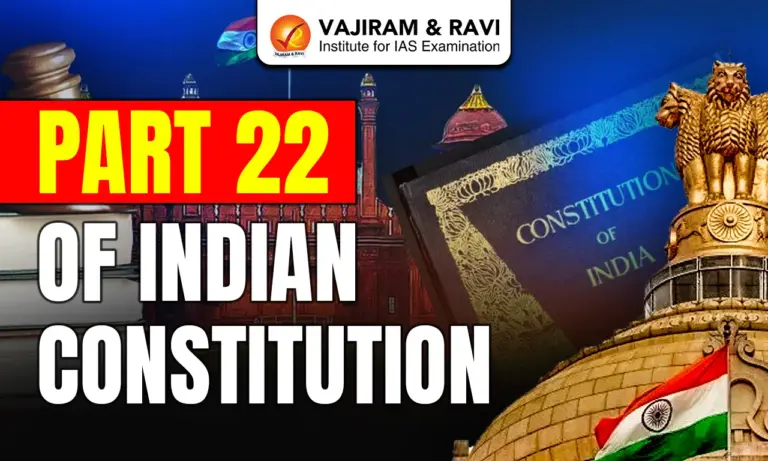
Part 22 of the Constitution of India forms the concluding segment of the Constitution. It contains Articles 393 to 395 and deals with the Short Title, Commencement, Authoritative Text in Hindi and Repeals. Though brief in length, the Part 22 of Indian Constitution is constitutionally significant because it formally names the Constitution, fixes the date on which it came into force, provides for the authoritative Hindi version and repeals earlier British laws. These provisions ensure constitutional continuity, legal clarity and the complete sovereignty of the Republic of India after independence.
Article 393 of Part 22 of Indian Constitution
Article 393 of the Part 22 of Indian Constitution declares the official name of the Constitution in clear and simple terms.
- Article 393 states that “This Constitution may be called the Constitution of India.”
- It establishes the formal legal name of the document adopted on 26 November 1949.
- Draft Article 313A, introduced on 17 October 1949, contained this declaration.
- This provision ensures uniform legal reference in courts, legislation and official documents, confirming the Constitution as the supreme governing instrument of India.
Article 394 of Part 22 of Indian Constitution
Article 394 of the Part 22 of Indian Constitution specifies when the Constitution came into force and lists provisions effective immediately.
- Article 394 provides that this article and Articles 5, 6, 7, 8, 9, 60, 324, 366, 367, 379, 380, 388, 391, 392 and 393 came into force at once.
- The remaining provisions became effective on 26 January 1950, referred to as the commencement of the Constitution.
- Draft Article 314 was debated on 17 October 1949. The date 26 January 1950 was chosen to commemorate the Declaration of Purna Swaraj of 26 January 1930, symbolizing complete independence from British rule.





Article 394A of Part 22 of Indian Constitution
Article 394A of the Part 22 of Indian Constitution establishes the authoritative Hindi version of the Constitution.
- It was inserted by the Constitution (Fifty-eighth Amendment) Act, 1987.
- Article 394A(1) (a): It empowers the President to publish the Hindi translation of the Constitution signed by members of the Constituent Assembly. It must conform to language, style and terminology of authoritative Hindi texts of Central Acts before publication.
- Article 394A (1)(b): The President also publishes the Hindi translation of every constitutional amendment enacted in English, ensuring that all future changes to the Constitution are officially available in authoritative Hindi text.
- Article 394A (2)– It states that the Hindi translation shall carry the same meaning as the original English text. If any difficulty arises in interpretation, the President may direct suitable revision. This ensures uniform constitutional understanding across languages and avoids legal ambiguity between versions.
- Article 394A (3) (a)– It declares that the Hindi translation published under this Article shall be deemed authoritative for all purposes in Hindi. This provision strengthens linguistic accessibility and gives the Hindi text equal constitutional recognition alongside the English version.
Article 395 of Part 22 of Indian Constitution
Article 395 of the Part 22 of Indian Constitution formally repeals British enactments governing India before the Constitution.
- Article 395 repeals the Indian Independence Act, 1947 and the Government of India Act, 1935 along with all enactments amending or supplementing the latter Act.
- However, it excludes the Abolition of Privy Council Jurisdiction Act, 1949.
- Draft Article 315 was discussed and members emphasized that the Constitution must stand as an independent legal authority and that earlier British legislation should cease upon its enforcement, affirming India’s full constitutional sovereignty.
Part 22 of Indian Constitution related Amendments
Certain constitutional changes have affected provisions under Part 22 of Indian Constitution:
- Constitution (Fifty-eighth Amendment) Act, 1987: This amendment inserted Article 394A into Part XXII. It authorized the President to publish the authoritative Hindi text of the Constitution and its amendments. The amendment ensured linguistic parity and strengthened accessibility of constitutional law in Hindi while maintaining consistency with the English version.
Case Laws related to Part 22 of Indian Constitution
Judicial decisions have clarified commencement and repeal provisions connected to Part 22 of Indian Constitution:
- Keshavan Madhava Menon v. State of Bombay (1951): This case examined the effect of commencement and continuation of pre-Constitution laws. The Court held that laws existing before 26 January 1950 remain valid unless inconsistent with the Constitution. It reinforced constitutional supremacy after repeal provisions under Article 395.
- State of Uttar Pradesh v. Raj Narain (1975): This judgment referred to commencement and interpretative provisions while discussing constitutional authority. The case highlighted the importance of constitutional structure and effective enforcement from the date fixed under Article 394, emphasizing the supremacy of constitutional governance.

 Last updated on March, 2026
→ UPSC Final Result 2025 is now out.
→ UPSC has released UPSC Toppers List 2025 with the Civil Services final result on its official website.
→ Anuj Agnihotri secured AIR 1 in the UPSC Civil Services Examination 2025.
→ UPSC Marksheet 2025 is now out.
→ UPSC Notification 2026 & UPSC IFoS Notification 2026 is now out on the official website at upsconline.nic.in.
→ UPSC Calendar 2026 has been released.
→ Check out the latest UPSC Syllabus 2026 here.
→ UPSC Prelims 2026 will be conducted on 24th May, 2026 & UPSC Mains 2026 will be conducted on 21st August 2026.
→ The UPSC Selection Process is of 3 stages-Prelims, Mains and Interview.
→ Prepare effectively with Vajiram & Ravi’s UPSC Prelims Test Series 2026 featuring full-length mock tests, detailed solutions, and performance analysis.
→ Enroll in Vajiram & Ravi’s UPSC Mains Test Series 2026 for structured answer writing practice, expert evaluation, and exam-oriented feedback.
→ Join Vajiram & Ravi’s Best UPSC Mentorship Program for personalized guidance, strategy planning, and one-to-one support from experienced mentors.
→ Shakti Dubey secures AIR 1 in UPSC CSE Exam 2024.
→ Also check Best UPSC Coaching in India
Part 22 of Indian Constitution FAQs
Q1. What does Part 22 of Indian Constitution deal with?+
Q2. What is stated in Article 393 of the Part 22 of Indian Constitution?+
Q3. When did the Constitution of India come into force under Article 394 of Part 22 of Indian Constitution?+
Q4. Why was Article 394A added to the Constitution?+
Q5. Which Acts were repealed by Article 395 of Part 22 of Indian Constitution?+
Tags: constitution part 22 of indian constitution