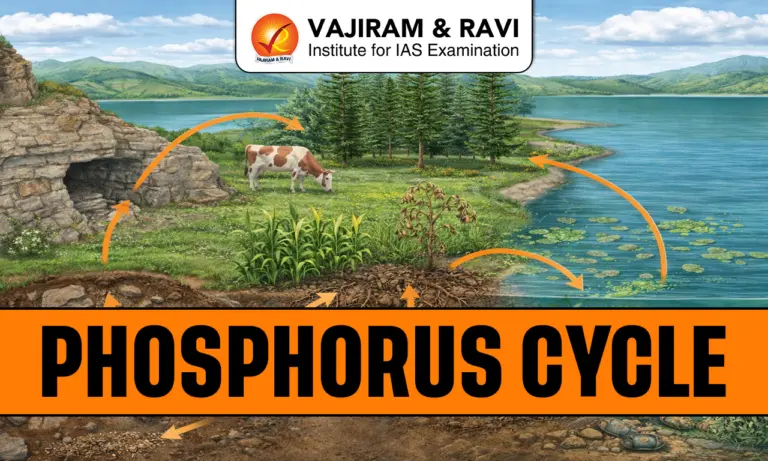
The Phosphorus Cycle is the natural movement of phosphorus through the environment. It is an essential nutrient needed by all living organisms for growth and development. In this cycle, phosphorus circulates mainly through rocks, soil, water, and living organisms, helping maintain the balance of ecosystems.
About Phosphorus Cycle
- The phosphorus Cycle is a type of sedimentary biogeochemical cycle that explains how phosphorus moves through the lithosphere (land), hydrosphere (water), and biosphere (living organisms). Phosphorus is an important mineral found mainly in phosphate rocks, and it enters the cycle through processes like weathering and erosion.
- Over millions of years, movements of Earth’s crust (tectonic uplift) bring phosphorus-rich rocks from the ocean floor to the surface, making them available again.
- The global phosphorus cycle mainly involves four key processes:
- Weathering of rocks: Phosphorus-containing rocks (such as apatite) break down due to physical, chemical, and biological weathering, releasing phosphorus into soil and water.
- Movement through water: The released phosphorus is carried to lakes, rivers, and oceans through surface runoff and underground flow.
- Use by living organisms: Plants absorb phosphorus from the soil, and animals get it by eating plants or other animals.
- Sedimentation: In water bodies, phosphorus settles down as sediments and gets buried over time, eventually forming new rocks.
- This cycle is slow and does not involve the atmosphere, making phosphorus a limited but very important nutrient in ecosystems.
Also Read: Biogeochemical Cycles
Phosphorus Cycle Steps Involved
The phosphorus cycle can be understood in four simple stages:
- Weathering
-
- Phosphorus is mainly found in rocks, where it is combined with other minerals. Over time, these rocks break down due to rain, temperature changes and the action of microbes. This process is called weathering.
- Rainwater and acids produced by microorganisms help release phosphorus from rocks into the soil. Microbes like bacteria and fungi (such as Bacillus, Pseudomonas, Aspergillus, and Penicillium) play an important role in making phosphorus available in the soil.
- Some of this phosphorus also gets dissolved in water and is carried to rivers, lakes, and oceans. Natural events like volcanic eruptions can also release phosphorus from the Earth’s crust.
- Absorption by Plants
-
- Plants absorb phosphorus from the soil through their roots. This mineral is essential for plant growth, helping in the formation of roots, seeds, and energy transfer.
- Sometimes, the amount of phosphorus in the soil is low, so farmers add fertilizers to improve soil fertility. In water bodies, aquatic plants absorb phosphorus from the water.
- Certain helpful bacteria in the soil also assist plants by converting phosphorus into a form that plants can easily use.
- Absorption by Animals
-
- Animals get phosphorus by eating plants or other animals. As phosphorus moves through the food chain, it becomes part of important substances in the body.
- It helps in forming bones and teeth and is also a key part of molecules like DNA and energy compounds. As animals consume food, phosphorus passes from one organism to another.
- Decomposition
-
- When plants and animals die, decomposers like bacteria and fungi break down their bodies. This process returns phosphorus back to the soil or water in a usable form.
- This conversion of organic phosphorus into inorganic form is called mineralization. During rainfall, some phosphorus may be washed into water bodies and eventually reach the oceans.
- In oceans, phosphorus settles at the bottom as sediments. Over a long time, these sediments form rocks, and through geological processes, they may rise again to the surface continuing the cycle.





Phosphorus Cycle Significance
- Maintains nutrient balance and ecosystem stability: The phosphorus cycle ensures a continuous supply of phosphorus in soil and water, helping maintain balance in both terrestrial and aquatic ecosystems.
- Supports growth and life processes: Phosphorus is essential for plant growth, root development, and food production. It is also a key component of DNA, RNA, and ATP, which are necessary for energy transfer, growth, and reproduction.
- Helps in formation of bones and tissues: It plays an important role in forming strong bones and teeth and is needed for the development of body tissues in living organisms.
- Recycles nutrients: Through decomposition, phosphorus from dead plants and animals is returned to the soil and water, ensuring it can be reused by other organisms.

 Last updated on April, 2026
→ UPSC Final Result 2025 is now out.
→ UPSC has released UPSC Toppers List 2025 with the Civil Services final result on its official website.
→ Anuj Agnihotri secured AIR 1 in the UPSC Civil Services Examination 2025.
→ UPSC Marksheet 2025 is now out.
→ UPSC Notification 2026 & UPSC IFoS Notification 2026 is now out on the official website at upsconline.nic.in.
→ UPSC Calendar 2026 has been released.
→ Check out the latest UPSC Syllabus 2026 here.
→ UPSC Prelims 2026 will be conducted on 24th May, 2026 & UPSC Mains 2026 will be conducted on 21st August 2026.
→ The UPSC Selection Process is of 3 stages-Prelims, Mains and Interview.
→ Prepare effectively with Vajiram & Ravi’s UPSC Prelims Test Series 2026 featuring full-length mock tests, detailed solutions, and performance analysis.
→ Enroll in Vajiram & Ravi’s UPSC Mains Test Series 2026 for structured answer writing practice, expert evaluation, and exam-oriented feedback.
→ Join Vajiram & Ravi’s Best UPSC Mentorship Program for personalized guidance, strategy planning, and one-to-one support from experienced mentors.
→ Shakti Dubey secures AIR 1 in UPSC CSE Exam 2024.
→ Also check Best UPSC Coaching in India
Phosphorus Cycle FAQs
Q1. What is the Phosphorus Cycle?+
Q2. Why is phosphorus important?+
Q3. Where is phosphorus mainly found?+
Q4. How does phosphorus enter the cycle?+
Q5. How do plants and animals get phosphorus?+
Tags: geography geography notes Phosphorus Cycle