About Piezoelectricity
- The term “piezoelectric” originates from the Greek words “piezein,” meaning ‘to squeeze’, and “elektron”, for amber – a material known for its association with static electricity.
- Piezoelectricity is a remarkable phenomenon whereby some materials – including quartz, ceramics such as lead zirconate titanate (PZT), and even certain biological substances like bone and the tendons – can generate an electric charge in response to mechanical stress.
- This property is the result of their unusual crystal structures.
- Usually, the charges on atoms in the molecules that make them up are symmetric on two sides of an axis.
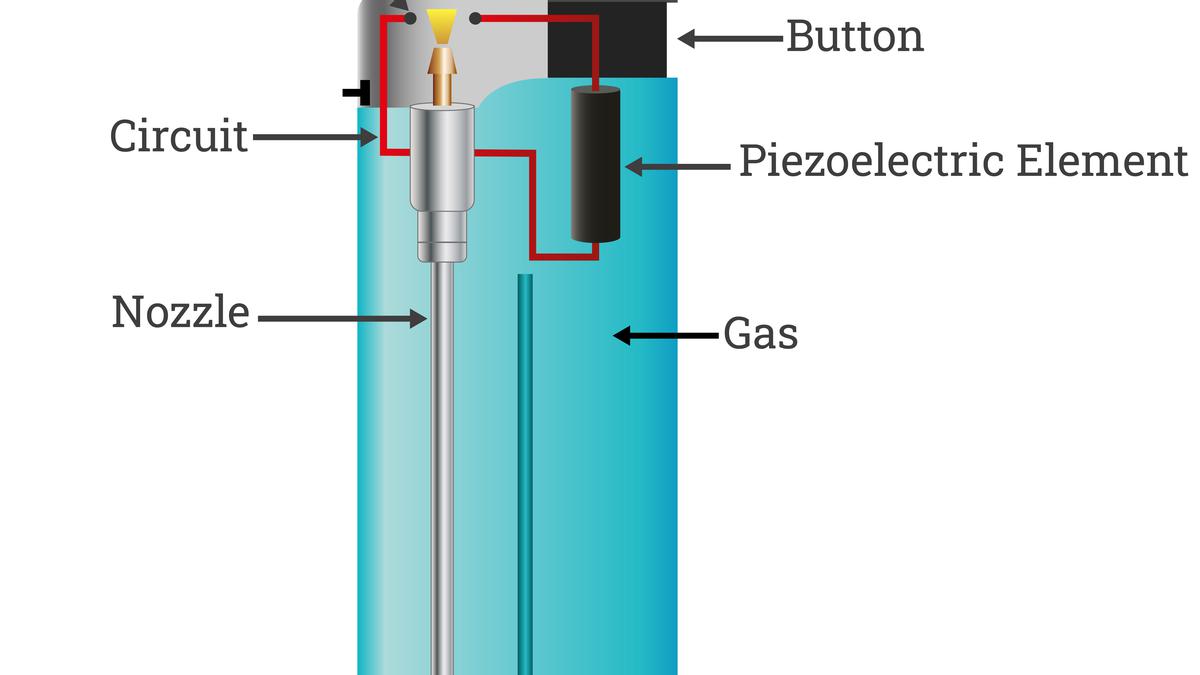
- When some stress is applied, the molecule becomes distorted and the asymmetry of charges gives rise to a small electric current.
- Some materials also display an inverse piezoelectric effect, where the application of an electric current induces a mechanical deformation.
- Applications
- Both direct and inverse piezoelectric materials are widely used in pressure sensors, accelerometers, and acoustic devices – where their ability to convert mechanical signals into electrical signals is crucial.
- It is also used in quartz watches.
- Piezoelectric transducers are common in ultrasonic applications, such as intrusion detectors and alarms.
- Piezoelectric devices are employed at AF (audio frequencies) as pickups, microphones, earphones, beepers, and buzzers.
- In wireless applications, piezoelectricity makes it possible to use crystals and ceramics as oscillators that generate predictable and stable signals at RF (radio frequencies).
Q1) What is Quartz?
It is a widely distributed mineral of many varieties that consists primarily of silica, or silicon dioxide. It is a crystal that develops positive and negative charges on alternate prism edges when it is subjected to pressure or tension. The charges are proportional to the change in pressure.
Source: Piezoelectricity: Why quartz ticks


 Last updated on Oct, 2026
→ UPSC 2027 Notification will be released on 13 January 2027 at upsconline.nic.in.
→ Check Nobel Prize 2026 Winners List here.
→ Download PIB PRiSM Monthly Magazine 2026 here.
→ Check UPSC Monthly Current Affairs Magazine The Recitals here.
→ Check out the latest UPSC Syllabus here.
→ Download UPSC Model Answers for Mains 2026
→ UPSC Mains Question Paper 2026 is out now for Essay & GS Paper 1, 2, 3 & 4.
→ UPSC Calendar 2027 has been released.
→ Enroll in Vajiram & Ravi’s UPSC Mains Test Series 2027 for structured answer writing practice, expert evaluation, and exam-oriented feedback.
→ Join Vajiram & Ravi’s UPSC Mentorship Program 2027 for personalized guidance, strategy planning, and one-to-one support from experienced mentors.
→ Go through the UPSC Mains Previous Year Papers to enhance your preparation.
→ UPSC has released UPSC Toppers List 2025 with the Civil Services final result on its official website.
→ Also check Best UPSC Coaching in India