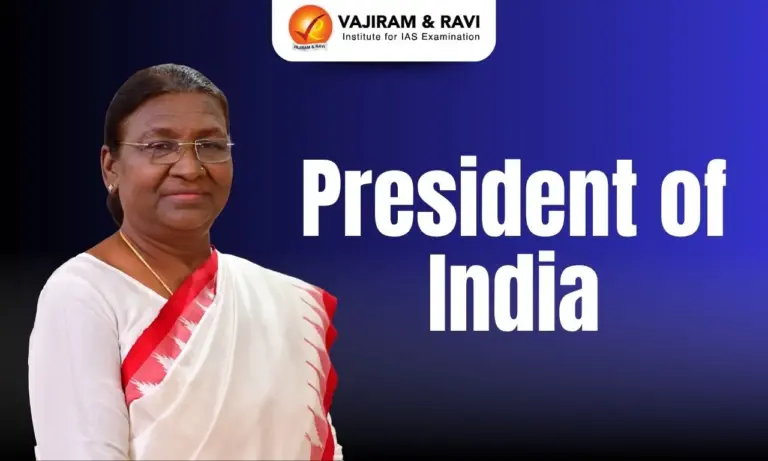
List of President of India from 1950 to 2026: Draupadi Murmu serves as the 15th President of India, marking a historic moment as the first tribal woman to hold this esteemed position. Her candidacy received substantial backing from various political groups, particularly the National Democratic Alliance (NDA). From the beginning, her victory over Yashwant Sinha, the opposition-backed candidate, was widely anticipated.
President of India
The President of India is the constitutional head of the country and symbolises the unity and integrity of the nation. Article 52 of the Indian Constitution states that “there shall be a President of India.” While the President is the head of state, their role is largely ceremonial, with executive powers exercised by the Prime Minister and the Council of Ministers. The President acts on the advice of the Prime Minister and performs functions like assenting to bills, appointing key officials, and representing India in international agreements.
Since India’s independence, several leaders have served as the President of India. The first President, Dr Rajendra Prasad, played a vital role in shaping the office’s legacy. The current President of India is Droupadi Murmu, who made history by being the first tribal woman to hold the position. She succeeded Shri Ram Nath Kovind after his term ended.
List of Presidents of India from 1950 to 2026
Dr. Rajendra Prasad was the first President of India, serving from 1950 to 1962, while Droupadi Murmu is the current President, having assumed office in 2022. Below is the List of all 15 Presidents of India from 1950 to 2026:
| All Presidents of India from 1950 to 2026 | |||
|
Name |
Starting date |
Ending date |
Profiles |
|
Dr. Rajendra Prasad |
January 26th, 1950 |
May 13th, 1962 |
He was the first President of republic of India. |
|
Dr. Sarvepalli Radhakrishnan |
May 13th, 1962 |
May 13th, 1967 |
He was the 2nd President of India. |
|
Dr.the Zakir Hussain |
May 13th, 1967 |
May 3rd, 1969 |
He was the 3rd President of India. |
|
Varahagiri Venkata Giri |
May 3rd, 1969 |
July 20th, 1969 |
He was acting President because of Hussain’s death. |
|
Mohammad Hidayatullah |
July 20th, 1969 |
August 24th, 1969 |
He was acting President till Giri’s presidency. |
|
Varahagiri Venkata Giri |
August 24th, 1969 |
August 24th, 1974 |
He was the 4th President of India. |
|
Fakhruddin Ali Ahmed |
August 24th, 1974 |
February 11th, 1977 |
He was the 5th President of India. |
|
Basappa Danappa Jatti |
February 11th, 1977 |
July 25th, 1977 |
He was a chief minister of the Mysore but got elected as President, After the death of Ahmed. |
|
Neelam Sanjiva Reddy |
July 25th, 1977 |
July 25th, 1982 |
Reddy was the 6th President of India unopposed. |
|
Giani Zail Singh |
July 25th, 1982 |
July 25th, 1987 |
He was the 7th President of India and was also a member of the Congress party. |
|
Ramaswamy Venkataraman |
July 25th, 1987 |
July 25th, 1992 |
He was the 8th President of India. He was also a lawyer and a professional politician. |
|
Shankar Dayal Sharma |
July 25th, 1992 |
July 25th, 1997 |
He was the 9th President of India, and he was also a member of the National Congress party of India. |
|
Kocheril Raman Narayanan |
July 25th, 1997 |
July 25th, 2002 |
He was the 10th President of India and the best diplomat in India. |
|
Dr. A.P.J. Abdul Kalam |
July 25th, 2002 |
July 25th, 2007 |
He was the 11th President of India, and he was a great scientist. He worked in ISRO and DRDO organizations. |
|
Pratibha Patil |
July 25th, 2007 |
July 25th, 2012 |
She was the 12th President of India, and she was the first woman to be President. |
|
Pranab Mukherjee |
July 25th, 2012 |
July 25th, 2017 |
He was the 13th President of India, and he was also a senior leader of the National Congress party. |
|
Shri Ram Nath Kovind |
July 25th, 2017 |
July 21st, 2022 |
He was the 14th President of India, and he was also ex-governor Of Bihar. |
|
Droupadi Murmu |
July 21st, 2022 |
Working |
She is the 15th President of India and was a member of the Bharatiya Janata Party |





List of Presidents of India 2026
- Dr. Rajendra Prasad
- First President of India, Dr. Rajendra Prasad served two full terms and played an important role in the freedom movement.
- He also presided over the Constituent Assembly and was honoured with the Bharat Ratna in 1962 for his contributions to nation-building.
- Dr. Sarvepalli Radhakrishnan
- A renowned philosopher and academic, Dr. Radhakrishnan was Second President of India.
- His birthday is celebrated as Teacher’s Day in India, and he was awarded the Bharat Ratna in 1954.
- Dr. Zakir Husain
- The First Muslim President of India, Dr. Zakir Husain was an educationist who passed away while in office.
- He co-founded Jamia Millia Islamia University and is remembered for his commitment to modern education.
- V. V. Giri
- V.V. Giri was the only President elected as an independent candidate and had earlier served as Vice President.
- He was awarded the Bharat Ratna in 1975.
- Fakhruddin Ali Ahmed
- Fifth President of India, Fakhruddin Ali Ahmed, is remembered for declaring the Emergency under Article 352.
- He was the second Indian President to die in office, after Dr. Zakir Husain.
- Neelam Sanjeeva Reddy
- The Sixth President of India, Neelam Sanjeeva Reddy, was the youngest to assume office and the only one elected unopposed.
- He also served as the first Chief Minister of Andhra Pradesh and later as Lok Sabha Speaker.
- Giani Zail Singh
- Giani Zail Singh served as President during tough period in Indian history, including Operation Blue Star.
- He was also Chief Minister of Punjab and known for exercising the pocket veto power during his term.
- R. Venkataraman
- R. Venkataraman served as President from 1987 to 1992 and was earlier Vice President and Defence Minister of India.
- A freedom fighter, he was known for his legal insights and received global honours including the Soviet Land Prize.
- Dr. Shankar Dayal Sharma
- Before his presidency, Dr. Sharma served as Bhopal’s Chief Minister and as Vice President of India.
- He received the ‘Living Legend of Law’ award and was respected for his legal and academic contributions.
- K. R. Narayanan
- K.R. Narayanan was First Dalit President of India and a distinguished diplomat in the Indian Foreign Service.
- He was the first Indian President to vote in a general election while in office.
- Dr. A.P.J. Abdul Kalam
- Known as the “Missile Man of India,” Dr. Kalam was a scientist and the first scientist to become President.
- He played an important role in India’s 1998 nuclear tests and inspired millions through his speeches and books.
- Smt. Pratibha Patil
- Smt. Pratibha Patil was First Woman President of India and served as Governor of Rajasthan before her presidency.
- She made history by becoming the first woman head of state to fly a Sukhoi fighter jet.
- Pranab Mukherjee
- Pranab Mukherjee held key ministries and was known as the “man for all seasons” in Indian politics.
- He was awarded the Padma Vibhushan in 2008 and earned wide respect across political lines.
- Ram Nath Kovind
- Ram Nath Kovind, a lawyer and former Governor of Bihar, served as India’s 14th President from 2017.
- He focused on social justice, and during his tenure, he advocated for transparency and inclusive governance.
- Droupadi Murmu
- Droupadi Murmu became First Tribal President of India and second female President in 2022.
- A former Jharkhand Governor, she is known for her dedication to tribal welfare and grassroots leadership.
President of India Eligibility Criteria
Article 58 of the Indian Constitution provides a clear framework regarding the qualifications required for an individual to be eligible for the esteemed position of the President of India. The key qualifications are as follows:
Citizenship
The candidate must be a citizen of India. This requirement emphasizes the importance of national allegiance and ensures that the President has a clear interest in the country’s welfare.
Age Requirement
The individual must be at least 35 years of age at the time of the election. This criteria ensures that the candidate possesses the maturity and experience required for such a critical role.
Parliamentary Qualification
The candidate should be eligible for election as a member of the Lok Sabha, the lower house of the Indian Parliament. This means they must meet all the qualifications set under Article 84 of the Constitution, which includes factors such as citizenship, age, and other specified qualifications.
No Office of Profit
The candidate must not hold any office of profit under the Union Government, State Government, or any local or public authority. However, exceptions include positions such as President, Vice President, Governor of a State, or Minister for the Union or State. This provision ensures that the President remains neutral and does not have conflicts of interest arising from other official roles.
President of India Powers
- The President of India is the head of the legislature, executive, and judiciary.
- The President serves a five-year term but can resign at any time or be removed through impeachment.
- The President can continue in office beyond the five-year term until a successor takes over.
- The President is elected by an Electoral College consisting of Members of Parliament and State Legislative Assemblies.
- Members of the Electoral College use preferential voting with single transferable votes.
President of India Important Points
The President of India is the ceremonial head of the state within the parliamentary system of government. Although the President represents the nation at the national and international levels, they do not have the executive power. Instead, the real executive authority rests with the Council of Ministers, headed by the Prime Minister. The President serves as the Supreme Commander of the Indian Armed Forces.
The President is elected through an electoral college consisting of:
- Elected members from both Houses of Parliament.
- Elected members from the legislative assemblies of the states.
- Elected members from the Legislative Assemblies of Delhi and Puducherry (following the 70th Amendment Act of 1992).
- The term of office for the President is five years, with the possibility of re-election. There is no limit on the number of terms a President can serve.
In the event of a breach of the Constitution, the President can be removed from office through an impeachment process, which may be initiated in either House of Parliament.
In the absence of the President due to death, resignation, impeachment, or other reasons, the Vice President of India assumes the role of Acting President. If the position of the Vice President is also vacant, the Chief Justice of India steps in as the Acting President until a new President is elected.
President of India Facts
- Dr. Rajendra Prasad was the inaugural President of India, serving for two consecutive terms. He holds the distinction of being the longest-serving President in the country’s history.
- V.V. Giri stepped in as an interim President after the passing of Dr. Zakir Husain. He remains unique in holding the position of both President and Acting President at the same time.
- India has had three Acting Presidents, in addition to the fourteen Presidents who served full terms.
- Both Dr. Zakir Husain and Fakhruddin Ali Ahmed tragically passed away while in office, marking significant moments in India’s presidential history.
- The President of India holds a ceremonial position within the government, with executive powers vested in the Prime Minister and the Council of Ministers.
- Unlike most democracies, the President of India is elected by the members of Parliament and Legislative Assemblies, not directly by the citizens.
- In 2007, Pratibha Patil made history by becoming the first woman President of India.

 Last updated on March, 2026
→ UPSC Final Result 2025 is now out.
→ UPSC has released UPSC Toppers List 2025 with the Civil Services final result on its official website.
→ Anuj Agnihotri secured AIR 1 in the UPSC Civil Services Examination 2025.
→ UPSC Marksheet 2025 is now out.
→ UPSC Notification 2026 & UPSC IFoS Notification 2026 is now out on the official website at upsconline.nic.in.
→ UPSC Calendar 2026 has been released.
→ Check out the latest UPSC Syllabus 2026 here.
→ UPSC Prelims 2026 will be conducted on 24th May, 2026 & UPSC Mains 2026 will be conducted on 21st August 2026.
→ The UPSC Selection Process is of 3 stages-Prelims, Mains and Interview.
→ Prepare effectively with Vajiram & Ravi’s UPSC Prelims Test Series 2026 featuring full-length mock tests, detailed solutions, and performance analysis.
→ Enroll in Vajiram & Ravi’s UPSC Mains Test Series 2026 for structured answer writing practice, expert evaluation, and exam-oriented feedback.
→ Join Vajiram & Ravi’s Best UPSC Mentorship Program for personalized guidance, strategy planning, and one-to-one support from experienced mentors.
→ Shakti Dubey secures AIR 1 in UPSC CSE Exam 2024.
→ Also check Best UPSC Coaching in India
Presidents of India FAQs
Q1. Who elects the President of India?+
Q2. What is the term of the office of the President?+
Q3. Who conducts the election of President of India?+
Q4. Who was the first President of India?+
Q5. Who is the present president of India?+
Tags: president of india president of india list