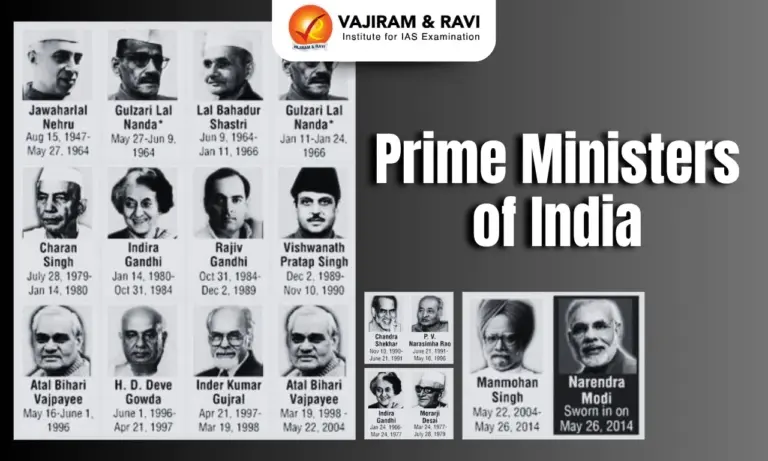
The Prime Minister of India is the head of the government and plays a crucial role in shaping the nation’s policies, governance, and international relations. They lead the Council of Ministers, make key decisions, and ensure the smooth functioning of the administration. Narendra Modi is the current Prime Minister of India, serving since 2014. He took the oath for his third term on June 9, 2024, making him the second longest-serving Prime Minister after Jawaharlal Nehru. This article provides a List of Prime Ministers of India from 1947-2026 highlighting their contributions and leadership.
Prime Ministers of India
India has seen 15 Prime Ministers since independence, each shaping the nation’s progress. Narendra Modi, currently serving his third term in 2024, began his leadership in 2014 and has introduced transformative reforms like GST, Make in India, and Swachh Bharat Abhiyan. His tenure also witnessed major decisions, including the revocation of Article 370, digital advancements, and a push for self-reliance (Atmanirbhar Bharat).
List of Prime Ministers of India from 1947-2026
Jawaharlal Nehru, India’s first Prime Minister, took office on 15th August 1947. Currently, Narendra Modi serves as India’s 15th Prime Minister. Below is a detailed List of Prime Ministers of India from 1947-2026 along with their tenure and key contributions.
| List of Prime Ministers of India from 1947-2026 | |||||
| No. | Name | Start of Term | End of Term | Duration in years and days | Party |
|
1 |
Jawaharlal Nehru (1889–1964) |
15 August 1947 |
27 May 1964 |
16 years, 286 days |
Indian National Congress |
|
2 |
Gulzarilal Nanda (1898–1998) |
27 May 1964 |
9 June 1964 |
13 days |
– |
|
3 |
Lal Bahadur Shastri (1904–1966) |
9 June 1964 |
11 January 1966 |
1 year, 216 days |
– |
|
4 |
Indira Gandhi (1917–1984) |
24 January 1966 |
24 March 1977 |
11 years, 59 days |
Indian National Congress (R) |
|
5 |
Morarji Desai (1896–1995) |
24 March 1977 |
28 July 1979 |
2 years, 126 days |
Janata Party |
|
6 |
Charan Singh (1902–1987) |
28 July 1979 |
14 January 1980 |
170 days |
Janata Party (Secular) |
|
7 |
Indira Gandhi (1917–1984) |
14 January 1980 |
31 October 1984 |
4 years, 291 days |
Indian National Congress (I) |
|
8 |
Rajiv Gandhi (1944–1991) |
31 October 1984 |
2 December 1989 |
5 years, 32 days |
Indian National Congress |
|
9 |
Vishwanath Pratap Singh (1931–2008) |
2 December 1989 |
10 November 1990 |
343 days |
Janata Dal |
|
10 |
Chandra Shekhar (1927–2007) |
10 November 1990 |
21 June 1991 |
223 days |
Samajwadi Janata Party (Rashtriya) |
|
11 |
P. V. Narasimha Rao (1921–2004) |
21 June 1991 |
16 May 1996 |
4 years, 330 days |
Indian National Congress (I) |
|
12 |
Atal Bihari Vajpayee (1924–2018) |
16 May 1996 |
1 June 1996 |
16 days |
Bharatiya Janata Party |
|
13 |
H. D. Deve Gowda (born 1933) |
1 June 1996 |
21 April 1997 |
324 days |
Janata Dal |
|
14 |
Inder Kumar Gujral (1919–2012) |
21 April 1997 |
19 March 1998 |
332 days |
– |
|
15 |
Atal Bihari Vajpayee (1924–2018) |
19 March 1998 |
22 May 2004 |
6 years, 64 days |
Bharatiya Janata Party (NDA) |
|
16 |
Manmohan Singh (1932-2024) |
22 May 2004 |
26 May 2014 |
10 years, 4 days |
Indian National Congress (UPA) |
|
17 |
Narendra Modi (born 1950) |
26 May 2014 |
May 30, 2019 |
10 years, 192 days |
Bharatiya Janata Party (NDA) |
|
May 30, 2019 |
June 9, 2024 |
||||
|
June 9, 2024 |
Incumbent |
||||





Prime Ministers of India from 1947-2026
From Jawaharlal Nehru’s vision for a modern India to Narendra Modi’s digital and economic transformation, each leader has played a significant role in nation-building. Check out the contribution of each leader in shaping the independent India:
Narendra Modi (2014 – Present)
Narendra Modi became India’s 14th Prime Minister in 2014 and has served three consecutive terms. His tenure has been marked by bold economic and policy reforms such as GST (Goods and Services Tax), Digital India, Make in India, and Swachh Bharat Abhiyan. He also played a crucial role in revoking Article 370 in Jammu & Kashmir, the implementation of the CAA.
Dr. Manmohan Singh (2004-2014)
Dr. Manmohan Singh served as India’s 13th Prime Minister and was a respected economist. He is known for introducing economic liberalization in 1991 as Finance Minister. As Prime Minister, he launched schemes like MNREGA, Right to Information (RTI), and the Indo-US Nuclear Deal. His tenure saw significant economic growth, but it was also affected by corruption scandals such as 2G, Commonwealth Games, and Coalgate.
Atal Bihari Vajpayee (1996, 1998-99, 1999-2004)
Atal Bihari Vajpayee was the 10th Prime Minister of India and served three terms. He is remembered for Pokhran-II nuclear tests (1998), the Kargil War (1999), and the Golden Quadrilateral highway project. His tenure strengthened India’s defense and infrastructure. In 2014, he was honored with the Bharat Ratna, India’s highest civilian award.
Inder Kumar Gujral (1997-1998)
Inder Kumar Gujral, the 12th Prime Minister of India, is best known for his Gujral Doctrine, which promoted good relations with India’s neighbors. His tenure was short-lived, but his diplomatic initiatives aimed at improving relations with Pakistan, Nepal, and Bangladesh had a long-term impact.
H.D. Deve Gowda (1996-1997)
H.D. Deve Gowda served as India’s 11th Prime Minister and was a leader from Karnataka. He focused on agriculture and irrigation projects, benefiting farmers across the country. His tenure was part of a coalition government formed by the United Front.
P.V. Narasimha Rao (1991-1996)
P.V. Narasimha Rao was the 10th Prime Minister of India and is regarded as the architect of India’s economic liberalization. His government introduced Liberalization, Privatization, and Globalization (LPG) reforms, which transformed India into a free-market economy. His leadership helped India recover from an economic crisis and improved foreign relations.
Chandra Shekhar (1990-1991)
Chandra Shekhar served as the 8th Prime Minister of India for a brief period. His government struggled with a weak coalition, leading to political instability. His tenure was marked by the 1991 economic crisis and the assassination of Rajiv Gandhi.
V.P. Singh (1989-1990)
V.P. Singh was the 7th Prime Minister of India and is most remembered for implementing the Mandal Commission Report, which introduced reservations for OBCs in government jobs and educational institutions. His tenure also saw political turbulence due to caste-based reservations and protests.
Rajiv Gandhi (1984-1989)
Rajiv Gandhi, the 6th Prime Minister of India, was the youngest to hold office at 40 years old. His tenure focused on modernizing India’s technology and telecom sector. He introduced computerization, reduced the voting age to 18, and initiated the Panchayati Raj system. However, his term was marred by the Bofors scandal, Shah Bano case, and Bhopal Gas Tragedy. He was assassinated by an LTTE suicide bomber in 1991.
Chaudhary Charan Singh (1979-1980)
Chaudhary Charan Singh served as the 5th Prime Minister of India. Coming from a farmer’s background, he championed agricultural and land reforms. His tenure was short-lived due to lack of parliamentary support.
Morarji Desai (1977-1979)
Morarji Desai, the 4th Prime Minister of India, was the first non-Congress Prime Minister. He led the Janata Party government after Indira Gandhi’s Emergency. He worked on dismantling the Emergency laws and improving India’s foreign relations, including with Pakistan and China.
Indira Gandhi (1966-1977, 1980-1984)
Indira Gandhi was India’s 3rd and first woman Prime Minister. She is best known for leading India during the 1971 Bangladesh Liberation War and implementing the Green Revolution to achieve self-sufficiency in food production. However, her decision to impose Emergency (1975-1977) remains controversial. She was assassinated in 1984 following Operation Blue Star.
Gulzarilal Nanda (1964, 1966 – Interim PM)
Gulzarilal Nanda served as interim Prime Minister twice (1964, 1966) after the deaths of Jawaharlal Nehru and Lal Bahadur Shastri. His tenure lasted only 13 days each time, but he played a role in ensuring political stability.
Lal Bahadur Shastri (1964-1966)
Lal Bahadur Shastri was the 2nd Prime Minister of India. He is famous for the slogan “Jai Jawan, Jai Kisan”, which honored soldiers and farmers. He led India during the 1965 Indo-Pakistan War. His tenure ended abruptly due to his mysterious death in Tashkent after signing a peace agreement.
Jawaharlal Nehru (1947-1964)
Jawaharlal Nehru was India’s first and longest-serving Prime Minister. A key figure in the Indian independence movement, he played a major role in shaping modern India. His contributions include establishing IITs, AIIMS, the Planning Commission, and a non-aligned foreign policy. He was popularly called “Chacha Nehru” for his love for children.
Current Prime Minister of India
The current Prime Minister of India is Shri Narendra Modi, serving his third consecutive term after winning the 2024 general elections. He first took office on May 26, 2014, and has continued to lead the nation with a focus on development, digital transformation, and global diplomacy. His leadership marks one of the longest continuous tenures in independent India’s history.
First Prime Minister of India
Pandit Jawaharlal Nehru was the first Prime Minister of India, serving from 1947 to 1964. He played a pivotal role in shaping modern India through his vision of democracy, secularism, and industrial development. Under his leadership, India laid the foundation for progress in science, education, and international diplomacy.
Second Prime Minister of India
Shri Gulzarilal Nanda served as the Second Prime Minister of India, holding office for two brief terms. He played a key role in the establishment and organization of the Indian National Trade Union Congress (INTUC). In recognition of his remarkable contributions to the nation, he was honoured with the Bharat Ratna, India’s highest civilian award, in 1997.
Prime Ministers of India Important Facts
- Jawaharlal Nehru is recognized as the architect of modern India and holds the longest tenure as Prime Minister, serving 16 years and 286 days.
- Indira Gandhi was India’s first and only female Prime Minister, holding office for 15 years and 350 days across two terms.
- Rajiv Gandhi became India’s youngest Prime Minister at age 40, assuming office on October 31, 1984.
- Morarji Desai was India’s first non-Congress Prime Minister, serving from March 24, 1977, to July 28, 1979.
- Atal Bihari Vajpayee had the shortest tenure of 16 days during his first term in 1996.
- Manmohan Singh was India’s first Sikh Prime Minister, serving from May 22, 2004, to May 26, 2014.
- P. V. Narasimha Rao was the first Prime Minister from South India, serving from June 21, 1991, to May 16, 1996.
- Gulzarilal Nanda served as acting Prime Minister twice, each time for just 13 days.
- Narendra Modi has been in office since May 26, 2014, and is currently serving his third consecutive term after being re-elected in June 2024.

 Last updated on March, 2026
→ UPSC Final Result 2025 is now out.
→ UPSC has released UPSC Toppers List 2025 with the Civil Services final result on its official website.
→ Anuj Agnihotri secured AIR 1 in the UPSC Civil Services Examination 2025.
→ UPSC Marksheet 2025 is now out.
→ UPSC Notification 2026 & UPSC IFoS Notification 2026 is now out on the official website at upsconline.nic.in.
→ UPSC Calendar 2026 has been released.
→ Check out the latest UPSC Syllabus 2026 here.
→ UPSC Prelims 2026 will be conducted on 24th May, 2026 & UPSC Mains 2026 will be conducted on 21st August 2026.
→ The UPSC Selection Process is of 3 stages-Prelims, Mains and Interview.
→ Prepare effectively with Vajiram & Ravi’s UPSC Prelims Test Series 2026 featuring full-length mock tests, detailed solutions, and performance analysis.
→ Enroll in Vajiram & Ravi’s UPSC Mains Test Series 2026 for structured answer writing practice, expert evaluation, and exam-oriented feedback.
→ Join Vajiram & Ravi’s Best UPSC Mentorship Program for personalized guidance, strategy planning, and one-to-one support from experienced mentors.
→ Shakti Dubey secures AIR 1 in UPSC CSE Exam 2024.
→ Also check Best UPSC Coaching in India
Prime Ministers of India FAQs
Q1. Who is PM 2026 in India? +
Q2. Who was the first CM of India?+
Q3. Who is the longest serving PM?+
Q4. Who is the first lady Prime Minister of India? +
Q5. Who is the 12th Prime Minister of India?+
Tags: List of Prime Ministers of India