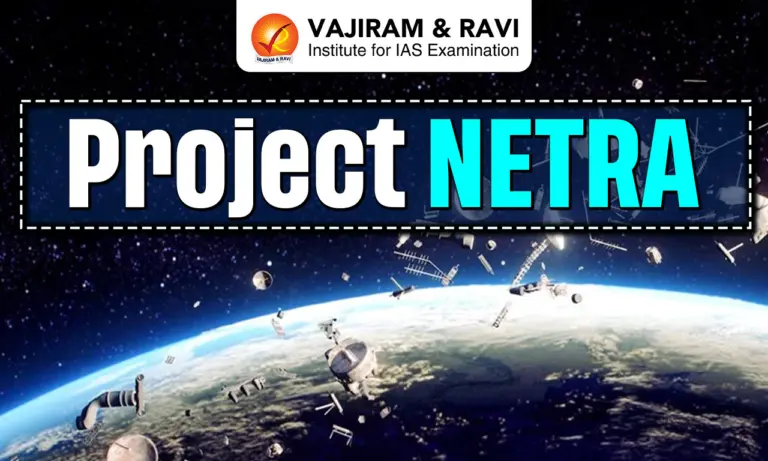
Project NETRA (Network for Space Object Tracking and Analysis) is an initiative by ISRO to develop India’s own Space Situational Awareness (SSA) capability. It aims to track space debris and protect Indian satellites.
About Project NETRA
- Project NETRA (Network for Space Object Tracking and Analysis) is a space surveillance initiative by ISRO.
- It aims to develop India’s indigenous Space Situational Awareness (SSA) capability to detect, track, and monitor objects in space.
- The project focuses on tracking space debris, inactive satellites, and other orbiting objects that may pose a threat to active Indian satellites.
- It helps in providing early warning of potential collisions, allowing corrective actions like changing satellite orbit.
- Project NETRA uses a network of ground-based radars, optical telescopes, and data processing systems to observe and analyze space objects.
- It can track objects in Low Earth Orbit (LEO), Medium Earth Orbit (MEO), and Geostationary Orbit (GEO).
- The project is part of India’s effort to ensure the safety, security, and sustainability of its space assets.
Project NETRA Components
- Project NETRA includes a network of advanced telescopes and radars to track objects in space.
- It plans to set up a high-precision, long-range telescope in Leh and a radar system in the North-East to improve coverage across different regions of India.
- It also uses existing systems like the Multi-Object Tracking Radar (MOTR) at the Satish Dhawan Space Centre, along with telescopes at Ponmudi (Kerala) and Mount Abu (Rajasthan).
- All these systems together help in creating a comprehensive picture of space activities and tracking space debris.
- A dedicated Space Situational Awareness (SSA) centre will be set up to bring together all tracking data from different ISRO centres into one place for better analysis and quick decision-making.
- At present, India has several important satellites that need protection:
- Around 15 communication satellites in geostationary orbit (about 36,000 km)
- Around 13 remote sensing satellites in low Earth orbit (up to 2,000 km)
- Around 8 navigation satellites in medium Earth orbit
- Earlier, India depended partly on global agencies like NORAD (USA-Canada) for space debris data, but Project NETRA aims to build independent capability.
- Implementing Agency: Efforts related to Space Situational Awareness (SSA) in India are led by ISRO. These activities are coordinated through the SSA Control Centre in Bengaluru and are managed by the Directorate of Space Situational Awareness and Management at ISRO headquarters.





Concerns Related to Space Debris
- Space debris (space junk) includes old rocket parts, non-working satellites, and small fragments created after collisions or anti-satellite (ASAT) tests.
- These objects move at extremely high speeds around 27,000 km/h in Low Earth Orbit (LEO) so even a tiny piece can seriously damage or destroy a satellite.
- This makes space increasingly dangerous and crowded, putting important services like communication, GPS, weather forecasting, and defence at risk.
- According to ISRO, thousands of close approach events are detected every year where space objects come very near to Indian satellites, increasing the risk of collision.
- A major source of debris is past events like:
- China’s 2007 ASAT test (Fengyun-1C destruction)
- The 2009 collision between Cosmos 2251 and Iridium 33
- Recently, there have also been several close encounters (within 1 km) involving satellites from Starlink and Indian satellites.
- Growing space activity increases the risk of a chain reaction of collisions (Kessler Syndrome), which can make some orbits unusable in the future.
Project NETRA Challenges and Limitations
- High Cost and Infrastructure Needs: Setting up advanced radars, telescopes, and data centres requires huge investment and continuous maintenance.
- Technological Limitations: Detecting very small debris (less than a few cm) is difficult, even with advanced systems, but such debris can still cause serious damage.
- Limited Coverage: India’s SSA network is still developing and has less global coverage compared to countries like the USA.
- Data Accuracy and Tracking Complexity: Space objects move at very high speeds, making precise tracking and prediction of collisions challenging.
- Dependence on International Data: Despite NETRA, India still needs to rely partly on external agencies for comprehensive global tracking data.
Project NETRA Strategic and Security Significance
- Project NETRA has strong strategic and security importance for India. It gives the country the ability to independently monitor space activities, including satellites and objects belonging to other nations. This is crucial in today’s time, as space is increasingly becoming a domain of competition and strategic importance.
- Project NETRA can detect, track, and record space objects as small as 10 cm. It has a tracking range of about 3,400 km, allowing it to monitor objects in orbits up to around 2,000 km above the Earth.
- By developing its own Space Situational Awareness (SSA) system through ISRO, India can reduce its dependence on foreign agencies for tracking data. This ensures better control over sensitive information and faster decision-making in case of potential threats.
- Project NETRA also helps in protecting critical space assets such as communication, navigation, and defence satellites, which are essential for national security and daily services. In the context of rising militarization of space and anti-satellite (ASAT) capabilities, it allows India to detect suspicious activities and respond effectively.
Enhancing Space Situational Awareness (SSA)
- India, as a growing space power, needs strong Space Situational Awareness (SSA) to protect its satellites and space assets. It is an important part of national capability, just like in advanced countries.
- SSA acts as a force multiplier by improving both space safety and national security. It helps India keep track of all activities happening in space.
- It has a strategic and military role, as it supports defence systems by monitoring objects that could pose threats from space.
- SSA uses a mix of satellites, ground-based radars, and tracking systems to detect and monitor objects not only in space but also potential threats from air and missile systems.
- With the help of long-range radars, SSA can also work as an early warning system against incoming ballistic missiles.
Global Context and Comparison
- Advanced space powers like the United States have highly developed Space Situational Awareness (SSA) systems, such as the Space Surveillance Network, which can track thousands of space objects accurately.
- These countries use a combination of ground-based radars, telescopes, and space-based sensors for global coverage and real-time monitoring.
- Other major players like Russia and China are also strengthening their SSA capabilities due to increasing space competition and security concerns.
- Compared to them, India’s SSA capability is still developing, but Project NETRA is a major step towards bridging this gap.
- With Project NETRA, India is moving towards becoming a self-reliant and responsible space power, ensuring better protection of its space assets and contributing to global space safety.

 Last updated on March, 2026
→ UPSC Final Result 2025 is now out.
→ UPSC has released UPSC Toppers List 2025 with the Civil Services final result on its official website.
→ Anuj Agnihotri secured AIR 1 in the UPSC Civil Services Examination 2025.
→ UPSC Marksheet 2025 is now out.
→ UPSC Notification 2026 & UPSC IFoS Notification 2026 is now out on the official website at upsconline.nic.in.
→ UPSC Calendar 2026 has been released.
→ Check out the latest UPSC Syllabus 2026 here.
→ UPSC Prelims 2026 will be conducted on 24th May, 2026 & UPSC Mains 2026 will be conducted on 21st August 2026.
→ The UPSC Selection Process is of 3 stages-Prelims, Mains and Interview.
→ Prepare effectively with Vajiram & Ravi’s UPSC Prelims Test Series 2026 featuring full-length mock tests, detailed solutions, and performance analysis.
→ Enroll in Vajiram & Ravi’s UPSC Mains Test Series 2026 for structured answer writing practice, expert evaluation, and exam-oriented feedback.
→ Join Vajiram & Ravi’s Best UPSC Mentorship Program for personalized guidance, strategy planning, and one-to-one support from experienced mentors.
→ Shakti Dubey secures AIR 1 in UPSC CSE Exam 2024.
→ Also check Best UPSC Coaching in India
Project NETRA FAQs
Q1. What is Project NETRA?+
Q2. What are the main objectives of Project NETRA?+
Q3. What does Project NETRA consist of?+
Q4. Why is space debris a concern?+
Q5. What are the major challenges of Project NETRA?+
Tags: Project NETRA