About Pulsar:
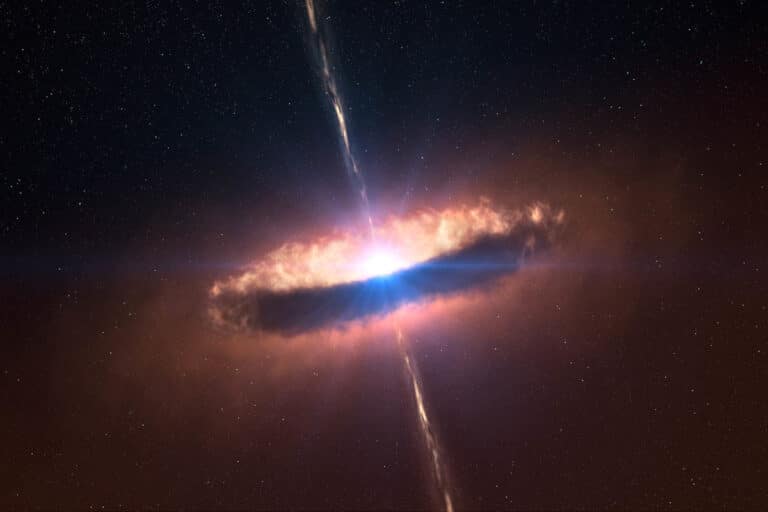
- Pulsars are rapidly rotating neutron stars that blast out pulses of radiation at regular intervals ranging from seconds to milliseconds.
- Pulsars have very strong magnetic fields, which funnel jets of particles out along the two magnetic poles. These accelerated particles produce very powerful beams of light.
- Often, the magnetic field is not aligned with the spin axis, so those beams of particles and light are swept around as the star rotates.
- The periodicity of pulsars is caused by these beams of light crossing the line of sight on Earth, with the pulsar appearing to ‘switch off’ at points when the light is facing away from us. The time between these pulses is the ‘period’ of the pulsar.
- Pulsars have been primarily observed at radio wavelengths.
- Pulsar masses range between 1.18 and 1.97 times that of the Sun, but most pulsars have a mass 1.35 times that of the Sun.
What is a Neutron Star?
- Neutron stars are highly dense remnants of massive stars that have collapsed, composed mainly of neutrons and other elementary particles.
- Neutron stars are formed when a massive star runs out of fuel and collapses.
- The very central region of the star – the core – collapses, crushing together everyproton and electron into a neutron.
- If the core of the collapsing star is between about 1 and 3 solar masses, these newly-created neutrons can stop the collapse, leaving behind a neutron star.
What is the Green Bank Telescope (GBT)?
- With a 100 m × 110 m off-axis paraboloid dish, the GBT is the largest fully steerable radio telescope on Earth.
- It is located at Green Bank Observatory in the National Radio Quiet Zone in Green Bank, West Virginia, U.S.
Q1: What is a neutron?
Neutrons, along with protons, are subatomic particles found inside the nucleus of every atom. The only exception is hydrogen, where the nucleus contains only a single proton. Neutrons have a neutral electric charge (neither negative nor positive) and have slightly more mass than positively charged protons. “Free” neutrons are those no longer confined inside a nucleus. These free neutrons are produced by fission and fusion processes.
Source: New millisecond pulsar discovered






 Last updated on March, 2026
→ UPSC Final Result 2025 is now out.
→ UPSC has released UPSC Toppers List 2025 with the Civil Services final result on its official website.
→ Anuj Agnihotri secured AIR 1 in the UPSC Civil Services Examination 2025.
→ UPSC Marksheet 2025 is now out.
→ UPSC Notification 2026 & UPSC IFoS Notification 2026 is now out on the official website at upsconline.nic.in.
→ UPSC Calendar 2026 has been released.
→ Check out the latest UPSC Syllabus 2026 here.
→ UPSC Prelims 2026 will be conducted on 24th May, 2026 & UPSC Mains 2026 will be conducted on 21st August 2026.
→ The UPSC Selection Process is of 3 stages-Prelims, Mains and Interview.
→ Prepare effectively with Vajiram & Ravi’s UPSC Prelims Test Series 2026 featuring full-length mock tests, detailed solutions, and performance analysis.
→ Enroll in Vajiram & Ravi’s UPSC Mains Test Series 2026 for structured answer writing practice, expert evaluation, and exam-oriented feedback.
→ Join Vajiram & Ravi’s Best UPSC Mentorship Program for personalized guidance, strategy planning, and one-to-one support from experienced mentors.
→ Shakti Dubey secures AIR 1 in UPSC CSE Exam 2024.
→ Also check Best UPSC Coaching in India