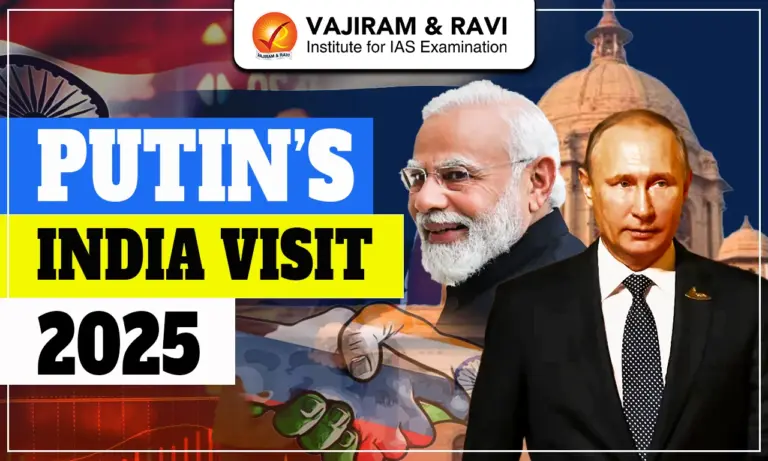
Russian President Vladimir Putin visited India on 4-5 December 2025, coinciding with the 23rd India-Russia Annual Summit. This visit comes amid shifting global geopolitics, including sanctions on Russia, U.S. tariff pressures on India, and global energy volatility.
During the summit, both nations reaffirmed their Special and Privileged Strategic Partnership, a cornerstone of bilateral relations since 2000.
Putin’s India Visit 2025 Why Now?
The timing of Putin’s India Visit 2025 is significant for several reasons:
Institutionalised Annual Summits: India and Russia have held annual summits since the 2000 Strategic Partnership Declaration to reinforce long-term cooperation.
First Visit Since 2021: This is Putin’s first visit to India after a gap of four years, underlining renewed engagement.
Recent Developments:
- Russia acknowledges U.S. pressure on India regarding trade and tariffs.
- Russia seeks a “third-country-proof” payment mechanism to facilitate smoother bilateral trade.
Historical Anchoring:
- The 1971 Treaty of Peace, Friendship and Cooperation laid the foundation for a strategic partnership.
- Since the Soviet era, India and Russia have maintained deep defence, energy, and nuclear synergies.
Also Read: RELOS Agreement
India-Russia Bilateral Relations Evolution
India-Russia Bilateral Relations have evolved from strategic and defence-focused ties during the Cold War to multi-dimensional cooperation today. The partnership has strengthened through defence deals, energy trade, nuclear collaboration, and regional/global forum coordination.
- 1971: USSR supported India during the Bangladesh Liberation War, using its UNSC veto three times in India’s favour.
- Cold War Era: Transfer of advanced military platforms to India strengthened defence capability.
- 2000: Strategic Partnership formalised, leading to annual summits.
- 2010: Upgraded to Special & Privileged Strategic Partnership, signalling deeper trust.
- 2019 onwards: Renewed engagement through initiatives like the Eastern Economic Forum and India’s “Act Far East Policy.”
- Post-2022: Russia became India’s largest crude oil supplier via discounted oil arrangements amid sanctions.
Also Read: India-Russia Relations





India-Russia Summit 2025 Outcomes
India and Russia held the 23rd Annual Summit in New Delhi on 4–5 December 2025, marking 25 years of the Strategic Partnership (2000–2025). The visit reaffirmed the Special and Privileged Strategic Partnership, emphasizing continuity, trust, and strategic alignment despite global uncertainties.
Political & Diplomatic Engagement
- High-level exchanges across parliaments, ministries, and NSA-level talks.
- Opening of new Indian Consulates in Yekaterinburg and Kazan.
- Active cooperation in UN, SCO, BRICS, G20, and support for UNSC reforms with Russia backing India’s permanent seat.
Trade & Economic Partnership
- Revised trade target: USD 100 billion by 2030.
- Adoption of “Programme 2030” for expanding bilateral economic cooperation.
- Progress on India–EAEU Free Trade Agreement and Investment Protection Agreement.
Key Areas
- Cooperation in energy, fertilizers, precious metals, minerals, critical raw materials.
- Push for smooth payment systems, national currency settlements, CBDC cooperation.
- Joint efforts to remove logistics bottlenecks, tariff/non-tariff barriers, and insurance issues.
Energy Partnership
- One of the strongest pillars of the relationship.
- Broad cooperation in:
- Oil & gas, LNG, petrochemicals, refineries
- Underground coal gasification
- Nuclear energy (Kudankulam NPP; India’s 100 GW nuclear capacity goal by 2047)
-
Agreement to resolve pending investment issues.
Connectivity & Transport
- Major push for three strategic corridors:
- International North–South Transport Corridor (INSTC)
- Chennai–Vladivostok Maritime Corridor
- Northern Sea Route (NSR)
-
MoU on training Indian specialists for polar water navigation.
Russian Far East & Arctic Cooperation
- Framework: India–Russia Far East Cooperation Programme (2024–29).
- Areas: agriculture, mining, manpower, diamonds, pharmaceuticals, shipping.
- India ready to expand role as Observer in Arctic Council.
Defence & Military-Technical Cooperation
- Defence cooperation shifting from “buyer–seller” to co-development & co-production.
- Joint manufacturing of spare parts for Russian-origin weapons in India.
- Expansion of INDRA joint exercises and military delegations.
- Emphasis on Make-in-India and joint development of high-tech systems.
India-Russia Annual Summit 2025 Significance
The 23rd India-Russia Annual Summit 2025 on 4-5 December 2025 holds major diplomatic, economic, and defence importance at a time of shifting global geopolitics, energy volatility, and Western sanctions on Russia.
Diplomatic Significance
- Reaffirmation of Strategic Partnership despite global tensions and sanctions.
- Strengthens India’s strategic autonomy by maintaining balanced ties with Russia, the U.S., Europe, and the Global South.
- Russia’s continued support for India’s bid for a UNSC permanent seat.
- Reinforces cooperation in BRICS, SCO, RIC, G-20, and the Arctic.
- Helps India maintain influence in Eurasia and Central Asia, where Russia remains a major player.
Economic & Energy Significance
- Russia remains India’s largest crude supplier, providing discounted oil post-2022.
- Expected creation of a non-USD, “third-country-proof” payment mechanism to bypass sanctions.
- Push for long-term oil & gas supply contracts for price stability.
- Discussion on expanding civil nuclear projects, possibly Kudankulam Units 7-8 or SMR cooperation.
- Boost to connectivity projects like INSTC and the Chennai-Vladivostok maritime corridor.
Defence Significance
- Ensures continuity in major defence deliveries including S-400, spare parts, engines.
- Expansion of joint defence manufacturing, including localisation of components for Su-30, T-90, and helicopters.
- Strengthens BrahMos cooperation and potential upgrades in air defence systems.
- Discussions on joint R&D in hypersonic systems, UAVs, aircraft engines, etc.
- Establishment of joint MRO hubs to reduce dependency and delays.
- Helps India maintain operational readiness, as 60-70% of India’s defence equipment is Russian-origin.
Challenges in India-Russia Relations
- Severe Trade Imbalance: Russia-India trade is heavily skewed in Russia’s favour (imports ~$63.8 bn vs exports ~$4.9 bn), creating long-term sustainability concerns and limiting India’s bargaining power.
- Sanctions & Payment Mechanism Issues: Western sanctions complicate rupee-ruble settlements, banking channels, and large defence/energy payments, slowing trade and creating financial uncertainty.
- Defence Dependence & Delivery Delays: With 60-70% of India’s military equipment being Russian-origin, supply delays after the Ukraine conflict and reduced production capacity affect India’s operational readiness.
- Russia’s Growing Proximity to China: Deepening Russia-China strategic and defence ties, especially amid India-China border tensions, reduce India’s leverage and introduce new security challenges.
- Diverging Geopolitical Alignments: India’s closer partnerships with the U.S., QUAD, and Indo-Pacific frameworks diverge from Russia’s Eurasian and China-centric approach, creating diplomatic friction.
Way Forward
- Rebuild Strategic Trust: Regular high-level consultations and transparency on defence ties with China can prevent strategic misperceptions.
- Expand Non-Defence Trade: Prioritise trade in pharma, IT, agriculture, and logistics to reduce overdependence on energy and defence sectors.
- Secure Long-Term Energy Deals: Finalise multi-year contracts on discounted oil, LNG, nuclear fuel, and critical minerals to stabilise India’s energy basket.
- Advance Connectivity Projects: Fast-track INSTC, Chennai–Vladivostok Maritime Corridor, and Eurasian Economic Union FTA to cut logistics costs and boost market access.
- Strengthen People-Centric Engagement: Improve medical education standards for Indian students in Russia, boost tourism, and increase cultural/academic exchanges for durable ties.

 Last updated on April, 2026
→ UPSC Final Result 2025 is now out.
→ UPSC has released UPSC Toppers List 2025 with the Civil Services final result on its official website.
→ Anuj Agnihotri secured AIR 1 in the UPSC Civil Services Examination 2025.
→ UPSC Marksheet 2025 is now out.
→ UPSC Notification 2026 & UPSC IFoS Notification 2026 is now out on the official website at upsconline.nic.in.
→ UPSC Calendar 2026 has been released.
→ Check out the latest UPSC Syllabus 2026 here.
→ UPSC Prelims 2026 will be conducted on 24th May, 2026 & UPSC Mains 2026 will be conducted on 21st August 2026.
→ The UPSC Selection Process is of 3 stages-Prelims, Mains and Interview.
→ Prepare effectively with Vajiram & Ravi’s UPSC Prelims Test Series 2026 featuring full-length mock tests, detailed solutions, and performance analysis.
→ Enroll in Vajiram & Ravi’s UPSC Mains Test Series 2026 for structured answer writing practice, expert evaluation, and exam-oriented feedback.
→ Join Vajiram & Ravi’s Best UPSC Mentorship Program for personalized guidance, strategy planning, and one-to-one support from experienced mentors.
→ Shakti Dubey secures AIR 1 in UPSC CSE Exam 2024.
→ Also check Best UPSC Coaching in India
Putin's India Visit 2025 FAQs
Q1. Why is Vladimir Putin visiting India in 2025?+
Q2. What is the main agenda of the India–Russia Annual Summit 2025?+
Q3. How often do India and Russia hold Annual Summits?+
Q4. What are the key defence outcomes expected from the visit?+
Q5. How will this visit impact India’s energy security?+
Tags: putins india visit 2025