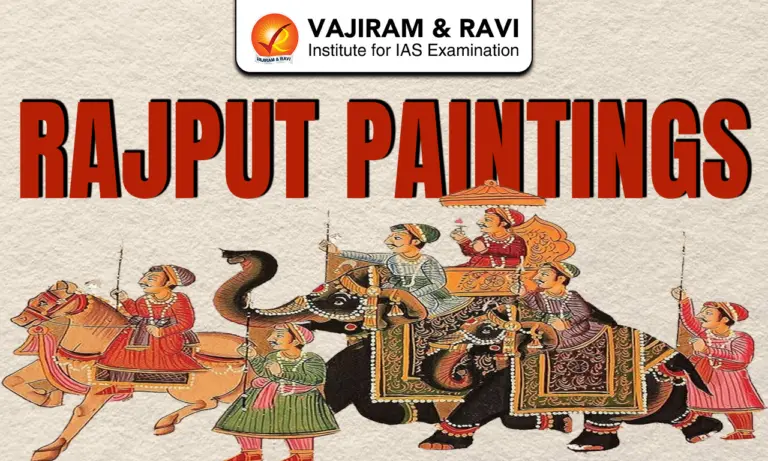
Rajput painting is a traditional style of Indian painting that developed in the royal courts of Rajasthan and nearby regions during the medieval period. These paintings were mainly supported by Rajput rulers and reflected themes related to religion, culture, nature, and court life. Known for their bright colours, decorative style, and expressive figures, Rajput paintings represent an important part of India’s artistic and cultural heritage.
Rajput Paintings Features
- Religious and Cultural Themes: Rajput painting was strongly influenced by Hindu traditions such as Vaishnavism, Shaivism, and Shaktism. Many paintings depict stories from the Ramayana, Mahabharata, and Bhagavata Purana, especially the life and love stories of Krishna and Radha. Scenes of royal life, festivals, hunting, and nature were also common.
- Style and Use of Colours: The paintings are known for bold outlines, bright and vibrant colours, and a decorative style. Colours were prepared from natural sources such as minerals, plants, and sometimes gold or silver. Artists focused more on emotional expression than realistic perspective.
- Representation of Figures and Scenes: Human figures were usually stylized with large expressive eyes, sharp features, and detailed clothing. Paintings often appear flat with little attempt to show depth, and sometimes the surface was divided into different coloured sections to show multiple scenes.
- Influence and Regional Schools: Interaction with Mughal painting brought more refinement in drawing and some natural elements in trees and figures. Over time, several regional styles developed in Rajasthan and nearby areas, such as the Mewar School of Painting, Marwar School of Painting, Bundi School of Painting, and Kangra School of Painting.
- Medium and Form: Most Rajput paintings were miniature paintings made on paper, though some were also created on materials like ivory, silk, and on the walls of palaces and forts.
Rajput Paintings Origin
- Rajput painting developed between the 16th and 17th centuries in the royal courts of Rajasthan and nearby regions. These paintings grew out of earlier Indian artistic traditions and later evolved by interacting with other styles.
- Indigenous Roots: The early form of Rajput painting was influenced by local manuscript painting traditions, especially the Chaurapanchasika style of western India. These early paintings used bright colours, bold lines, and simple compositions.
- Influence of Mughal Art: Contact with the Mughal painting style during the 16th century introduced better techniques of drawing, portrait making, and more detailed backgrounds. This interaction helped refine the Rajput style while still keeping its traditional character.
- Spread and Development: When the Mughal Empire weakened during the reign of Aurangzeb, many artists left the Mughal court and moved to Rajput kingdoms. These artists brought new artistic skills, which led to the further development of regional schools of Rajput painting.
- Over time, Rajput paintings flourished from the 16th to 19th centuries, depicting themes such as stories of Krishna, scenes from the Ramayana, musical themes like Ragamala paintings, and the lifestyle of Rajput courts. These paintings became an important part of India’s traditional miniature painting heritage.





Schools of Rajput Painting
Rajput painting developed in different Rajput kingdoms, and each region created its own artistic style. These styles are usually named after the princely states where they flourished. Although they share some common features, each school developed unique themes, techniques, and artistic expressions.
- Mewar School
-
- One of the earliest and most important Rajput painting styles, developed under the patronage of the Mewar rulers.
- The famous artist Sahibdin illustrated works such as Rasikapriya, Ramayana, and Bhagavata Purana.
- Later paintings began to show scenes from royal court life.
- A notable feature was “tamasha” paintings, which depicted court ceremonies and detailed city views.
- Kishangarh School
-
- Developed in the kingdom of Kishangarh, founded by Kishan Singh in 1609.
- Flourished under the patronage of Man Singh.
- Known for romantic and devotional themes, especially the love of Radha and Krishna.
- The famous painting Bani Thani became a symbol of this style.
- Bundi School
-
- It emerged in Bundi in the Hadoti region of Rajasthan.
- Known for detailed landscapes showing trees, gardens, rivers, and nature.
- Human figures usually have round faces with slightly pointed noses.
- The sky is often painted in bright colours, sometimes with a red band.
- Amber-Jaipur School
-
- Developed in the regions of Amber and Jaipur, also called the Dhundar school.
- Early examples can be seen in wall paintings at Bairat and Amer Palace.
- Shows both folk and Mughal influences in style and clothing.
- It reached its peak under Sawai Pratap Singh in the eighteenth century.
- Malwa School
-
- Developed in the Malwa region of central India.
- Known for bright colours and simple compositions.
- Figures are often shown against solid coloured backgrounds.
- Themes mainly include religious texts and Ragamala paintings.
- Kota School
-
- Developed from the Bundi style in the kingdom of Kota.
- Famous for dynamic hunting scenes of kings and nobles.
- Artists paid special attention to animals and forests.
- Known for lively brushwork, shading, and the depiction of double-eyelid eyes.
- Bikaner School
-
- Developed in the kingdom of Bikaner founded by Rao Bika Rathore.
- Influenced by Mughal artists who worked in the region.
- Known for delicate lines, fine detailing, and soft colours like blue, green, and red.
- Female figures are shown as slender with graceful, deer-like eyes.
- Jodhpur School
-
- It flourished under the rulers of Jodhpur, especially Maharaja Jaswant Singh.
- Early examples include a Ragamala series painted by artist Virji in 1623.
- Many paintings depict themes related to Krishna and the Bhagavata Purana.
- Important works during the reign of Man Singh include the Ramayana, Dhola-Maru, Panchatantra, and Shiva Purana.
Differences between the Mughal Painting and Rajput Painting
Mughal painting and Rajput painting are two important traditions of Indian miniature painting that developed during the medieval period. However, they differ in themes, style, and artistic influences. The major Differences between the Mughal Painting and Rajput Painting are discussed below.
| Differences between the Mughal Painting and Rajput Painting | ||
|
Basis |
Mughal painting |
Rajput painting |
|
Nature of Style |
Developed mainly as a courtly and aristocratic art under the patronage of Mughal emperors. |
Developed in Rajput courts but was closely connected with local traditions and popular culture. |
|
Themes |
Focused on royal life, court scenes, battles, hunting, and portraits of emperors and nobles. |
Mainly depicted religious stories, mythology, love themes, and nature, especially stories of Krishna and Radha. |
|
Artistic Influence |
Strongly influenced by Persian painting and Central Asian traditions, later blending with Indian elements. |
Rooted largely in indigenous Indian traditions and also influenced by local folk art. |
|
Purpose and Audience |
Created mainly for Mughal emperors and royal patrons, often kept within imperial collections. |
Produced for regional courts and society, reflecting cultural and religious life of the people. |
|
Style and Technique |
Known for fine detailing, realism, and naturalistic representation of humans, animals, and landscapes. |
Characterized by bold lines, bright colours, stylized figures, and decorative compositions. |
|
Subject Approach |
Mostly portrayed historical events and contemporary court activities. |
Focused on spiritual, mythological, and emotional themes. |
|
Representation of Animals and Nature |
Animals and nature were often shown realistically, especially in hunting scenes. |
Animals and nature were often shown symbolically and aesthetically, sometimes with religious meaning. |
|
Form of Painting |
Primarily miniature paintings created for manuscripts and albums. |
Included miniatures as well as wall paintings and murals in palaces and temples. |
Rajput Paintings Significance
Rajput painting holds an important place in the history of Indian art and culture. It reflects the social, religious, and cultural life of the Rajput kingdoms.
- Cultural Heritage: Rajput paintings represent the rich artistic traditions of Rajasthan and nearby regions and are an important part of India’s cultural heritage.
- Religious Expression: Many paintings depict stories from Hindu texts such as the Ramayana, Mahabharata, and Bhagavata Purana, helping to spread religious ideas and devotion.
- Reflection of Society and Culture: These paintings show the lifestyle of kings, royal courts, festivals, nature, and daily life, providing insights into the society of that period.
- Development of Regional Art Styles: Different regional schools such as the Mewar School of Painting and Kishangarh School of Painting contributed to the diversity and growth of Indian miniature painting.
- Influence on Later Art: Rajput painting influenced many later forms of Indian art and remains an important subject of study in Indian art history.

 Last updated on March, 2026
→ UPSC Final Result 2025 is now out.
→ UPSC has released UPSC Toppers List 2025 with the Civil Services final result on its official website.
→ Anuj Agnihotri secured AIR 1 in the UPSC Civil Services Examination 2025.
→ UPSC Marksheet 2025 is now out.
→ UPSC Notification 2026 & UPSC IFoS Notification 2026 is now out on the official website at upsconline.nic.in.
→ UPSC Calendar 2026 has been released.
→ Check out the latest UPSC Syllabus 2026 here.
→ UPSC Prelims 2026 will be conducted on 24th May, 2026 & UPSC Mains 2026 will be conducted on 21st August 2026.
→ The UPSC Selection Process is of 3 stages-Prelims, Mains and Interview.
→ Prepare effectively with Vajiram & Ravi’s UPSC Prelims Test Series 2026 featuring full-length mock tests, detailed solutions, and performance analysis.
→ Enroll in Vajiram & Ravi’s UPSC Mains Test Series 2026 for structured answer writing practice, expert evaluation, and exam-oriented feedback.
→ Join Vajiram & Ravi’s Best UPSC Mentorship Program for personalized guidance, strategy planning, and one-to-one support from experienced mentors.
→ Shakti Dubey secures AIR 1 in UPSC CSE Exam 2024.
→ Also check Best UPSC Coaching in India
Rajput Paintings FAQs
Q1. What are Rajput paintings?+
Q2. What are the main themes of Rajput paintings?+
Q3. What are the main features of Rajput paintings?+
Q4. What influenced the development of Rajput painting?+
Q5. What are some important schools of Rajput painting?+
Tags: art and culture art and culture notes Rajput Paintings