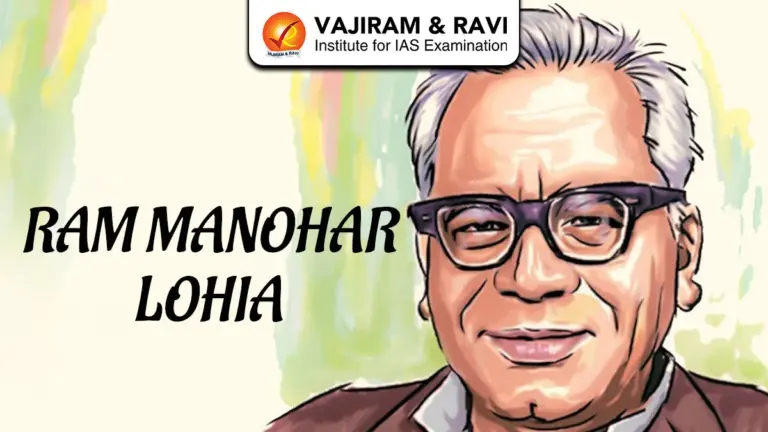
Ram Manohar Lohia was a prominent Indian freedom fighter, socialist leader, and one of the most original political thinkers of modern India. Born in 1910, he made deep contributions not only to the Indian freedom struggle but also to shaping India’s post-independence socio-political thought. Lohia became widely known for his idea of popular or “people-centric” socialism, which combined social justice, anti-imperialism, and empowerment of marginalized sections.
Ram Manohar Lohia Early Life and Education
Ram Manohar Lohia was born in 1910 in Akbarpur, Uttar Pradesh, and grew up in an environment deeply influenced by the Indian freedom movement. His early education in India and higher studies in Germany shaped his strong socialist and anti-imperialist ideas.
- Born on 23 March 1910 in Akbarpur, Uttar Pradesh, into a Brahmin family.
- Lost his mother at an early age, which made him self-reliant and disciplined.
- His upbringing was influenced by the national movement and anti-colonial ideas.
- Completed his early education in India, where he excelled academically.
- Went to Germany for higher studies and studied at the University of Berlin.
- Came in contact with the works of Marx, Engels, and European socialist thinkers.
- Exposure to global anti-imperialist and socialist movements shaped his worldview.
- His academic background helped him develop a distinct Indian form of socialism.
Ram Manohar Lohia Political Ideology
Ram Manohar Lohia’s political ideology was based on democratic socialism rooted in Indian social realities. He strongly opposed both Western capitalism and Soviet-style communism for promoting inequality and centralisation of power.
- He believed in democratic socialism with moral and ethical foundations.
- He criticised capitalism for creating economic inequality and concentration of wealth.
- Rejected Soviet-style communism for suppressing individual freedom and democracy.
- Emphasised social justice, especially for backward classes, women, and the rural poor.
- Viewed caste system as a major obstacle to equality and national unity.
- Supported decentralisation of power and strong local self-governance.
- Advocated economic equality through redistribution of resources.
- Combined Gandhian non-violence with radical social reform.
- Stressed that political freedom is incomplete without social and economic equality.





Ram Manohar Lohia’s Theory of Sapta Kranti
One of Ram Manohar Lohia’s most significant contributions to political thought was his theory of Sapta Kranti (Seven Revolutions). This theory aimed at bringing comprehensive change in society. The Seven Revolutions include:
- Gender equality between men and women
- End of caste-based discrimination
- Reduction of economic inequality
- Freedom from foreign domination and imperialism
- Establishment of democratic values over authoritarianism
- Protection of individual liberty and civil rights
- Opposition to war and weapons of mass destruction
Role of Ram Manohar Lohia in the Indian National Movement
Ram Manohar Lohia was an active freedom fighter who played a significant role in the mass phase of India’s national movement. He combined the struggle against British rule with a strong commitment to social justice and equality.
- Joined the Indian National Congress in the 1930s and emerged as a prominent young socialist leader.
- Became an important member of the Congress Socialist Party (CSP), which aimed to infuse socialist ideology into the freedom movement.
- Played a crucial role during the Quit India Movement (1942), especially after the arrest of senior Congress leaders.
- Organised and coordinated underground resistance activities, including secret communication networks to keep the movement alive.
- Worked closely with Jayaprakash Narayan, Acharya Narendra Dev, and Yusuf Meherally during the underground phase.
- Strongly opposed British imperialism and colonial economic exploitation of India.
Used writings, pamphlets, and speeches to mobilise students, workers, and peasants. - Linked the freedom struggle with social transformation, highlighting issues of caste oppression, poverty, and inequality.
Supported Gandhian methods of non-violent resistance while advocating more radical social reforms.
Role of Ram Manohar Lohia After Independence
After Independence, Ram Manohar Lohia emerged as a powerful socialist thinker and opposition leader who challenged the dominant political narrative of the time.
- In 1948, Ram Manohar Lohia and other members of the Congress Socialist Party (CSP) formally left the Indian National Congress due to ideological differences.
- He became a founding member of the Praja Socialist Party in 1952 and served briefly as its General Secretary, but resigned in 1955 following internal disagreements.
- In the same year, Lohia established a separate Socialist Party (1955) and assumed the roles of Chairman and Editor of its journal Mankind.
- As a socialist leader, he consistently advocated far-reaching socio-political reforms, including the abolition of the caste system, protection of civil liberties, and empowerment of marginalized communities.
- In 1963, he was elected to the Lok Sabha, where he gained recognition for his fearless and sharp criticism of government policies.
- Ram Manohar Lohia was also a prolific writer, and his important works include Wheel of History, Marx, Gandhi and Socialism, and Guilty Men of India’s Partition.
Ram Manohar Lohia’s Legacy
Ram Manohar Lohia left a lasting legacy as a fearless socialist leader who gave voice to the poor, backward classes, and marginalized sections of society. He strengthened opposition politics in India and ensured that issues like caste inequality, social justice, and decentralisation became part of national debate. His ideas continue to influence Indian politics, especially movements for equality, democracy, and inclusive development.

 Last updated on March, 2026
→ UPSC Final Result 2025 is now out.
→ UPSC has released UPSC Toppers List 2025 with the Civil Services final result on its official website.
→ Anuj Agnihotri secured AIR 1 in the UPSC Civil Services Examination 2025.
→ UPSC Marksheet 2025 is now out.
→ UPSC Notification 2026 & UPSC IFoS Notification 2026 is now out on the official website at upsconline.nic.in.
→ UPSC Calendar 2026 has been released.
→ Check out the latest UPSC Syllabus 2026 here.
→ UPSC Prelims 2026 will be conducted on 24th May, 2026 & UPSC Mains 2026 will be conducted on 21st August 2026.
→ The UPSC Selection Process is of 3 stages-Prelims, Mains and Interview.
→ Prepare effectively with Vajiram & Ravi’s UPSC Prelims Test Series 2026 featuring full-length mock tests, detailed solutions, and performance analysis.
→ Enroll in Vajiram & Ravi’s UPSC Mains Test Series 2026 for structured answer writing practice, expert evaluation, and exam-oriented feedback.
→ Join Vajiram & Ravi’s Best UPSC Mentorship Program for personalized guidance, strategy planning, and one-to-one support from experienced mentors.
→ Shakti Dubey secures AIR 1 in UPSC CSE Exam 2024.
→ Also check Best UPSC Coaching in India
Ram Manohar Lohia FAQs
Q1. Who was Ram Manohar Lohia?+
Q2. What is Sapta Kranti?+
Q3. What kind of socialism did Lohia believe in?+
Q4. What was Ram Manohar Lohia’s role after independence?+
Tags: ram manohar lohia