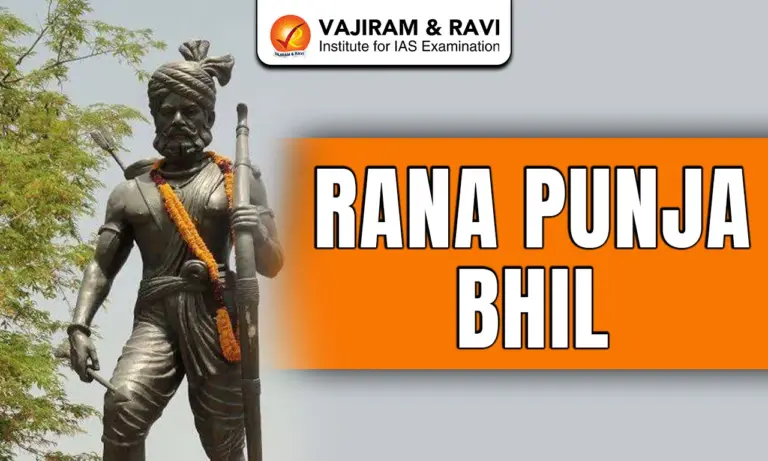
Rana Punja Bhil was a courageous tribal leader and warrior who played a significant role in Indian history, particularly during the resistance against Mughal expansion in the 16th century. He belonged to the Bhil tribe, one of the oldest and largest indigenous communities of India. Rana Punja Bhil is widely remembered for supporting Maharana Pratap of Mewar during the historic Battle of Haldighati in 1576.
Rana Punja Bhil Key Facts
- Rana Punja Bhil was a contemporary of Maharana Pratap, the ruler of Mewar.
- He played a crucial role in supporting Maharana Pratap against Mughal Emperor Akbar.
- During the Battle of Haldighati in 1576, he led a strong contingent of Bhil warriors.
- His leadership and military skills strengthened Maharana Pratap’s army.
- Due to his exceptional leadership and bravery, he was honoured with the title “Rana.”
- The Bhil community voluntarily joined Maharana Pratap’s resistance movement against Mughal rule.
- Rana Punja Bhil used guerrilla warfare tactics and deep knowledge of forests and terrain to support Mewar forces.
Rana Punja Bhil Role in the Battle of Haldighati
The Battle of Haldighati was fought in 1576 between:
- Mewar forces led by Maharana Pratap
- Mughal forces led by Raja Man Singh I of Amber under Emperor Akbar
Although Maharana Pratap was defeated in the battle, the resistance against Mughal rule continued. Rana Punja Bhil and his Bhil warriors helped Maharana Pratap survive and continue guerrilla warfare in the forests of Mewar. Their support became a turning point in sustaining resistance against Mughal expansion in Rajasthan.





Historical Importance
Rana Punja Bhil symbolizes tribal participation in India’s freedom struggles and regional defense movements. His legacy reflects unity between Rajput rulers and tribal communities during challenging times.
About Bhil Community
The Bhil community is one of the oldest and largest tribal groups in India, known for its rich cultural heritage and traditional warrior skills. They have historically lived in forest and hilly regions and played an important role in regional politics, warfare, and cultural preservation.
The Bhil community is one of the oldest and largest tribal groups in India, known for its rich cultural heritage and traditional warrior skills. They have historically lived in forest and hilly regions and played an important role in regional politics, warfare, and cultural preservation.
- The Bhils are widely distributed across Rajasthan, Gujarat, Madhya Pradesh, Maharashtra, Chhattisgarh, Karnataka, Andhra Pradesh, West Bengal, and Tripura.
- They are the largest tribal group in Rajasthan and are classified as a Scheduled Tribe in the state.
- The term “Bhil” is derived from the word “Billu,” which means bow, highlighting their traditional expertise in archery.
- The Bhil community mainly speaks the Bhili language, which has several regional dialects.
- Bhil women traditionally wear sarees and heavy ornaments made of silver, brass, beads, and coins, while men wear long frocks and pyjamas.
- The community is known for its deep knowledge of forests, hills, and natural resources, which helped them survive in difficult terrains.
- Historically, Bhils were skilled in guerrilla warfare and often supported regional rulers like the Rajputs in military campaigns.
- Many Bhils today are engaged in agriculture, farming, and labour work, though traditional crafts and sculpture remain important skills.
- The Bhils ruled several princely regions in southern Gujarat and maintained strong tribal governance systems.
- During British colonial rule, the Bhils revolted several times, including in 1846, 1857–58, and 1868, opposing colonial policies.
- The British government labelled them as a criminal tribe under the Criminal Tribes Act of 1871, which negatively impacted their social and economic conditions.
- The Bhil community continues to preserve its folk traditions, festivals, and cultural identity, contributing significantly to India’s tribal heritage.
Other Communities in Rajasthan
Rajasthan is home to several tribal and indigenous communities that have preserved unique traditions, lifestyles, and cultural practices for centuries.
- Sahariyas are considered one of the most backward and vulnerable tribal groups in Rajasthan and are mainly found in forest and rural areas.
- The Sahariya community traditionally depends on forest produce, daily wage labour, and agriculture for livelihood.
- Minas are the second-largest tribal group in Rajasthan and are believed to have historical links with the ancient Indus Valley Civilization.
- The Mina community is largely engaged in agriculture and is known for its rich customs and social traditions.
- Gadiya Lohars are a small tribal group associated with Rajput heritage and are traditionally known as skilled blacksmiths.
- The Gadiya Lohars were historically nomadic and moved from place to place, repairing tools and weapons.
- Garasias are another tribal group connected to Rajput ancestry and are mainly found in southern Rajasthan.
- The Garasia community is known for its distinct marriage customs, festivals, and cultural traditions.
- Kathodi is a small tribal community mainly found in the Mewar region and is traditionally dependent on forest resources.
- Sansi is a tribal group historically associated with nomadic lifestyles and traditional occupations.
- Kanjar is another tribal community known for its cultural performances and traditional livelihood practices.

 Last updated on March, 2026
→ UPSC Final Result 2025 is now out.
→ UPSC has released UPSC Toppers List 2025 with the Civil Services final result on its official website.
→ Anuj Agnihotri secured AIR 1 in the UPSC Civil Services Examination 2025.
→ UPSC Marksheet 2025 is now out.
→ UPSC Notification 2026 & UPSC IFoS Notification 2026 is now out on the official website at upsconline.nic.in.
→ UPSC Calendar 2026 has been released.
→ Check out the latest UPSC Syllabus 2026 here.
→ UPSC Prelims 2026 will be conducted on 24th May, 2026 & UPSC Mains 2026 will be conducted on 21st August 2026.
→ The UPSC Selection Process is of 3 stages-Prelims, Mains and Interview.
→ Prepare effectively with Vajiram & Ravi’s UPSC Prelims Test Series 2026 featuring full-length mock tests, detailed solutions, and performance analysis.
→ Enroll in Vajiram & Ravi’s UPSC Mains Test Series 2026 for structured answer writing practice, expert evaluation, and exam-oriented feedback.
→ Join Vajiram & Ravi’s Best UPSC Mentorship Program for personalized guidance, strategy planning, and one-to-one support from experienced mentors.
→ Shakti Dubey secures AIR 1 in UPSC CSE Exam 2024.
→ Also check Best UPSC Coaching in India
Rana Punja Bhil FAQs
Q1. Who was Rana Punja Bhil?+
Q2. Why is Rana Punja Bhil famous?+
Q3. What was the Battle of Haldighati?+
Q4. Which tribe did Rana Punja Bhil belong to?+
Q5. Where are Bhils mainly found in India?+
Tags: rana punja bhil