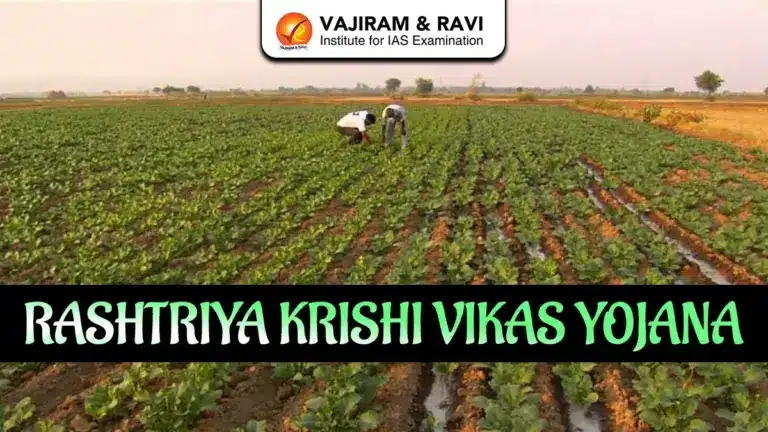
The Pradhan Mantri Rashtriya Krishi Vikas Yojana (PM-RKVY) is a major centrally sponsored scheme of the Government of India aimed at accelerating agricultural growth and improving farmers’ income. The scheme focuses on strengthening agriculture and allied sectors through increased public investment, infrastructure creation, innovation, and state-specific planning.
By adopting a decentralised and flexible approach, PM-RKVY plays an important role in ensuring food security, rural development, and sustainable agriculture in India.
Rashtriya Krishi Vikas Yojana Objectives
The objectives of PM-RKVY focus on inclusive, sustainable, and income-oriented agricultural development:
- To encourage states to increase public investment in agriculture and allied sectors.
- To enhance agricultural productivity and overall farm growth.
- To strengthen agricultural and post-harvest infrastructure and reduce losses.
- To promote diversification into high-value crops, horticulture, livestock, and fisheries.
- To encourage adoption of modern, innovative, and climate-resilient farming practices.
- To ensure efficient and sustainable use of natural resources such as soil and water.
- To reduce regional disparities in agricultural development.
- To enhance farmers’ income and improve rural livelihoods.
- To promote agribusiness, food processing, and value-chain development.
Also Read: PM VIKAS Scheme
Pradhan Mantri Rashtriya Krishi Vikas Yojana Features
The Pradhan Mantri Rashtriya Krishi Vikas Yojana has several important features that make it a comprehensive agricultural development programme:
- State-Led and Decentralized Approach: States have the flexibility to plan and implement agricultural projects according to local priorities.
- Growth-Oriented Scheme: The scheme aims to achieve a sustained annual growth rate of around 4 percent in agriculture and allied sectors.
- Wide Sectoral Coverage: It supports crop production, horticulture, livestock, fisheries, organic farming, agricultural research, and marketing infrastructure.
- Incentive-Based Funding: States receive financial assistance based on their commitment to increasing public investment in agriculture.
- Infrastructure Development: Support is provided for irrigation facilities, warehouses, cold storage, soil testing laboratories, rural markets, and farm mechanization.
- Promotion of Innovation: Encourages adoption of modern technologies such as precision farming, climate-resilient agriculture, and digital advisory services.
- Farmer Welfare and Capacity Building: Includes training programmes, extension services, and skill development initiatives for farmers.
- Support for Value Addition: Emphasis on food processing, agribusiness development, Farmer Producer Organizations (FPOs), and supply chain strengthening.
Also Read: Pradhan Mantri Schools for Rising India (PM-SHRI) Scheme





Rashtriya Krishi Vikas Yojana Funding Pattern
PM-RKVY is a centrally sponsored scheme with a shared funding pattern:
- General States: 60 percent Centre and 40 percent State
- North-Eastern and Hilly States: 90 percent Centre and 10 percent State
- Union Territories: 100 percent central funding
Sub-Schemes under Rashtriya Krishi Vikas Yojana
The PM-RKVY comprises of the following schemes:
| Sub-Schemes under Rashtriya Krishi Vikas Yojana | ||
| Sub-Scheme | Objectives | Benefits |
|
Soil Health Management |
Improve soil fertility and productivity |
Soil testing, soil health cards, nutrient management, and farmer training |
|
Rainfed Area Development |
Enhance productivity in rainfed regions |
Water conservation, drought-resistant crops, watershed management, and improved farming practices |
|
Agroforestry |
Promote tree-based farming systems |
Integration of trees with crops, sustainable land use, and additional income sources for farmers |
|
Paramparagat Krishi Vikas Yojana (PKVY) |
Encourage organic farming |
Support for certified organic crops, training, and market linkages for organic produce |
|
Agricultural Mechanization including Crop Residue Management |
Increase farm efficiency and sustainability |
Farm machinery, mechanized harvesting, crop residue management to reduce stubble burning |
|
Per Drop More Crop (Micro Irrigation) |
Improve water use efficiency |
Drip and sprinkler irrigation, water-saving technologies, and higher crop productivity |
|
Crop Diversification Programme |
Encourage cultivation of high-value crops |
Promotion of horticulture, medicinal plants, pulses, oilseeds, and other remunerative crops |
|
RKVY DPR Component |
Support state-specific agriculture projects |
Funding for district/state-level projects based on Annual Action Plans (AAPs) and local needs |
|
Accelerator Fund for Agri Startups |
Promote agripreneurship |
Seed funding, incubation support, start-ups in agri-processing, technology, and allied sectors |

 Last updated on March, 2026
→ UPSC Final Result 2025 is now out.
→ UPSC has released UPSC Toppers List 2025 with the Civil Services final result on its official website.
→ Anuj Agnihotri secured AIR 1 in the UPSC Civil Services Examination 2025.
→ UPSC Marksheet 2025 is now out.
→ UPSC Notification 2026 & UPSC IFoS Notification 2026 is now out on the official website at upsconline.nic.in.
→ UPSC Calendar 2026 has been released.
→ Check out the latest UPSC Syllabus 2026 here.
→ UPSC Prelims 2026 will be conducted on 24th May, 2026 & UPSC Mains 2026 will be conducted on 21st August 2026.
→ The UPSC Selection Process is of 3 stages-Prelims, Mains and Interview.
→ Prepare effectively with Vajiram & Ravi’s UPSC Prelims Test Series 2026 featuring full-length mock tests, detailed solutions, and performance analysis.
→ Enroll in Vajiram & Ravi’s UPSC Mains Test Series 2026 for structured answer writing practice, expert evaluation, and exam-oriented feedback.
→ Join Vajiram & Ravi’s Best UPSC Mentorship Program for personalized guidance, strategy planning, and one-to-one support from experienced mentors.
→ Shakti Dubey secures AIR 1 in UPSC CSE Exam 2024.
→ Also check Best UPSC Coaching in India
Rashtriya Krishi Vikas Yojana FAQs
Q1. What is Rashtriya Krishi Vikas Yojana (RKVY)?+
Q2. What are the main objectives of RKVY?+
Q3. Who implements RKVY?+
Q4. What is the funding pattern under RKVY?+
Q5. Which sectors are covered under RKVY?+
Tags: rashtriya krishi vikas yojana