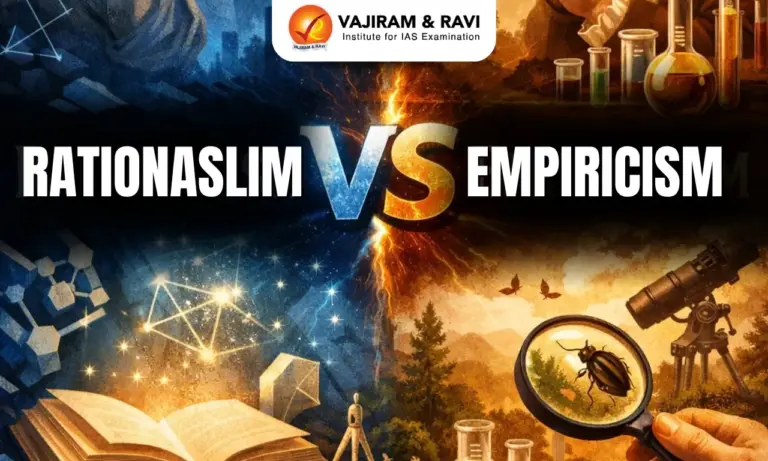
The debate between Rationalism and Empiricism represents one of the most fundamental intellectual confrontations in the history of philosophy. At its core, this debate seeks to answer a simple yet profound question: How do humans acquire knowledge? While Rationalism places its trust in reason and innate ideas, Empiricism emphasizes sense experience and observation as the foundation of knowledge. These two approaches have shaped Western philosophy, scientific inquiry, ethics, and modern education systems.
What is Rationaslim?
Rationalism is a philosophical doctrine that considers reason as the primary and most reliable source of knowledge. Rationalists argue that certain truths exist independently of sensory experience and can be discovered through logical reasoning, intellectual intuition, and deduction.
According to Rationalism, the human mind is not a blank slate. Instead, it is equipped with innate ideas or principles that structure human understanding. Mathematical truths, logical principles, and metaphysical concepts are often cited as examples of knowledge that does not depend on experience.
What is Empiricism?
Empiricism is a philosophical theory that asserts that all knowledge arises from sensory experience. Empiricists reject the notion of innate ideas and argue that the human mind begins as a tabula rasa, or blank slate.
According to Empiricism, ideas are formed through observation, perception, reflection, and experimentation. Knowledge, therefore, is always provisional and open to revision based on new experiences. This perspective laid the intellectual foundation for modern science and experimental methods.





Rationaslim vs Empiricism Comparison
Rationalism vs Empiricism represents a fundamental philosophical debate on the source of knowledge. While Rationalism emphasizes reason and innate ideas as the primary means of understanding reality, Empiricism asserts that knowledge arises mainly from sensory experience and observation.
| Rationaslim vs Empiricism Comparison | ||
| Basis of Comparison | Rationalism | Empiricism |
|
Definition |
Rationalism is a philosophical view that holds reason and logic as the primary sources of knowledge. |
Empiricism is a philosophical view that considers experience and sensory perception as the main sources of knowledge. |
|
Belief |
Rationalists believe that reason alone can explain the nature and working of the world. |
Empiricists believe that observation and experimentation are necessary to understand reality. |
|
Principles |
Based on mental processes, innate ideas, and organizing principles of the mind. |
Based on sensory experience, observation, and association of ideas. |
|
History |
The roots of Rationalism can be traced back to ancient Greek thinkers like Pythagoras (570–495 BCE) and later philosophers. |
Empiricism developed through early philosophical traditions (600–200 BCE) and was systematized later by modern thinkers. |
|
Examples |
Mathematics and logic are classic examples of rationalist knowledge. |
Experimental and natural sciences are prime examples of empiricist knowledge. |
Criticisms of Rationalism
- Overemphasizes abstract reasoning, often ignoring the role of real-world experience.
- The idea of innate ideas lacks clear empirical proof.
- Can lead to speculative and metaphysical conclusions detached from practical reality.
- Underestimates the importance of learning through observation and experimentation.
Criticisms of Empiricism
- Neglects the role of reason in organizing and interpreting experience.
- Fails to fully explain abstract knowledge such as mathematics and logic.
- Sensory experience can be misleading or subjective.
- Can result in skepticism, especially about universal truths and causality.

 Last updated on April, 2026
→ UPSC Final Result 2025 is now out.
→ UPSC has released UPSC Toppers List 2025 with the Civil Services final result on its official website.
→ Anuj Agnihotri secured AIR 1 in the UPSC Civil Services Examination 2025.
→ UPSC Marksheet 2025 is now out.
→ UPSC Notification 2026 & UPSC IFoS Notification 2026 is now out on the official website at upsconline.nic.in.
→ UPSC Calendar 2026 has been released.
→ Check out the latest UPSC Syllabus 2026 here.
→ UPSC Prelims 2026 will be conducted on 24th May, 2026 & UPSC Mains 2026 will be conducted on 21st August 2026.
→ The UPSC Selection Process is of 3 stages-Prelims, Mains and Interview.
→ Prepare effectively with Vajiram & Ravi’s UPSC Prelims Test Series 2026 featuring full-length mock tests, detailed solutions, and performance analysis.
→ Enroll in Vajiram & Ravi’s UPSC Mains Test Series 2026 for structured answer writing practice, expert evaluation, and exam-oriented feedback.
→ Join Vajiram & Ravi’s Best UPSC Mentorship Program for personalized guidance, strategy planning, and one-to-one support from experienced mentors.
→ Shakti Dubey secures AIR 1 in UPSC CSE Exam 2024.
→ Also check Best UPSC Coaching in India
Rationaslim vs Empiricism FAQs
Q1. What is the core debate between Rationalism and Empiricism?+
Q2. Which philosophy believes in innate ideas?+
Q3. Which approach influenced modern science more?+
Q4. Can sensory experience alone produce knowledge?+
Q5. Is there a middle path between Rationalism and Empiricism?+
Tags: rationaslim vs empiricism