State of the Economy Latest News
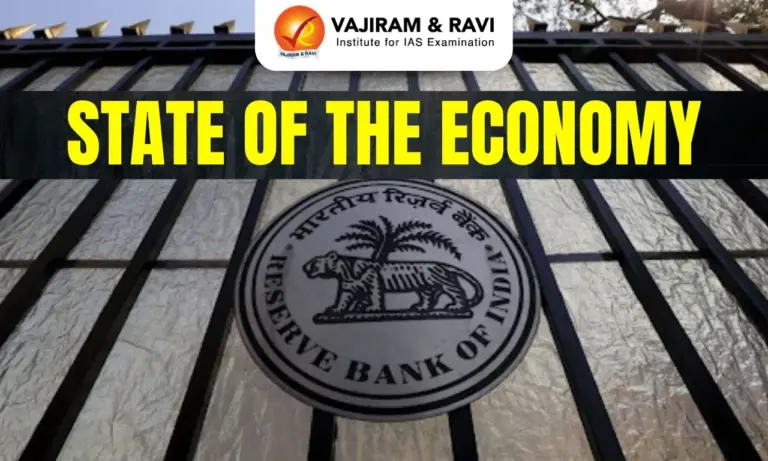
- The Reserve Bank of India (RBI), in its State of the Economy article, has assessed India’s macroeconomic conditions based on high-frequency indicators (for December 2025).
- The assessment points towards continued growth momentum, resilient domestic demand, and optimism about future prospects, despite elevated global geopolitical and geo-economic uncertainties.
- The views expressed in the article are those of the authors and not the official stance of the RBI.
Key Growth Signals – Domestic Economy
- Robust demand conditions: High-frequency indicators suggest sustained buoyancy in growth impulses. Demand conditions remain upbeat, supported by consumption and economic activity.
- Revival of rural demand:
- Retail automobile sales recorded broad-based growth across categories.
- Key drivers are GST rate cuts improving affordability, year-end promotional offers, and pre-buying ahead of expected price hikes in January.
- Commercial activity and logistics: Retail commercial vehicle sales maintained strong growth. It indicates improved goods movement, and strong underlying economic activity.
- GST and formal economy indicators: E-way bill generation continued healthy growth due to GST rate rationalisation, stock clearance, and firms pushing year-end sales.





Macro-Economic Indicators
- GDP growth: (National Statistics Office’s first advance estimate)
- The real GDP growth is estimated at 7.4% in 2025-26, up from 6.5% a year ago.
- Inflation trends: In December, the consumer price index (CPI) inflation rose to 1.3% driven by a lower rate of deflation in the food group along with an increase in core index.
Global Geopolitical and Geo-Economic Risks
- Key developments at the start of 2026:
- US intervention in Venezuela
- Ongoing Middle East conflict
- Uncertainty over Russia–Ukraine peace deal
- Escalation of the Greenland dispute
- Implications:
- Elevated geo-economic risks
- High policy uncertainty
- Potential spillover effects on trade, energy, and capital flows
Structural Reforms and Policy Environment (2025)
- Major reforms highlighted:
- Rationalisation of tax structures
- Implementation of labour codes (labour market reforms)
- Financial sector deregulation
- Expected outcomes:
- Improved growth prospects
- Enhanced productivity
- Strengthened medium- to long-term economic fundamentals
External Sector and Trade Strategy
- Export diversification: India has made significant efforts to diversify exports (like focusing on new markets in Africa and Latin America).
- Trade negotiations: Ongoing talks with 14 countries/groups, covering nearly 50 nations, including European Union (EU), Gulf Cooperation Council (GCC), United States.
Challenges and Way Ahead
- Persisting global geopolitical instability: Strengthen domestic demand while boosting export competitiveness.
- Risk of imported inflation: Tackling imported inflation by a mix of monetary (interest rate cuts), fiscal (reducing import duties) and trade policies (boosting domestic supply chains).
- Balancing growth and inflation management: Maintain a balanced policy approach between innovation vs. stability, and growth vs. consumer protection.
- Ensuring inclusive and sustainable growth: Deepen structural reforms to enhance productivity and resilience.
- Managing policy uncertainty: Continue prudent regulation and supervision.
Conclusion
- The RBI’s State of the Economy assessment underlines the resilience of the Indian economy, supported by strong domestic demand, improving rural consumption, robust GST indicators, and sustained reform momentum.
- While global uncertainties remain elevated, India’s macroeconomic fundamentals and reform-oriented policy framework provide credible grounds for optimism, positioning the economy for stronger and more stable long-term growth.
Source: IE

 Last updated on March, 2026
→ UPSC Final Result 2025 is now out.
→ UPSC has released UPSC Toppers List 2025 with the Civil Services final result on its official website.
→ Anuj Agnihotri secured AIR 1 in the UPSC Civil Services Examination 2025.
→ UPSC Marksheet 2025 is now out.
→ UPSC Notification 2026 & UPSC IFoS Notification 2026 is now out on the official website at upsconline.nic.in.
→ UPSC Calendar 2026 has been released.
→ Check out the latest UPSC Syllabus 2026 here.
→ UPSC Prelims 2026 will be conducted on 24th May, 2026 & UPSC Mains 2026 will be conducted on 21st August 2026.
→ The UPSC Selection Process is of 3 stages-Prelims, Mains and Interview.
→ Prepare effectively with Vajiram & Ravi’s UPSC Prelims Test Series 2026 featuring full-length mock tests, detailed solutions, and performance analysis.
→ Enroll in Vajiram & Ravi’s UPSC Mains Test Series 2026 for structured answer writing practice, expert evaluation, and exam-oriented feedback.
→ Join Vajiram & Ravi’s Best UPSC Mentorship Program for personalized guidance, strategy planning, and one-to-one support from experienced mentors.
→ Shakti Dubey secures AIR 1 in UPSC CSE Exam 2024.
→ Also check Best UPSC Coaching in India
State of the Economy FAQs
Q1. How do high-frequency indicators reflect the current growth momentum of the Indian economy?+
Q2. What factors contributed to the revival of rural demand as highlighted by the RBI?+
Q3. Despite global uncertainties, why does the RBI express optimism about India’s growth prospects?+
Q4. What is the role of structural reforms undertaken in 2025 in strengthening India’s long-term growth?+
Q5. How does India’s trade strategy contribute to economic resilience amid geo-economic uncertainties?+
Tags: mains articles state of the economy upsc current affairs upsc mains current affairs