IED Latest News
- A deadly blast near the Red Fort Metro Station in Delhi on November 10 killed 13 people and injured several others, likely caused by an improvised explosive device (IED).
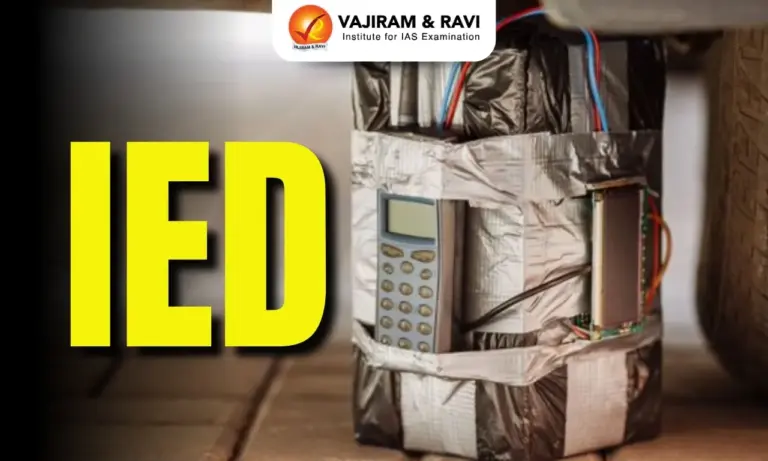
- While official details are still emerging, experts explain that IEDs are dangerous, easily assembled weapons capable of causing mass harm.
- They emphasise that IEDs reflect the darkest impulses of human intent and highlight the urgent need for a comprehensive national counter-IED strategy to prevent future attacks.
Why Terrorists Rely on IEDs
- IEDs remain the preferred weapon for terrorists because they are low-risk, high-impact, and easy to assemble using widely available materials.
- An IED typically consists of a container, battery, detonator, switch, and explosives, with added fragments like ball bearings or nails to increase lethality.
- Except for the detonator, most components can be improvised from everyday items.
- While most groups use commercially made detonators for reliability, some extremists have experimented with unstable homemade versions.
- Overall, the ease of fabrication and devastating potential make IEDs a go-to tool for terror attacks.





How IEDs Reveal the ‘Signature’ of the Terror Group
- IED components often carry identifiable patterns that help investigators trace the group behind an attack.
- The type of explosive used — military-grade like RDX/TNT, commercial explosives, or homemade mixtures such as ANFO (Ammonium Nitrate Fuel Oil) — offers key clues, since terror groups usually stick to familiar materials and methods.
- The triggering mechanism also narrows down suspects. Whether the device is command-operated, timer-based, or victim-operated (like suitcase or transistor bombs) reflects the group’s typical modus operandi.
- Additionally, the method of placement — vehicle-borne, suicide-borne, or person-borne — further refines the analysis.
- Together, these elements form a distinct “bomb signature,” enabling agencies to link an attack to likely perpetrators.
- The National Bomb Data Centre of the NSG maintains detailed blast records and provides expert assessments to support such investigations.
Declining Patterns in IED Attacks Across Conflict Zones
- IED attacks in India have shown a steady decline across major conflict areas, including Jammu & Kashmir, Naxal-affected regions, and the hinterland.
- In J&K, recent blasts have often used a mix of military-grade, commercial, and homemade explosives — as seen in the 2019 Pulwama attack, which combined RDX from Pakistan with locally sourced commercial explosives and fertiliser-based materials.
- Drone-dropped magnetic IEDs from Pakistan, once a concern in J&K and Punjab, have also reduced significantly.
- In Naxal-affected regions, IED incidents have sharply fallen, with most devices relying on commercially available explosives.
- In the rest of the country, only a few significant incidents have occurred, such as the 2024 Bengaluru Rameshwaram Café blast using low-grade explosives.
- Overall, jihadi groups now increasingly mix different explosive types to assemble devices, even as the overall frequency of attacks declines.
Sources of Explosives: A Persistent Cat-and-Mouse Battle
- Military-grade materials largely enter India through Pakistan-backed channels — via drones or human couriers.
- Despite stronger border surveillance, agencies must intercept every attempt, while handlers need only one success.
- This creates an unending cat-and-mouse dynamic requiring continuous technological upgrades and vigilance.
Commercial Explosives: Pilferage from Licensed Supply Chains
- Commercial explosives and detonators used in mining, construction and road projects are regulated by the Petroleum and Explosives Safety Organization (PESO).
- Although PESO enforces strong safety standards, its limited manpower leads to gaps at the last-mile.
- In insurgency-prone zones, pilferage occurs through coercion or collusion with end-users, making enforcement a challenge.
Homemade Explosives: Misuse of Precursor Chemicals
- Terrorists often extract explosive material from precursor chemicals and commonly available substances such as fertilisers.
- While Indian fertilisers include safeguards that make “cooking” difficult, the threat persists due to the wide availability of precursor items.
- Experts recommend identifying such chemicals clearly and mandating vendors to report bulk purchases to local police.
- This layered sourcing — border smuggling, local pilferage, and chemical extraction — underscores the need for tighter monitoring, inter-agency coordination, and proactive regulation.
Toward a National Counter-IED Policy Framework
- A comprehensive National Counter-IED Policy is urgently needed to unify strategy, clarify responsibilities, and strengthen coordination among all stakeholders involved in preventing and responding to explosive threats.
- The Red Fort blast appears to involve a nitrate-based mix, but speculating further is premature.
- The Nowgam police station explosion highlights critical gaps in safe handling.
- Such blasts can occur either due to an embedded detonator accidentally triggering upon friction or because contaminated, confined ammonium nitrate detonates when exposed to sustained heat.
- The key lesson is clear: all recovered explosives, blast remnants, and devices must be “rendered safe” exclusively by trained Bomb Detection and Disposal Squads before any evidence collection begins.
- The account also underscores the exemplary actions of the Srinagar doctor-cop whose meticulous investigation dismantled a new terror module — a reminder of the critical role of skilled, alert personnel in counter-terror operations.

 Last updated on March, 2026
→ UPSC Final Result 2025 is now out.
→ UPSC has released UPSC Toppers List 2025 with the Civil Services final result on its official website.
→ Anuj Agnihotri secured AIR 1 in the UPSC Civil Services Examination 2025.
→ UPSC Marksheet 2025 is now out.
→ UPSC Notification 2026 & UPSC IFoS Notification 2026 is now out on the official website at upsconline.nic.in.
→ UPSC Calendar 2026 has been released.
→ Check out the latest UPSC Syllabus 2026 here.
→ UPSC Prelims 2026 will be conducted on 24th May, 2026 & UPSC Mains 2026 will be conducted on 21st August 2026.
→ The UPSC Selection Process is of 3 stages-Prelims, Mains and Interview.
→ Prepare effectively with Vajiram & Ravi’s UPSC Prelims Test Series 2026 featuring full-length mock tests, detailed solutions, and performance analysis.
→ Enroll in Vajiram & Ravi’s UPSC Mains Test Series 2026 for structured answer writing practice, expert evaluation, and exam-oriented feedback.
→ Join Vajiram & Ravi’s Best UPSC Mentorship Program for personalized guidance, strategy planning, and one-to-one support from experienced mentors.
→ Shakti Dubey secures AIR 1 in UPSC CSE Exam 2024.
→ Also check Best UPSC Coaching in India
IED FAQs
Q1. What caused the Red Fort blast according to initial assessments?+
Q2. Why are IEDs popular among terrorist groups?+
Q3. How do investigators identify the terror group behind an IED blast?+
Q4. What are the key trends in IED attacks in India?+
Q5. Why does India need a national counter-IED policy?+
Tags: IED mains articles upsc current affairs upsc mains current affairs