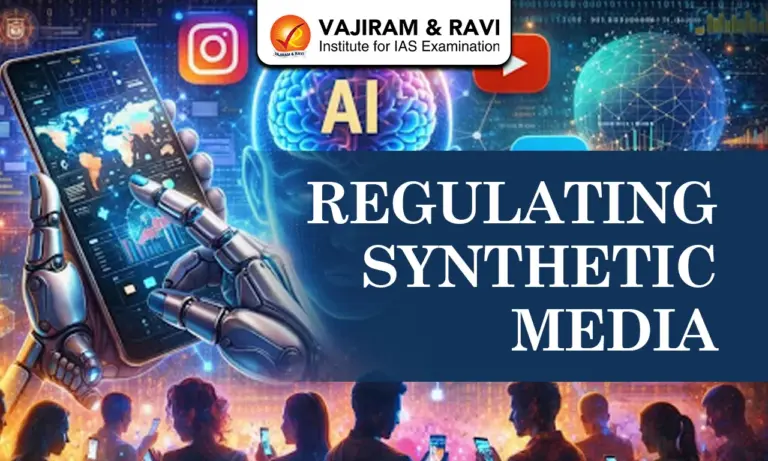
Regulating Synthetic Media Latest News
- The Union Government has notified amendments to the Information Technology (Intermediary Guidelines and Digital Media Ethics Code) Rules, 2021.
- It will strengthen regulation of AI-generated (synthetic) content and drastically reduce takedown timelines for unlawful material.
- The amendments (effective February 20, 2026) aim to curb the spread of non-consensual deepfakes, intimate imagery, and unlawful content, while reinforcing platform accountability under the IT Act, 2000.
Key Amendments at a Glance
- Sharp reduction in removal timelines:
- For example,
- For Court/Government-declared illegal content takedown timeline reduced to 3 hours (from earlier 24–36 hours.
- Similarly, for non-consensual intimate imagery/deepfakes it is 2 hours (earlier 24 hours), and for other unlawful content from 36 hours to 3 hours.
- Rationale: Earlier timelines were seen as ineffective in preventing virality. The government argues tech companies possess sufficient technical capacity for faster removal.
- Concerns: Determining “illegality” within 2–3 hours is operationally difficult. Risk of over-censorship and precautionary takedowns. Increased compliance burden for intermediaries.
- For example,
- Mandatory Labelling of AI-generated content:
- Legal definition of “Synthetically Generated Information (SGI)”: Audio, visual or audio-visual content artificially created, generated, modified, or altered using a computer resource in a way that makes it appear real or indistinguishable from authentic events or persons.
- Important features:
- AI-generated imagery must be labelled “prominently.”
- The earlier proposal requiring 10% of image space to carry the label has been diluted.
- Platforms must seek user disclosure for AI-generated content, proactively label content if disclosure is absent, and remove non-consensual deepfakes.
- Exclusions: Routine editing and quality-enhancing tools (e.g., smartphone touch-ups) are excluded — narrowing the scope from the draft October 2025 version.





Safe Harbour and Intermediary Liability
- What is Safe Harbour? Under Section 79 of the IT Act, 2000, intermediaries are protected from liability for user-generated content, provided they exercise “due diligence.”
- Amendment impact:
- If an intermediary knowingly permits, promotes, or fails to act against unlawful synthetic content, it may be deemed to have failed due diligence.
- This may result in loss of safe harbour protection, significantly increasing regulatory pressure on platforms.
Administrative Changes
- The amendment partially rolls back an earlier rule that limited States to appointing only one officer for issuing takedown orders.
- Now, States can designate multiple authorised officers, addressing administrative needs of populous States.
Trigger Events – The Global Deepfake Crisis
- The urgency follows global controversies, including AI platforms generating non-consensual intimate images of women.
- Such incidents raise privacy concerns, gender dignity issues, pose threats to democratic discourse, and misrepresents real-world events.
- This places the reform within a broader international debate on AI governance and platform accountability.
Governance and Constitutional Dimensions
- Article 19(1)(a) – Freedom of Speech: Overbroad or rushed takedowns may chill legitimate expression. Short timelines increase risk of defensive over-removal.
- Article 21 – Right to Privacy and Dignity: Faster removal of non-consensual deepfakes strengthens protection of individual dignity.
- Federal implications: Allowing multiple State officers enhances decentralised enforcement.
Key Challenges
- Determining illegality within 2–3 hours: Legal ambiguity, law enforcement communications may lack clarity.
- Risk of over-censorship: Platforms may make mistakes on the side of removal – could undermine free speech and digital innovation.
- Compliance burden on Big Tech: Real-time moderation requires high-end AI tools and human review. Smaller platforms may struggle disproportionately.
- Verification mechanisms: Ensuring authenticity of user declarations. Deploying “reasonable technical measures” without privacy violations.
Way Forward
- Clearer illegality standards: Develop structured guidance for platforms, and standardised digital takedown protocols.
- Independent oversight mechanism: Appellate or review authority to check arbitrary takedowns.
- Strengthening AI detection tools: Promote indigenous AI detection systems under India’s AI mission.
- Harmonisation with Digital Personal Data Protection Act: Ensure consistency in privacy and consent standards.
- Capacity building for States: Training authorised officers in cyber law and AI governance.
Conclusion
- India’s amended IT Rules reflect a decisive shift toward proactive regulation of AI-driven misinformation and digital harm.
- By these amendments, the government seeks to protect privacy, dignity, and public order in an era of rapidly advancing generative AI.
- However, the reform also raises critical concerns. So, the long-term success of this framework will depend on calibrated enforcement, technological readiness, and institutional safeguards against overreach.

 Last updated on March, 2026
→ UPSC Final Result 2025 is now out.
→ UPSC has released UPSC Toppers List 2025 with the Civil Services final result on its official website.
→ Anuj Agnihotri secured AIR 1 in the UPSC Civil Services Examination 2025.
→ UPSC Marksheet 2025 is now out.
→ UPSC Notification 2026 & UPSC IFoS Notification 2026 is now out on the official website at upsconline.nic.in.
→ UPSC Calendar 2026 has been released.
→ Check out the latest UPSC Syllabus 2026 here.
→ UPSC Prelims 2026 will be conducted on 24th May, 2026 & UPSC Mains 2026 will be conducted on 21st August 2026.
→ The UPSC Selection Process is of 3 stages-Prelims, Mains and Interview.
→ Prepare effectively with Vajiram & Ravi’s UPSC Prelims Test Series 2026 featuring full-length mock tests, detailed solutions, and performance analysis.
→ Enroll in Vajiram & Ravi’s UPSC Mains Test Series 2026 for structured answer writing practice, expert evaluation, and exam-oriented feedback.
→ Join Vajiram & Ravi’s Best UPSC Mentorship Program for personalized guidance, strategy planning, and one-to-one support from experienced mentors.
→ Shakti Dubey secures AIR 1 in UPSC CSE Exam 2024.
→ Also check Best UPSC Coaching in India
Regulating Synthetic Media FAQs
Q1. What is the significance of the recent amendments to the IT Rules, 2021?+
Q2. How do the amended IT Rules impact the doctrine of ‘safe harbour’ for intermediaries?+
Q3. What are the constitutional tensions arising from compressed takedown timelines under the amended IT Rules?+
Q4. What are the administrative and federal implications of the amendments?+
Q5. What are the challenges in operationalising the new definition of SGI under the IT Rules?+
Tags: mains articles regulating synthetic media upsc current affairs upsc mains current affairs