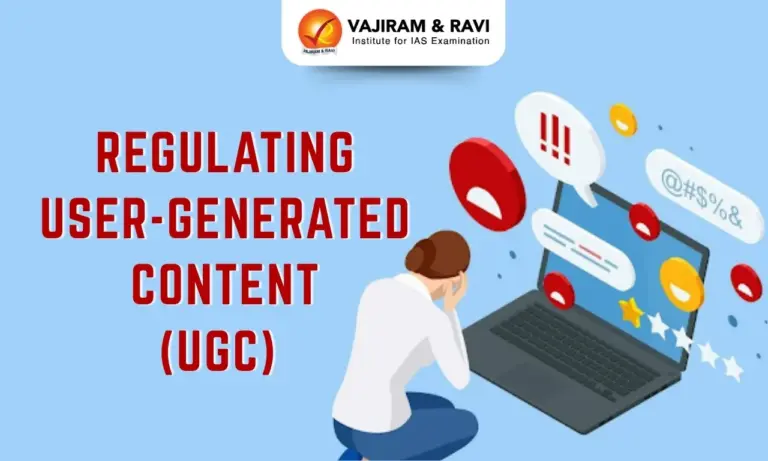
Regulating User-Generated Content (UGC) Latest News
- The Supreme Court of India expressed serious concern over the rapid spread of harmful User-Generated Content (UGC) on social media, including obscene, perverse, defamatory and allegedly “anti-national” content.
- The Court examined the need for autonomous regulation, age-verification mechanisms, preventive measures, and amendments to the IT (Intermediary Guidelines and Digital Media Ethics Code) Rules/ IT Rules 2021 while ensuring compliance with Article 19(1)(a) and Article 19(2).
Key Developments
- SC’s observations:
- UGC with adult content, defamatory material or harmful misinformation goes viral before takedowns are possible.
- Existing warnings before adult content are insufficient.
- Users can run their own channels without accountability — termed as “very strange” by the Chief Justice of India (CJI).
- Need for an impartial and autonomous authority, independent of government and private broadcasters.
- Protection vs free speech:
- The court clarified the intention not to curb free speech, but to protect innocents from irreversible harm.
- Emphasised that misuse of online speech undermines the rights of vulnerable individuals.





Proposed Regulatory Measures
- Preventive mechanisms for online content:
- Age verification: Suggested use of Aadhaar or PAN for age verification before accessing sensitive content.
- Stricter oversight: Autonomous body to regulate UGC — “self-styled bodies will not be effective.”
- AI–enabled moderation: Platforms must leverage AI for impact assessment, early detection, and prompt moderation.
- Amendments proposed by the Ministry of I&B:
- Expansion of the IT Rules, 2021: Incorporation of guidelines on obscenity standards, AI and deepfake regulation, accessibility norms, rating of content by age group, bar on anti-national digital content.
- Definition of “obscene content”: Based on lascivious character, prurient interest, and potential to “deprave or corrupt” the audience.
- Digital content must not:
- Offend decency, attack religions/communities, promote communal attitudes
- Be obscene, defamatory, false or contain suggestive innuendos
- Promote violence, anti-national attitudes, criminality
- Derogate women or PwDs
- Present indecent or vulgar themes
- Violate Cinematograph Act, 1952
- Include live coverage of anti-terror operations outside official briefings
- Community standards test: Use of Aveek Sarkar judgment (contemporary community standards).
- Content rating framework: U (can be viewed by a person under the age of 7 years with parental guidance), U/A 7+, U/A 13+, U/A 16+, A (online curated content which is restricted to adults).
Key Concerns Raised
- Risk of pre-censorship: Senior Advocate Amit Sibal warned that the term “preventive” may imply “pre-censorship.” Suggested replacing it with “effective” regulation.
- Ambiguity in ‘anti-national’ definition: Advocate Prashant Bhushan expressed concerns over broad and vague use of the term.
- Need for public consultations: Prior SC directions mandating consultations with stakeholders not yet followed. Pre-legislative consultation policy (2014) requires open public debate on such rules.
- Other concerns:
- Rapid virality of content before takedown.
- Lack of pre-emptive protection for victims.
- Borderless nature of social media communication.
- Difficulty balancing free speech with protection against harm.
- Children’s vulnerability to unfiltered online content.
- Confusion among platforms due to legal overlaps and pending challenges to IT Rules, 2021.
Way Forward
- Establish autonomous digital content authority: Independent of both State and private intermediaries.
- Implement secure age verification: Explore Aadhaar/PAN integration with strong privacy protections.
- Strengthen IT Rules, 2021: Clear standards for obscenity, deepfakes, community harm, and discrimination.
- Mandate public consultations: In line with the 2014 Pre-Legislative Consultation Policy.
- AI-driven early detection systems: Mandatory deployment for content risk assessment.
- Clear definition of key terms: Especially “anti-national,” “perverse content,” “obscene digital content”.
- Enhanced platform accountability: Strict penalties for non-compliance, modelled on SC/ST Act safeguarding principles.
Conclusion
- The Supreme Court’s intervention marks a critical step in India’s evolving digital governance landscape.
- While reaffirming the sanctity of freedom of speech under Article 19(1)(a), the Court emphasises the urgent need for preventive, accountable and technologically updated mechanisms to safeguard citizens from harmful UGC.
- The proposed amendments to the IT Rules, 2021 and establishment of an autonomous regulatory body aim to strike a delicate balance between digital rights and digital safety, ensuring a responsible and secure online environment.

 Last updated on March, 2026
→ UPSC Final Result 2025 is now out.
→ UPSC has released UPSC Toppers List 2025 with the Civil Services final result on its official website.
→ Anuj Agnihotri secured AIR 1 in the UPSC Civil Services Examination 2025.
→ UPSC Marksheet 2025 is now out.
→ UPSC Notification 2026 & UPSC IFoS Notification 2026 is now out on the official website at upsconline.nic.in.
→ UPSC Calendar 2026 has been released.
→ Check out the latest UPSC Syllabus 2026 here.
→ UPSC Prelims 2026 will be conducted on 24th May, 2026 & UPSC Mains 2026 will be conducted on 21st August 2026.
→ The UPSC Selection Process is of 3 stages-Prelims, Mains and Interview.
→ Prepare effectively with Vajiram & Ravi’s UPSC Prelims Test Series 2026 featuring full-length mock tests, detailed solutions, and performance analysis.
→ Enroll in Vajiram & Ravi’s UPSC Mains Test Series 2026 for structured answer writing practice, expert evaluation, and exam-oriented feedback.
→ Join Vajiram & Ravi’s Best UPSC Mentorship Program for personalized guidance, strategy planning, and one-to-one support from experienced mentors.
→ Shakti Dubey secures AIR 1 in UPSC CSE Exam 2024.
→ Also check Best UPSC Coaching in India
Regulating User-Generated Content (UGC) FAQs
Q1. Why did SC proposed an autonomous authority for regulating User-Generated Content (UGC)?+
Q2. How does the SC seek to balance freedom of speech with the need to regulate harmful digital content?+
Q3. What is the importance of age-verification mechanisms in the SC’s observations?+
Q4. What amendments to the IT Rules, 2021 were proposed to address issues around UGC?+
Q5. Why did the SC highlight the need for preventive mechanisms rather than relying solely on post-occurrence penalties?+
Tags: regulating user-generated content