Why in news?
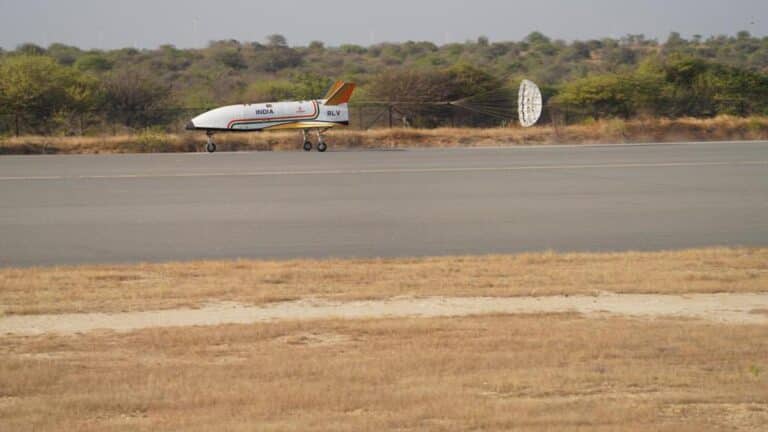
- An Indian Air Forces (IAF) Chinook helicopter was used to drop the RLV-TD from a 4.5 km altitude and ISRO executed the landing experiment of the RLV-TD as planned.
- The release of this vehicle was autonomous as it performed approach and landing manoeuvres using Integrated Navigation, Guidance, and control system and completed an autonomous landing on the airstrip
- It is the first in the world; a winged body has been carried to an altitude of 4.5 km.
- It is the second in the series of experimental flights of the programme.
Key facts about Reusable Launch Vehicle-Technology Demonstration
- This programme is planned as a series of technology demonstration missions that have been considered as a first step towards realising a Two Stage To Orbit (TSTO) fully reusable vehicle.
- A Winged RLV-TD has been configured to act as a flying test bed to evaluate various technologies namely, hypersonic flight, autonomous landing, and powered cruise flight.
- These technologies will be developed in phases through a series of experimental flights.
- RLV-TD is similar to that of an aircraft and combines the complexity of both launch vehicles and aircraft.
- Features of RLV-TD
- It consists of a fuselage (body), a nose cap, double delta wings, and twin vertical tails.
- It also features symmetrically placed active control surfaces called Elevons and Rudder.
What are the previous launches?
- RLV-TD was successfully flight tested on May 23, 2016, from Sriharikota validating the critical technologies such as autonomous navigation, guidance and control, reusable thermal protection system, and re-entry mission management.
- During this mission, the vehicle landed on a hypothetical runway over the Bay of Bengal.
Q1) What is a cruise missile?
A cruise missile either locates its target or has a preset target. It navigates using a guidance system such as inertial or beyond visual range satellite GPS guidance and comprises a payload and aircraft propulsion system.
Source: ISRO successfully conducts landing experiment of the Reusable Launch Vehicle






 Last updated on March, 2026
→ UPSC Final Result 2025 is now out.
→ UPSC has released UPSC Toppers List 2025 with the Civil Services final result on its official website.
→ Anuj Agnihotri secured AIR 1 in the UPSC Civil Services Examination 2025.
→ UPSC Marksheet 2025 is now out.
→ UPSC Notification 2026 & UPSC IFoS Notification 2026 is now out on the official website at upsconline.nic.in.
→ UPSC Calendar 2026 has been released.
→ Check out the latest UPSC Syllabus 2026 here.
→ UPSC Prelims 2026 will be conducted on 24th May, 2026 & UPSC Mains 2026 will be conducted on 21st August 2026.
→ The UPSC Selection Process is of 3 stages-Prelims, Mains and Interview.
→ Prepare effectively with Vajiram & Ravi’s UPSC Prelims Test Series 2026 featuring full-length mock tests, detailed solutions, and performance analysis.
→ Enroll in Vajiram & Ravi’s UPSC Mains Test Series 2026 for structured answer writing practice, expert evaluation, and exam-oriented feedback.
→ Join Vajiram & Ravi’s Best UPSC Mentorship Program for personalized guidance, strategy planning, and one-to-one support from experienced mentors.
→ Shakti Dubey secures AIR 1 in UPSC CSE Exam 2024.
→ Also check Best UPSC Coaching in India