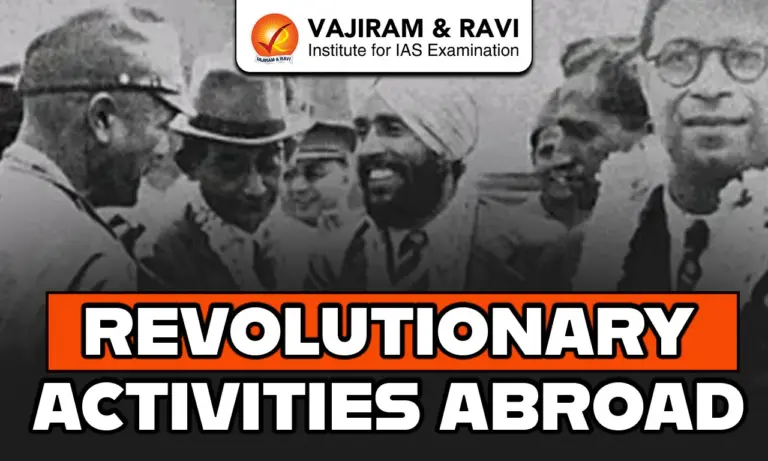
Revolutionary Activities Abroad formed a crucial dimension of India’s freedom struggle, especially during the early 20th century and World War I. When political repression intensified within India, several revolutionaries shifted their base to foreign countries such as England, Germany, France, the United States, Canada, Japan, Afghanistan, and Southeast Asia. From there, they organized networks, published nationalist literature, sought foreign assistance, and attempted armed revolts against British rule.
Revolutionary Activities Abroad Background
During World War I (1914-1918), Indian revolutionaries in exile saw an opportunity to weaken British power. Since Britain was engaged in a global war, its enemies especially Germany and Turkey, were seen as potential allies.
- Indian revolutionaries sought assistance from the German government to overthrow British rule in India.
- Efforts were made to mobilize support from Muslims in Iran, Iraq, and Afghanistan.
- Sardar Ajit Singh and Sufi Amba Prasad traveled to the Middle East to mobilize Indian soldiers captured during the war.
- Raja Mahendra Pratap led an Indo-German mission to Afghanistan and established a Provisional Government of India in Kabul (1915), seeking Afghan and German support against the British.
- The Komagata Maru incident intensified revolutionary feelings, particularly in Punjab.
- Revolutionary activities continued until 1945, when Subhas Chandra Bose died under mysterious circumstances.
Indian Home Rule Society (1905) and India House
The Indian Home Rule Society and its headquarters, India House, marked the beginning of organized revolutionary activities abroad. Founded in London, they became centers for spreading militant nationalism among Indian students and political exiles.
- Founder: Established in 1905 by Shyamji Krishna Varma to promote self-rule (Home Rule) for India.
- Objective: To create political awareness among Indian students in Britain and prepare them for revolutionary action.
- Publication: Varma published The Indian Sociologist, which criticized British rule and promoted nationalist ideology.
- Key Members: Included Vinayak Damodar Savarkar, Lala Har Dayal, and Madan Lal Dhingra.
- Major Incident: In 1909, Dhingra assassinated Curzon Wyllie, leading to a crackdown by British authorities.
- Decline: After Savarkar’s arrest (1910) and increasing surveillance, many members shifted to Paris, Geneva, and Berlin.





Revolutionary Centers in Europe
After repression in London, Indian revolutionaries established bases in continental Europe to continue their anti-British campaigns. Paris, Geneva, and Berlin emerged as prominent centers.
- Paris Base: Led by Bhikaji Cama, who published Bande Mataram and advocated independence internationally.
- Stuttgart Conference (1907): Madam Cama unfurled an early version of the Indian national flag at the Socialist Conference.
- Berlin Committee: Formed during World War I under Virendranath Chattopadhyaya to seek German support.
- Propaganda Work: Revolutionaries used European press freedom to publish anti-British literature.
- International Alliances: Attempted collaboration with Germany and Turkey against Britain.
- Strategic Shift: Europe became the hub for planning armed uprisings and coordinating with revolutionaries in India.
Ghadar Party (1913)
The Ghadar Party was formed in 1913 in the United States by Indian immigrants, mainly Sikhs, to organize armed revolt against British rule. It became one of the most influential overseas revolutionary organizations.
- Foundation: Established in San Francisco; early leadership included Sohan Singh Bhakna and Kartar Singh Sarabha.
- Ideology: Advocated complete independence through armed struggle.
- Publication: Published the Ghadar newspaper in multiple languages to inspire revolt.
- World War I Plan: Attempted to incite mutiny among Indian soldiers in 1915.
- British Suppression: Plans were foiled due to intelligence leaks; many leaders were arrested or executed.
- Impact: Inspired nationalist sentiments among overseas Indians and influenced later revolutionary movements.
Komagata Maru Incident (1914)
The Komagata Maru incident exposed racial discrimination in British colonies and intensified revolutionary activities, especially in Punjab.
- Chartered By: Gurdit Singh to challenge Canada’s discriminatory immigration laws.
- Passengers: 376 Indians (mostly Sikhs) sailed to Vancouver, Canada.
- Denial of Entry: Only 24 were allowed to land; others were forced to return.
- Return to India: Upon arrival in Calcutta, British police opened fire on protesting passengers.
- Casualties: Around 20 Sikhs were killed in the Budge Budge clash.
- Impact: Fueled revolutionary terrorism in Punjab and strengthened the Ghadar Movement.
Singapore Mutiny (1915)
The Singapore Mutiny was one of the most notable armed revolts by Indian soldiers abroad during World War I.
- Participants: Mainly soldiers of the 5th Light Infantry and 36th Sikh Battalion.
- Cause: Influenced by Ghadar propaganda and dissatisfaction among Muslim sepoys.
- Date: February 15, 1915.
- Leadership: Led by Jamadar Chisti Khan, Jamadar Abdul Gani, and Subedar Daud Khan.
- Suppression: Brutally crushed by British forces after intense fighting.
- Aftermath: 37 soldiers executed, 41 transported for life, demonstrating harsh colonial repression.
Indo-German Mission and Kabul Government
During World War I, Indian revolutionaries collaborated with Germany to weaken British rule and establish an alternative Indian government in exile.
- Leader: Raja Mahendra Pratap led the Indo-German mission.
- Establishment: Provisional Government of India formed in Kabul in 1915.
- Support: Received backing from Germany and Turkey.
- Objective: Secure Afghan support and declare war against Britain.
- Diplomatic Efforts: Attempted to gain international recognition.
- Outcome: Failed to achieve military success but symbolized India’s sovereignty abroad.
Continuation of Revolutionary Activities – INA Phase
Revolutionary activities abroad continued into World War II under the leadership of Subhas Chandra Bose, who revitalized the militant struggle through the Indian National Army (INA).
- Reorganization: Bose reorganized the INA in 1943 in Southeast Asia.
- Azad Hind Government: Established the Provisional Government of Free India.
- Military Campaign: Launched the “Delhi Chalo” movement against British forces.
- Women’s Regiment: Formed the Rani of Jhansi Regiment.
- INA Trials (1945-46): Sparked nationwide protests in India.
- Impact: Weakened British control and strengthened the final push toward independence in 1947.

 Last updated on April, 2026
→ UPSC Final Result 2025 is now out.
→ UPSC has released UPSC Toppers List 2025 with the Civil Services final result on its official website.
→ Anuj Agnihotri secured AIR 1 in the UPSC Civil Services Examination 2025.
→ UPSC Marksheet 2025 is now out.
→ UPSC Notification 2026 & UPSC IFoS Notification 2026 is now out on the official website at upsconline.nic.in.
→ UPSC Calendar 2026 has been released.
→ Check out the latest UPSC Syllabus 2026 here.
→ UPSC Prelims 2026 will be conducted on 24th May, 2026 & UPSC Mains 2026 will be conducted on 21st August 2026.
→ The UPSC Selection Process is of 3 stages-Prelims, Mains and Interview.
→ Prepare effectively with Vajiram & Ravi’s UPSC Prelims Test Series 2026 featuring full-length mock tests, detailed solutions, and performance analysis.
→ Enroll in Vajiram & Ravi’s UPSC Mains Test Series 2026 for structured answer writing practice, expert evaluation, and exam-oriented feedback.
→ Join Vajiram & Ravi’s Best UPSC Mentorship Program for personalized guidance, strategy planning, and one-to-one support from experienced mentors.
→ Shakti Dubey secures AIR 1 in UPSC CSE Exam 2024.
→ Also check Best UPSC Coaching in India
Revolutionary Activities Abroad FAQs
Q1. What are Revolutionary Activities Abroad?+
Q2. Why did Indian revolutionaries move abroad?+
Q3. What was the role of the Indian Home Rule Society?+
Q4. What was the Ghadar Party?+
Q5. What was the Komagata Maru Incident?+
Tags: modern indian history revolutionary activities abroad