Right to Protest in India Latest News
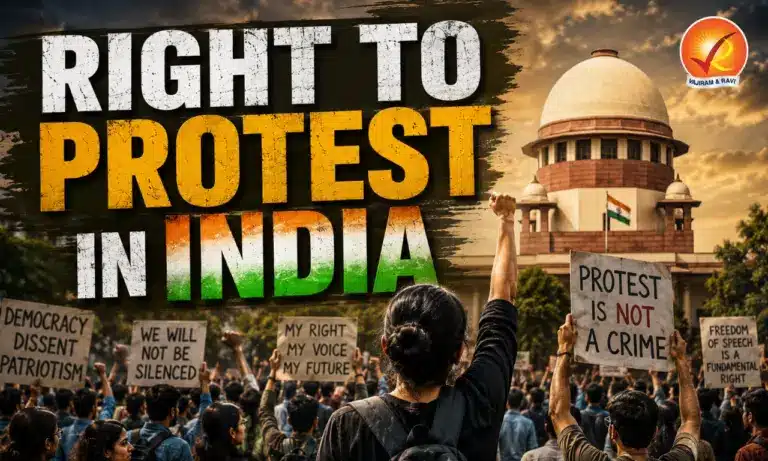
- Police cracked down on the Cockroach Janta Party (CJP) and its supporters as thousands joined a planned march to Parliament, leading to the shutting of Parliament complex gates.
- The government engaged with protesters, with CJP submitting a written letter of demands to a senior ruling party leader. The episode has revived the debate: is staging a protest legal in India, and what forms of protest are permitted?
Constitutional Basis for the Right to Protest
- The right to protest is protected under the Fundamental Right to Freedom:
- Article 19(1)(a): Guarantees “freedom of speech and expression.”
- Article 19(1)(b): Guarantees the right to “assemble peaceably and without arms.”
- However, these rights are subject to “reasonable restrictions” in the interest of:
- Sovereignty and integrity of India
- Security of the State
- Friendly relations with foreign States
- Public order, decency, or morality
- Contempt of court, defamation, or incitement to an offence


How Protests Are Regulated
- While citizens have the right to organise protests, this must be exercised within constitutional restrictions.
- The common regulatory practice in India includes:
- Designating specific spots for protests
- Making police permission mandatory
- Imposing prohibitory orders under Section 163 of the Bharatiya Nagarik Suraksha Sanhita (earlier Section 144 of the CrPC)
India’s Position at the UN
- At the 47th Session of the UN Human Rights Council (Geneva, 2021), India’s representative affirmed that peaceful assembly and marches are a “cherished and valuable aspect” of India’s democratic tradition, tracing this practice back to the independence struggle.
- It was noted that Article 19 guarantees the right to assemble peacefully without arms and to form associations and unions, and that the Supreme Court has recognised peaceful protest as a constitutional right.
- India also emphasised that the government must balance citizens’ rights with its duty to protect the right to life.
Key Supreme Court Rulings on Protest Rights
- The Supreme Court has, over the years, upheld both the right to protest and reasonable limits on it.
Himat Lal K. Shah v. Commissioner of Police (1973)
- The Court held that freedom of assembly is essential to democracy, enabling citizens to meet and discuss religious, political, economic, or social issues.
- It clarified that while the State can regulate its property for public purposes, there is a constitutional difference between “reasonable regulation and arbitrary exclusion.”
Mazdoor Kisan Shakti Sangathan v. Union of India (2018)
- This case challenged the repeated imposition of Section 144 CrPC banning assembly near Parliament House, North and South Block, Central Vista Lawns, and surrounding areas in Delhi.
- The Court laid down specific guidelines:
- Regulating the number of participants
- Maintaining minimum distance from Parliament House, North/South Blocks, the Supreme Court, and dignitaries’ residences
- Prohibiting demonstrators from carrying firearms, lathis, spears, swords, etc.
- This ruling effectively reaffirmed Jantar Mantar as Delhi’s designated protest site while clarifying that regulation must not amount to prohibition.
Amit Sahni v. Commissioner of Police (2020) – The Shaheen Bagh case
- The Supreme Court ruled that protests must be held in “identified areas” and that protesters cannot block public roads or cause public inconvenience.
- The Court stated clearly: “You cannot block public roads. There cannot be indefinite period of protest in such an area… You cannot create inconvenience for the people.”

 Last updated on July, 2026
→ UPSC Prelims Result 2026 is now out.
→ UPSC IFoS Prelims Result 2026 is now out.
→ Enroll in Vajiram & Ravi’s UPSC Mains Test Series 2026 for structured answer writing practice, expert evaluation, and exam-oriented feedback.
→ Join Vajiram & Ravi’s UPSC Mentorship Program 2026 for personalized guidance, strategy planning, and one-to-one support from experienced mentors.
→ Join Vajiram & Ravi’s UPSC Mentorship Program 2027 for personalized guidance, strategy planning, and one-to-one support from experienced mentors.
→ UPSC Prelims Provisional Answer Key 2026 out for GS Paper 1 and CSAT.
→ UPSC Prelims Question Paper 2026 Out, Download GS Paper 1 PDF conducted on 24th May 2026.
→ UPSC Mains 2026 will be conducted from 21st August 2026 onwards, and UPSC Prelims 2027 will be held on 23rd May 2027.
→ UPSC Final Result 2025 is now out.
→ UPSC has released UPSC Toppers List 2025 with the Civil Services final result on its official website.
→ Anuj Agnihotri secured AIR 1 in the UPSC Civil Services Examination 2025.
→ UPSC Notification 2026 & UPSC IFoS Notification 2026 is now out on the official website at upsconline.nic.in.
→ UPSC Calendar 2027 has been released.
→ Check out the latest UPSC Syllabus 2026 here.
→ The UPSC Selection Process is of 3 stages-Prelims, Mains and Interview.
→ Shakti Dubey secures AIR 1 in UPSC CSE Exam 2024.
→ Also check Best UPSC Coaching in India
Right to Protest in India FAQs
Q1. What is the constitutional basis of the Right to Protest in India?+
Q2. Can the Right to Protest in India be restricted?+
Q3. How has the Supreme Court interpreted the Right to Protest in India?+
Q4. What role does Section 163 of the BNSS play in the Right to Protest in India? +
Q5. Why is the Right to Protest in India important in a democracy?+
Tags: right to protest in india upsc current affairs upsc mains current affair