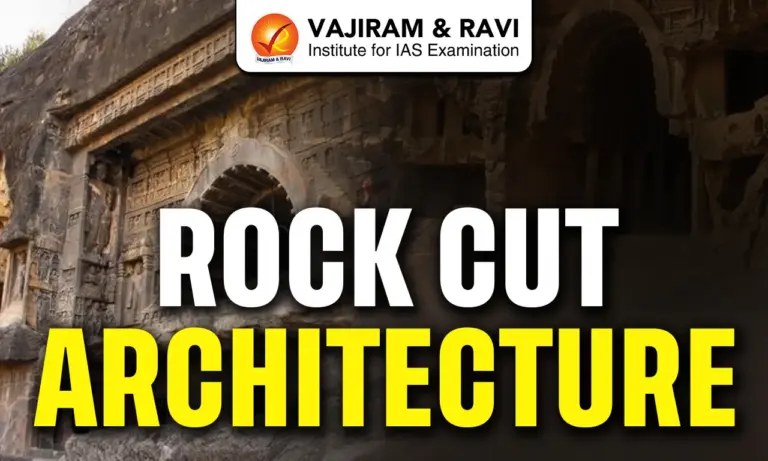
Rock Cut Architecture represents one of the most remarkable achievements of ancient Indian engineering and artistic skill. This method produced caves, temples, monasteries, and sculptures without assembling separate building materials. In India, Rock Cut Architecture developed extensively and reflects remarkable achievements in ancient engineering, art, and religious expression. Many of these monuments were built between the 3rd century BCE and the medieval period.
What is Rock Cut Architecture?
Rock Cut Architecture is the practice of excavating and sculpting structures from a single solid rock mass. Instead of constructing buildings with bricks or stones, artisans removed unwanted rock portions to create interior spaces, pillars, halls, and sculptures. This technique demanded advanced craftsmanship and planning. In India, most rock cut structures were associated with religious activities such as monasteries, prayer halls, and temples.
Rock Cut Architecture Historical Evolution
Rock Cut Architecture in India evolved through several historical phases, reflecting religious developments, technological advancement, and artistic creativity across centuries.
- Prehistoric Natural Cave Usage: Early humans used natural caves for shelter and ritual activities during the Palaeolithic and Mesolithic periods. Sites such as the Bhimbetka rock shelters contain paintings dating around 8000 BCE and represent early artistic expression on rock surfaces.
- Early Religious Use of Natural Caves: During the time of Gautama Buddha in the 6th century BCE, monks began using natural caves for meditation and residence. The Saptaparni Cave near Rajgir in Bihar is believed to have hosted the first Buddhist council after Buddha’s death.
- Mauryan Period Rock-Cut Caves: The earliest artificial rock-cut caves in India were built during the Mauryan Empire in the 3rd century BCE. The Barabar caves in Bihar were commissioned by Emperor Ashoka around 250 BCE and feature polished granite interiors with precise geometric designs.
- Development of Advanced Cave Architecture: In the post-Mauryan period, cave construction expanded significantly. Religious communities began carving more elaborate caves containing pillars, halls, and decorative elements. These structures were largely funded by merchants, rulers, and religious followers.
- Western Deccan Expansion: Between 100 BCE and 170 CE, cave architecture flourished in western India. Buddhist caves such as Bhaja, Karla, Bedse, Kanheri, and Ajanta developed along major trade routes where monks interacted with travelling merchants.
- Influence of Wooden Architecture: Early rock-cut caves often imitated wooden structures. Craftsmen carved stone beams, arches, and pillars resembling timber architecture, preserving the style of earlier wooden buildings that had decayed over time.
- Rise of Chaitya and Vihara Structures: During early centuries CE, Rock Cut Architecture evolved into two main types of religious spaces. Chaitya halls served as prayer halls with stupas, while Viharas functioned as monasteries where monks lived in small cells around central halls.
- Second Phase of Construction: A major revival occurred during the 5th and 6th centuries CE with sites like Ajanta and Ellora. These complexes displayed advanced artistic decoration, sculptural reliefs, and intricate architectural planning.
- Hindu and Jain Influence: Over time, Hindu and Jain rulers also began commissioning rock-cut temples. The Badami caves and Ellora complex include temples dedicated to Hindu gods and Jain Tirthankaras, showing religious diversity in rock-cut monuments.
- Final Phase of Rock-Cut Monuments: Rock cut construction continued until the medieval period. Jain monuments around Gwalior Fort and other regions represent some of the last phases of rock carving before free-standing temples became dominant.
Also Read: Historical Monuments in India





Rock Cut Architecture Types
Rock Cut Architecture developed into multiple structural forms used for religious worship, residence, and artistic expression across different historical periods.
- Rock-Cut Caves: These are excavated chambers carved into hillsides or cliffs. Many served as monasteries and meditation spaces for monks. Early examples include the Barabar caves and numerous Buddhist caves in western India.
- Chaitya Halls: Chaityas were prayer halls containing a stupa at the end of an apsidal hall. They often featured columns forming a circumambulatory path. The Karla Chaitya Hall in Maharashtra is one of the largest examples built in the 1st century BCE.
- Viharas (Monastic Residences): Viharas were residential complexes where monks lived and studied. They typically contained a large central hall surrounded by small individual cells carved into the rock for monks’ accommodation.
- Rock-Cut Temples: Unlike caves, these temples were carved to resemble structural temples with decorative pillars, halls, and sculptures. They often depicted deities and mythological scenes from religious traditions.
- Monolithic Temples: Monolithic structures were carved entirely from a single rock mass. The Kailash Temple at Ellora is the most famous example, excavated vertically from the top of a basalt hill during the 8th century CE.
- Rock Relief Sculptures: Some monuments were created as large sculptures carved directly into rock faces. These reliefs often depicted mythological scenes and religious figures in large monumental compositions.
- Rock-Cut Stepwells: Stepwells are deep wells with steps leading to water reservoirs. Some were carved directly into rock formations and used for water conservation during dry seasons in regions such as Gujarat and Rajasthan.
- Rock-Cut Monastic Complexes: Large cave complexes often contained multiple structures including chaityas, viharas, shrines, and courtyards. These complexes functioned as religious centres for study, worship, and pilgrimage.
Rock Cut Architecture in India
India contains more than 1,500 Rock Cut Architecture representing the most extensive collection of such structures in the world.
- Barabar Caves, Bihar: Built during the Mauryan period around 250 BCE, these caves were commissioned by Emperor Ashoka and his grandson Dasharatha. The caves feature extremely smooth granite walls polished to a mirror-like finish and are among the earliest artificial caves in India.
- Bhaja Caves, Maharashtra: Dating from around the 2nd century BCE, these Buddhist caves contain chaitya halls and monasteries carved into basalt cliffs. The complex includes carved pillars and wooden-style architectural features preserved in stone.
- Karla Caves, Maharashtra: The Karla cave complex contains one of the largest chaitya halls in India built during the 1st century BCE. The structure includes tall pillars, decorative facades, and a large stupa used for congregational worship.
- Bedse Caves, Maharashtra: These Buddhist caves are known for their beautifully carved entrance arches and large prayer halls. The caves demonstrate advanced architectural planning and decorative carvings from the early centuries CE.
- Kanheri Caves, Maharashtra: Located near Mumbai, this complex contains over 100 Buddhist caves dating from the 1st century BCE onwards. The site served as a major monastic centre with living quarters, prayer halls, and inscriptions from donors.
- Ajanta Caves, Maharashtra: Ajanta consists of 30 rock-cut Buddhist caves built between the 2nd century BCE and 6th century CE. The caves include monasteries and chaitya halls famous for their murals, sculptures, and detailed carvings depicting Buddhist themes.
- Ellora Caves, Maharashtra: Ellora is one of the largest rock-cut complexes with 34 caves built between the 5th and 11th centuries CE. The caves represent three religions with 12 Buddhist caves, 17 Hindu caves, and 5 Jain caves.
- Kailash Temple, Ellora: The Kailash temple (Cave 16) is a massive monolithic structure carved from a single rock. Commissioned by Rashtrakuta king Krishna I in the 8th century CE, it required excavation more than 100 feet deep into basalt rock.
- Elephanta Caves, Maharashtra: Located on Elephanta Island near Mumbai, these caves contain magnificent Hindu sculptures dedicated mainly to Lord Shiva. The central hall features massive stone pillars and the famous three-headed Shiva sculpture.
- Badami Cave Temples, Karnataka: These caves were created in the 6th century CE during the Chalukya period. The complex includes four caves with elaborate carvings of Hindu deities and one Jain shrine.
- Udayagiri and Khandagiri Caves, Odisha: Built during the reign of King Kharavela in the 2nd century BCE, these caves were mainly used by Jain monks. The complex contains 18 caves in Udayagiri and 15 caves in Khandagiri.
- Bagh Caves, Madhya Pradesh: The Bagh caves consist of nine Buddhist caves built around the 6th century CE along the Bagh River. These caves resemble the architectural design and decoration style seen in Ajanta.
- Udayagiri Caves, Madhya Pradesh: These Gupta period caves include around 20 rock-cut chambers. Cave 5 contains a large relief of the Varaha incarnation of Vishnu rescuing the Earth goddess.
- Pandavleni Caves, Maharashtra: Also known as Nasik caves, this group contains 24 Buddhist caves built between the 1st century BCE and 3rd century CE. The caves include inscriptions from rulers and merchants.
- Mahabalipuram Monuments, Tamil Nadu: This coastal site contains monolithic rock-cut temples and sculptures created by the Pallava dynasty in the 7th century CE. The Pancha Rathas are famous examples carved from single stone blocks.
- Gwalior Rock-Cut Jain Monuments: These monuments near Gwalior Fort contain large statues of Jain Tirthankaras carved into rock cliffs between the 6th and 15th centuries CE, representing one of the final phases of rock-cut architecture.
- Masroor Rock-Cut Temple, Himachal Pradesh: The Masroor temples are a group of monolithic rock-cut temples carved from sandstone. They display Nagara style architecture and represent a rare example of rock-cut Hindu temple design in northern India.
- Undavalli Caves, Andhra Pradesh: These caves were built during the 4th to 5th centuries CE and contain large multi-storey structures with Buddhist and later Hindu sculptures carved into sandstone hills.

 Last updated on March, 2026
→ UPSC Final Result 2025 is now out.
→ UPSC has released UPSC Toppers List 2025 with the Civil Services final result on its official website.
→ Anuj Agnihotri secured AIR 1 in the UPSC Civil Services Examination 2025.
→ UPSC Marksheet 2025 is now out.
→ UPSC Notification 2026 & UPSC IFoS Notification 2026 is now out on the official website at upsconline.nic.in.
→ UPSC Calendar 2026 has been released.
→ Check out the latest UPSC Syllabus 2026 here.
→ UPSC Prelims 2026 will be conducted on 24th May, 2026 & UPSC Mains 2026 will be conducted on 21st August 2026.
→ The UPSC Selection Process is of 3 stages-Prelims, Mains and Interview.
→ Prepare effectively with Vajiram & Ravi’s UPSC Prelims Test Series 2026 featuring full-length mock tests, detailed solutions, and performance analysis.
→ Enroll in Vajiram & Ravi’s UPSC Mains Test Series 2026 for structured answer writing practice, expert evaluation, and exam-oriented feedback.
→ Join Vajiram & Ravi’s Best UPSC Mentorship Program for personalized guidance, strategy planning, and one-to-one support from experienced mentors.
→ Shakti Dubey secures AIR 1 in UPSC CSE Exam 2024.
→ Also check Best UPSC Coaching in India
Rock Cut Architecture FAQs
Q1. What is Rock Cut Architecture?+
Q2. Where is the earliest Rock Cut Architecture found in India?+
Q3. How many Rock Cut structures are found in India?+
Q4. What are the main types of Rock Cut structures in India?+
Q5. Which is the most famous Rock Cut Temple in India?+
Tags: architecture rock cut architecture