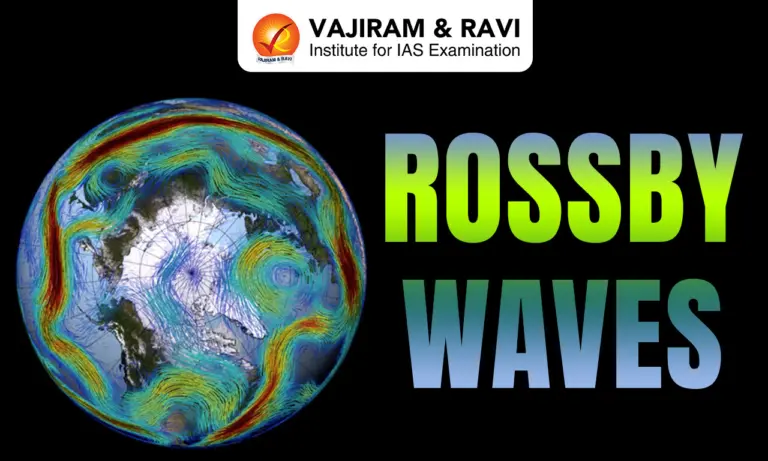
Rossby Waves are large, slow-moving waves in the Earth’s atmosphere that form due to the rotation of the Earth. They influence the movement of winds and weather systems across the planet. These waves play an important role in shaping global weather patterns and climate. The concept of Rossby waves was introduced by meteorologist Carl-Gustaf Rossby.
About Rossby Waves
- Rossby Waves are a type of large-scale planetary waves that occur in the atmosphere and oceans because the Earth rotates. They form naturally in moving fluids such as air and water due to the planet’s rotation.
- In the atmosphere, Rossby waves appear as large bends or meanders in high-altitude winds. These waves strongly influence weather patterns and are closely linked with the jet stream and different pressure systems that control the movement of storms.
- In the oceans, Rossby waves move slowly along the thermocline, which is the boundary separating the warm surface water from the colder, deeper layers.
- These waves develop when cold air from polar regions moves toward the Equator and warm tropical air moves toward the poles. This movement helps transfer heat from lower latitudes to higher latitudes, balancing the Earth’s climate system.
- Rossby waves also help explain the formation and movement of high-pressure and low-pressure systems, including cyclones, which are important for the weather of middle and high latitudes.
- For Rossby waves to occur, the fluid must behave in a barotropic manner, meaning its density mainly depends on pressure rather than temperature differences.
Rossby Waves Types
Rossby waves can mainly be divided into three types based on where they occur and how they move.
Oceanic Rossby Waves
- Oceanic Rossby waves occur in the oceans and are extremely large waves that move slowly across the ocean surface, usually from east to west. Unlike the small waves seen near the shore, these waves are very broad and can extend for hundreds of kilometres across the ocean.
- They travel along the thermocline, the boundary between warm surface water and colder deep water. Because of their large size and slow movement, they can influence ocean circulation and climate patterns over long periods.
- These waves can also affect sea level variations in certain regions. When combined with phenomena such as El Niño and seasonal high tides (often called King Tides), they may contribute to coastal flooding and unusually high sea levels in some parts of the world.
Atmospheric Rossby Waves
- Atmospheric Rossby waves occur in the upper atmosphere and appear as large bends or loops in high-altitude winds. These waves are closely associated with the Jet Stream.
- They play an important role in redistributing heat across the Earth by moving warm air from the tropics toward the poles and cold air from polar regions toward lower latitudes. In this way, they help maintain the global balance of temperature.
- Atmospheric Rossby waves also influence the movement of low-pressure and high-pressure systems, which determine the paths of storms and cyclones. Because these waves move slowly, they often lead to long-lasting weather conditions, such as prolonged rainfall, heat waves, or cold spells.
- Their movement is influenced mainly by the Coriolis force and differences in atmospheric pressure. Due to Earth’s rotation, moving air turns to the right in the Northern Hemisphere and to the left in the Southern Hemisphere.
Poleward Propagating Atmospheric (Topographic) Rossby Waves
- These Rossby waves are generated when strong heating occurs in the tropical regions, especially over very warm ocean surfaces. For example, during El Niño events, intense heating of the atmosphere leads to strong upward movement of warm air (deep convection).
- This process can generate atmospheric Rossby waves that move toward higher latitudes (poleward) and sometimes eastward. As they travel, they influence weather patterns far away from the tropics.
- Topographic Rossby waves can also be affected by large mountain ranges and landforms, which modify atmospheric circulation. These waves help explain the link between tropical climate events and weather changes in mid-latitude regions.





Rossby Waves Significance
- Role in Atmospheric Circulation: Rossby waves are an important part of the Ferrel Cell and help move warm tropical air toward the poles and cold polar air toward lower latitudes, maintaining the Earth’s heat balance.
- Weather Formation: They influence the formation and movement of cyclones (low-pressure systems) and anticyclones (high-pressure systems), which control weather conditions in middle and high latitudes.
- Long-lasting Weather Patterns: Because Rossby waves move slowly, they can cause persistent weather events such as heat waves, cold spells, or prolonged rainfall.
- Presence on Other Planets: Similar waves have been observed in the atmospheres of planets like Venus and Jupiter.
- Solar and Space Studies: Rossby-type waves have also been detected on the Sun, helping scientists study space weather, which can affect satellites, GPS systems, and power grids.
- Planetary Science: These waves may contribute to ocean heating on Europa and are also believed to occur in gas disks around forming stars.

 Last updated on March, 2026
→ UPSC Final Result 2025 is now out.
→ UPSC has released UPSC Toppers List 2025 with the Civil Services final result on its official website.
→ Anuj Agnihotri secured AIR 1 in the UPSC Civil Services Examination 2025.
→ UPSC Marksheet 2025 is now out.
→ UPSC Notification 2026 & UPSC IFoS Notification 2026 is now out on the official website at upsconline.nic.in.
→ UPSC Calendar 2026 has been released.
→ Check out the latest UPSC Syllabus 2026 here.
→ UPSC Prelims 2026 will be conducted on 24th May, 2026 & UPSC Mains 2026 will be conducted on 21st August 2026.
→ The UPSC Selection Process is of 3 stages-Prelims, Mains and Interview.
→ Prepare effectively with Vajiram & Ravi’s UPSC Prelims Test Series 2026 featuring full-length mock tests, detailed solutions, and performance analysis.
→ Enroll in Vajiram & Ravi’s UPSC Mains Test Series 2026 for structured answer writing practice, expert evaluation, and exam-oriented feedback.
→ Join Vajiram & Ravi’s Best UPSC Mentorship Program for personalized guidance, strategy planning, and one-to-one support from experienced mentors.
→ Shakti Dubey secures AIR 1 in UPSC CSE Exam 2024.
→ Also check Best UPSC Coaching in India
Rossby Waves FAQs
Q1. What are Rossby Waves?+
Q2. Who introduced the concept of Rossby Waves?+
Q3. Why do Rossby Waves form?+
Q4. What are the main types of Rossby Waves?+
Q5. What is the role of Rossby Waves in weather systems?+
Tags: geography rossby waves