Rupee Depreciation Latest News
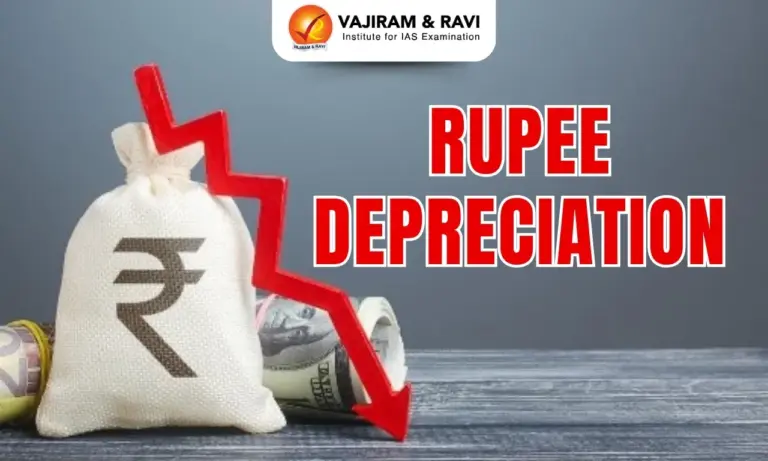
- The Indian Rupee (INR) recently breached the psychological level of ₹91/USD, triggering speculation about a possible slide towards ₹100/USD.
- The rupee depreciation comes amid global trade uncertainties, especially high U.S. tariffs on Indian goods, and has sparked a debate on whether this trend is structurally worrisome or cyclical and manageable.
- Experts present divergent views on the implications for macroeconomic stability, capital flows, exports, and growth.
Key Drivers of Rupee Depreciation
- External factors:
- U.S. tariffs (up to 50%) on Indian exports under the Trump administration.
- Global market volatility and risk-off sentiment.
- Broad-based depreciation of INR against major global currencies (USD, Euro, Yen, Pound, Swiss Franc, etc.).
- Domestic structural factors:
- Persistent Current Account Deficit (CAD).
- Dependence on capital inflows to finance growth.
- Rising outward remittances under the Liberalised Remittance Scheme (LRS) and demand for gold as a hedge.





Divergent Expert Views
- View 1 – Key arguments on depreciation as a serious concern:
- A “leaking rupee” hampers income growth targets.
- Reduces foreign portfolio investment (FPI) attractiveness due to currency risk.
- Encourages capital flight via LRS and dollar-linked assets.
- Shrinks domestic capital availability, increasing the cost of capital.
- Weakens macroeconomic growth potential in a high-growth phase.
- On exports: The notion that a weak rupee boosts exports is a myth –
- Indian exports lack pricing power (unlike Apple/Microsoft).
- Mostly B2B exports, where buyers negotiate based on rupee cost structures.
- Major exporter China succeeded on constant currency competitiveness, not depreciation.
- View 2 – Key arguments on depreciation not alarming:
- Depreciation is externally driven, not due to domestic macro weakness.
- India’s macroeconomic fundamentals remain strong adequate forex reserves, manageable CAD, robust GDP growth
- Seen as a temporary aberration, not a structural crisis.
- Opportunity angle:
- Indian Government Bonds (IGBs) are effectively 6% cheaper for foreign investors due to currency depreciation.
- Could attract fresh capital inflows into Indian markets.
Impact on Export Competitiveness
- Changing export structure: Shift towards value-added exports: engineering goods, specialty chemicals, pharmaceuticals, electronics.
- Problem with depreciation: These sectors have high import intensity in their value chains. A weaker rupee raises input costs, potentially reducing net export competitiveness.
Outlook for the Rupee
- Short-term pressure: Likely due to tariffs and global uncertainty.
- Medium-term optimism: Expected India–U.S. trade deal by early 2026. Anticipated improvement in capital flows.
- Long-term scenario:
-
- Assuming 2–3% annual depreciation, the rupee may stay under pressure but avoid disorderly collapse.
- Possibility of rupee strengthening below ₹90/USD if external conditions stabilise.
Challenges and Way Forward
- Managing CAD: This should be done without excessive capital inflow dependence. Strengthen export competitiveness through productivity gains, not currency depreciation.
- Preventing capital flight amid currency volatility: Promote stable, long-term capital inflows (FDI over volatile FPI).
- Balancing export competitiveness with rising import costs: Diversify export markets and products to reduce tariff vulnerability.
- Maintaining investor confidence: Maintain credible macroeconomic fundamentals – fiscal discipline, inflation control, forex buffer. Accelerate trade negotiations to reduce tariff-related shocks.
Conclusion
- The rupee’s fall past ₹91/USD reflects a complex interplay of external trade shocks and structural economic constraints rather than an immediate macroeconomic crisis.
- While strong fundamentals provide resilience, over-reliance on depreciation as a growth or export strategy is misplaced.
- For India, sustainable competitiveness, capital stability, and policy credibility—not a weaker currency—will determine long-term economic strength.
Source: TH

 Last updated on April, 2026
→ UPSC Final Result 2025 is now out.
→ UPSC has released UPSC Toppers List 2025 with the Civil Services final result on its official website.
→ Anuj Agnihotri secured AIR 1 in the UPSC Civil Services Examination 2025.
→ UPSC Marksheet 2025 is now out.
→ UPSC Notification 2026 & UPSC IFoS Notification 2026 is now out on the official website at upsconline.nic.in.
→ UPSC Calendar 2026 has been released.
→ Check out the latest UPSC Syllabus 2026 here.
→ UPSC Prelims 2026 will be conducted on 24th May, 2026 & UPSC Mains 2026 will be conducted on 21st August 2026.
→ The UPSC Selection Process is of 3 stages-Prelims, Mains and Interview.
→ Prepare effectively with Vajiram & Ravi’s UPSC Prelims Test Series 2026 featuring full-length mock tests, detailed solutions, and performance analysis.
→ Enroll in Vajiram & Ravi’s UPSC Mains Test Series 2026 for structured answer writing practice, expert evaluation, and exam-oriented feedback.
→ Join Vajiram & Ravi’s Best UPSC Mentorship Program for personalized guidance, strategy planning, and one-to-one support from experienced mentors.
→ Shakti Dubey secures AIR 1 in UPSC CSE Exam 2024.
→ Also check Best UPSC Coaching in India
Rupee Depreciation FAQs
Q1. What are the key factors behind the recent depreciation of the Indian Rupee beyond ₹91 per dollar?+
Q2. Why does a depreciating rupee not automatically enhance India’s export competitiveness?+
Q3. Why is a weakening rupee seen as a challenge for India’s capital formation and growth prospects?+
Q4. How do strong macroeconomic fundamentals moderate concerns over the rupee’s depreciation?+
Q5. What policy measures can help India manage exchange rate volatility without relying on depreciation-led growth?+
Tags: mains articles rupee depreciation upsc current affairs upsc mains current affairs