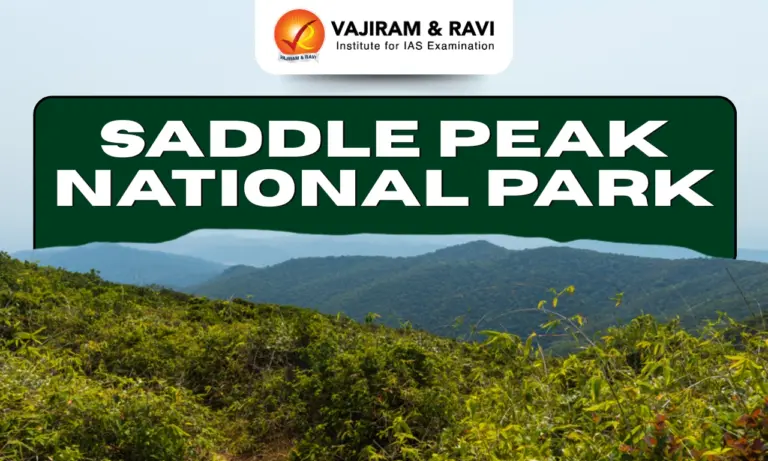
Saddle Peak National Park is a beautiful natural area known for its lush forests, hills, and rich wildlife. It is located in the Andaman and Nicobar Islands and is famous for its peaceful environment and scenic landscapes. The park is home to a wide variety of plants and animals and plays an important role in conserving the region’s natural biodiversity.
About Saddle Peak National Park
- Saddle Peak National Park is a beautiful natural area located in the Diglipur region of the Andaman and Nicobar Islands, known for its dense forests, scenic hills, and rich wildlife.
- It is named after Saddle Peak, which is the highest point in the Andaman and Nicobar Islands (around 732-737 meters above sea level).
- The park was established in 1979 and covers an area of about 32-33 sq. km, protecting a rich and diverse natural environment.
- The peak gets its name from its saddle-like (double-humped) shape, and from the top, visitors can enjoy panoramic views of the coastline and nearby islands.
Physical Features of Saddle Peak National Park
- The park stretches along the eastern coast of North Andaman Island, with one side bordered by the sea and rocky beaches.
- It includes lush evergreen forests, moist deciduous forests, bamboo patches, and coastal (littoral) vegetation, making it ecologically diverse.
- There are around 10 perennial streams and more than 100 seasonal streams, along with a freshwater pool that supplies water to nearby areas like Diglipur.
- Even though parts of the forest were logged in the past, the vegetation today is still thick, green, and rich in biodiversity.


Flora of Saddle Peak National Park
- The park has a variety of tropical forest types, including evergreen and semi-evergreen forests that remain green throughout the year.
- Important plant species include trees like Dipterocarpus, Diospyros, and Cratoxylum, along with bamboo and cane vegetation.
- The forests are dense and provide a natural habitat for many animals, while also helping maintain the region’s ecological balance.
Fauna of Saddle Peak National Park
- The park is home to many unique and native species, including the Andaman wild pig, Andaman hill myna, and imperial pigeon.
- Other animals include saltwater crocodiles, water monitor lizards, bats, and civets, along with occasional sightings of dolphins and whales nearby.
- It also supports a variety of birds, insects, and reptiles, making it an important biodiversity zone.
Challenges Faced by Saddle Peak National Park
- Illegal Activities (Poaching & Logging): Despite protection, poaching of wildlife and illegal cutting of trees sometimes occur, threatening the park’s biodiversity.
- Climate Change Impact: Changes in temperature, rainfall patterns, and sea levels affect the park’s delicate ecosystems and coastal areas.
- Human Encroachment: Expansion of nearby settlements and human activities can lead to habitat loss and disturbance to wildlife.
- Tourism Pressure: Unregulated or excessive tourism may cause littering, pollution, and disturbance to natural habitats.
- Natural Disasters: The Andaman region is prone to cyclones, heavy rains, and earthquakes, which can damage forests and wildlife habitats.
- Invasive Species: Introduction of non-native plants and animals can disturb the natural balance and compete with native species.
Conservation Efforts in Saddle Peak National Park
- Legal Protection Status: The park is a protected national park, which means activities like hunting, poaching, and deforestation are strictly prohibited to safeguard wildlife and forests.
- Biodiversity Conservation: Special efforts are made to protect endemic and rare species of plants and animals that are found only in the Andaman region.
- Forest Protection Measures: The evergreen and tropical forests are preserved by restricting logging and human interference, allowing natural vegetation to grow freely.
- Wildlife Protection: Animals such as the Andaman wild pig, saltwater crocodile, and native birds are protected through continuous monitoring and conservation programs.
- Control of Human Activities: Activities like grazing, land clearing, and unplanned tourism are limited to reduce environmental damage.
- Water Resource Conservation: The park’s streams and freshwater sources are protected, ensuring clean water supply and maintaining ecological balance.
- Eco-friendly Tourism: Visitors are encouraged to follow sustainable tourism practices, such as avoiding littering and respecting wildlife habitats.
Significance of Saddle Peak National Park
- Highest Point of the Andaman Islands: The park contains Saddle Peak, the highest peak in the Andaman and Nicobar Islands, offering strategic and scenic importance.
- Rich Biodiversity Hotspot: It is home to many endemic (native) species of plants, birds, and animals, making it an important biodiversity-rich region.
- Key Biodiversity Area (KBA): The park is recognized as a Key Biodiversity Area of international importance, highlighting its global ecological value.
- Protection of Unique Forest Ecosystems: It conserves different forest types like tropical evergreen, semi-evergreen, moist deciduous, and littoral forests, which are rare and ecologically significant.
- Habitat for Rare and Endemic Species: Species like the Andaman wild pig, Andaman hill myna, and imperial pigeon depend on this habitat for survival.
- Water Resource Importance: The presence of streams and freshwater sources supports local water needs and maintains ecological balance.
- Support to Ecological Balance: The dense forests help in climate regulation, soil conservation, and maintaining natural cycles in the region.

 Last updated on Oct, 2026
→ UPSC 2027 Notification will be released on 13 January 2027 at upsconline.nic.in.
→ Check Nobel Prize 2026 Winners List here.
→ Download PIB PRiSM Monthly Magazine 2026 here.
→ Check UPSC Monthly Current Affairs Magazine The Recitals here.
→ Check out the latest UPSC Syllabus here.
→ Download UPSC Model Answers for Mains 2026
→ UPSC Mains Question Paper 2026 is out now for Essay & GS Paper 1, 2, 3 & 4.
→ UPSC Calendar 2027 has been released.
→ Enroll in Vajiram & Ravi’s UPSC Mains Test Series 2027 for structured answer writing practice, expert evaluation, and exam-oriented feedback.
→ Join Vajiram & Ravi’s UPSC Mentorship Program 2027 for personalized guidance, strategy planning, and one-to-one support from experienced mentors.
→ Go through the UPSC Mains Previous Year Papers to enhance your preparation.
→ UPSC has released UPSC Toppers List 2025 with the Civil Services final result on its official website.
→ Also check Best UPSC Coaching in India
Saddle Peak National Park FAQs
Q1. What is Saddle Peak National Park famous for?+
Q2. Where is Saddle Peak National Park located?+
Q3. What is the height of Saddle Peak?+
Q4. What kind of wildlife is found in Saddle Peak National Park?+
Q5. When was Saddle Peak National Park established?+
Tags: environment environment notes saddle peak national park