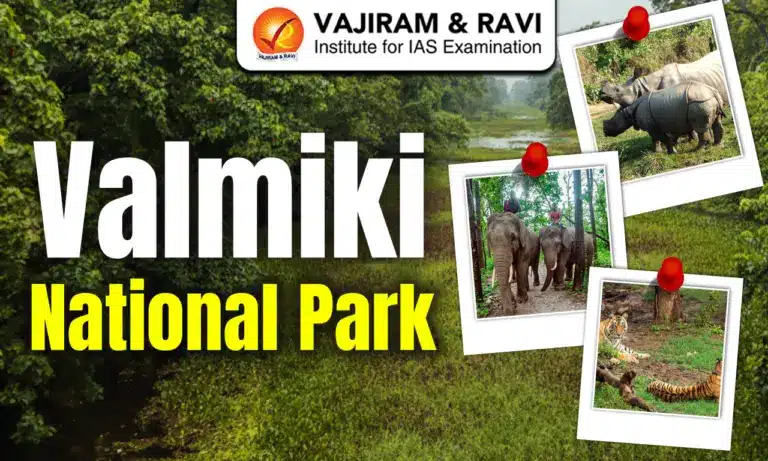
Valmiki National Park is a protected forest area located in the state of Bihar, near the border with Nepal. It is known for its rich biodiversity, dense forests, and scenic natural beauty. The park forms part of the Valmiki Tiger Reserve, providing a safe habitat for tigers, elephants, and many other wildlife species. It also lies in the foothills of the Himalayas, making it an important ecological region with rivers, forests, and diverse flora and fauna.
About Valmiki National Park
- Valmiki National Park is located in the northwestern part of Bihar along the India-Nepal border, making it an ecologically important transboundary region connecting two countries’ forest systems.
- It is the only national park in Bihar and forms the core of the Valmiki Tiger Reserve, which is crucial for wildlife conservation in eastern India.
- The park lies in the Himalayan Terai region, known for fertile land, dense forests, and favorable climate supporting rich biodiversity.
- It is especially important for conserving endangered species like the Bengal tiger, along with many other animals and plants.
- The region is also known for its scenic beauty, rivers, and forest landscapes, making it attractive for tourism and research.
- It contributes to India’s broader network of protected areas, ensuring ecological stability in the region.
Also Read : Himalayan Region in India
Valmiki National Park Location & Features
- The park is situated in West Champaran district, with Nepal forming its northern boundary and the Gandak River flowing along its western side.
- The terrain is highly varied, consisting of plains, hills, forests, and river valleys, which create multiple habitats within the park.
- The Someshwar Hills add elevation and ruggedness, providing shelter and breeding grounds for wildlife.
- It lies in the Bhabar-Terai belt, which has porous soil and high groundwater availability, supporting dense vegetation.
- Rivers like Pandai, Masan, Harha, and Manor flow through the region, enriching soil and sustaining life.
- Seasonal flooding in some areas helps maintain wetlands and grasslands, which are vital for biodiversity.
- The physical diversity of the region makes it suitable for both terrestrial and aquatic species.


Valmiki National Park Flora
- The park is dominated by tropical moist deciduous forests, especially Sal forests, which form dense and continuous vegetation cover.
- It also contains grasslands, riverine forests, and swampy areas, increasing ecological diversity across the landscape.
- Important plant species include teak, bamboo, semal, khair, and cane, which have ecological as well as economic value.
- Seasonal variation in vegetation ensures continuous food supply and shelter for wildlife throughout the year.
- Grasslands support grazing animals, while forests provide protection and breeding grounds.
- Vegetation helps in soil conservation, prevention of erosion, and maintenance of water cycles.
- It also plays a role in carbon storage and climate regulation, contributing to environmental stability.
Also Read : Tropical Deciduous Forest in India
Valmiki National Park Fauna
- The park supports a wide range of wildlife due to its diverse habitats, making it one of the richest biodiversity zones in Bihar.
- Major carnivores include tigers, leopards, and wild cats, which are key to maintaining ecological balance.
- Large herbivores such as elephants, gaur, sambar, and chital form the prey base and support the food chain.
- Smaller mammals like civets, monkeys, and fishing cats add to the diversity of species present.
- Reptiles such as snakes, crocodiles, and turtles are also found in riverine and forest areas.
- The park has more than 200 bird species, including migratory birds, making it a hotspot for birdwatching.
- Biodiversity richness makes it suitable for scientific research and conservation studies.
Valmiki National Park Ecological Importance
- The park serves as a transboundary wildlife corridor connecting Indian forests with Chitwan National Park, ensuring species movement across borders.
- This connectivity helps maintain genetic diversity, which is essential for long-term survival of species like tigers and elephants.
- Forests and rivers together regulate climate, rainfall, and water cycles, supporting agriculture and human life nearby.
- It acts as a watershed area, protecting soil and maintaining groundwater levels.
- The park supports the stability of the Terai ecosystem, which is one of the most productive ecological regions in India.
- Increase in wildlife population indicates healthy ecosystem functioning and successful conservation efforts.
- It also plays a role in mitigating climate change impacts through forest cover.
Human Communities in Valmiki National Park
- Indigenous Communities (Tharu Tribe): The region is inhabited by the Tharu tribe, an indigenous community that has lived in close harmony with forests for generations, maintaining a strong nature-dependent lifestyle.
- Nature-Based Livelihoods: Their livelihoods depend on agriculture, forest produce, fishing, and livestock rearing, creating a deep interdependence with natural resources.
- Traditional Ecological Knowledge: They possess rich traditional knowledge about forest management, medicinal plants, and wildlife behavior, which supports sustainable resource use.
- Community Participation in Conservation: Active community involvement has strengthened forest protection and helped reduce illegal activities like poaching and encroachment.
- Alternative Livelihood Programs: Government initiatives promote alternative livelihoods to reduce pressure on forests and ensure sustainable income sources.
- Cultural Values & Practices: Their cultural traditions and practices reflect a deep respect for nature and commitment to preserving biodiversity.
- Balancing Development & Conservation: Maintaining a balance between human needs and wildlife conservation remains an ongoing challenge in the region.
Infrastructure Issues
- Disruption of Wildlife Corridors: Roads and railway lines passing through forest areas fragment habitats and disrupt natural wildlife corridors, affecting ecosystem connectivity.
- Accidents & Mortality Risk: Animals face frequent road and rail accidents due to high-speed vehicles and trains, especially during night movement, leading to increased wildlife mortality.
- Human Interference & Pollution: Infrastructure development increases human interference, along with noise pollution and disturbance in otherwise undisturbed forest habitats.
- Barrier to Movement: Linear infrastructure acts as a physical barrier, restricting free movement, and negatively impacting breeding patterns and seasonal migration of animals.
- Poor Planning Impacts: Lack of scientific planning and environmental assessment leads to long-term ecological damage and habitat degradation.
- Mitigation Measures Needed: Solutions like eco-bridges, underpasses, and speed regulation are essential to ensure safe wildlife passage across infrastructure.
- Need for Sustainable Planning: Adopting sustainable infrastructure planning is crucial to balance development needs with wildlife conservation and habitat protection.
Valmiki National Park Conservation Initiatives
- ALIGN Project (WWF-India): The ALIGN project by WWF-India focuses on reducing the impact of linear infrastructure (roads, railways, canals) on wildlife and maintaining habitat connectivity.
- Wildlife-Friendly Infrastructure: Promotes structures like underpasses, overpasses, and eco-bridges to ensure safe animal movement across fragmented landscapes.
- Awareness & Capacity Building: Conducts awareness campaigns to educate local communities and authorities about the importance of wildlife conservation and sustainable development.
- Collaborative Approach: Encourages coordination between government agencies, NGOs, and local communities for effective policy implementation and conservation planning.
- Use of Technology: Utilizes tools like camera traps, GIS mapping, and data analysis to improve wildlife monitoring and decision-making.
- Reducing Conflict & Habitat Loss: Implements programs to minimize human-wildlife conflict and prevent further habitat destruction due to development activities.
- Sustainable Coexistence Goal: Aims to achieve long-term human-wildlife coexistence by balancing development needs with ecological conservation.
Valmiki National Park Conservation Achievements
- Increase in Tiger Population: The tiger population in Valmiki Tiger Reserve (West Champaran) has increased more than sevenfold, rising from 8 in 2010 to 54 in 2022, reflecting successful conservation strategies, effective protection measures, and significant habitat improvement.
- Anti-Poaching Measures: Strict anti-poaching laws, along with enhanced surveillance systems like patrolling and monitoring, have significantly reduced illegal hunting.
- Control on Exploitative Activities: Banning of sand mining and deforestation has helped in restoring ecological balance and protecting critical forest habitats.
- Grassland Management: Improved grassland management has enhanced prey base (herbivores), which in turn supports the survival and growth of carnivores like tigers.
- National Recognition: Recognition by national conservation bodies highlights the success of wildlife management practices and effective implementation of policies.
- Community Participation: Increased awareness among local communities has led to stronger public participation and support for conservation initiatives.
- Continuous Monitoring: Regular monitoring, use of technology, and data-based strategies ensure better wildlife management and adaptive policy implementation.
Valmiki National Park Challenges
- Habitat Fragmentation: Expansion of agriculture, roads, and human settlements breaks forests into smaller patches, disrupting wildlife corridors and limiting animal movement for feeding, breeding, and migration.
- Human-Wildlife Conflict: Increasing overlap between humans and forests leads to crop damage, livestock loss, and threats to human safety, creating resistance among local communities toward conservation efforts.
- Climate Change Impacts: Irregular rainfall, temperature fluctuations, and extreme weather events affect vegetation patterns, water availability, and overall ecosystem stability, making survival difficult for wildlife.
- Poaching & Encroachment: Illegal activities like poaching threaten endangered species, while encroachment into forest land leads to habitat degradation and loss of biodiversity.
- Population Pressure: Rising human population increases demand for land, fuelwood, and forest resources, putting excessive stress on already fragile ecosystems.
- Limited Conservation Resources: Lack of funding, trained manpower, and modern infrastructure weakens monitoring, protection, and effective implementation of conservation strategies.
- Need for Policy & Coordination: Weak policy enforcement and lack of cross-border coordination (especially with Nepal) hinder effective conservation of migratory and transboundary species.

 Last updated on Oct, 2026
→ UPSC 2027 Notification will be released on 13 January 2027 at upsconline.nic.in.
→ Check Nobel Prize 2026 Winners List here.
→ Download PIB PRiSM Monthly Magazine 2026 here.
→ Check UPSC Monthly Current Affairs Magazine The Recitals here.
→ Check out the latest UPSC Syllabus here.
→ Download UPSC Model Answers for Mains 2026
→ UPSC Mains Question Paper 2026 is out now for Essay & GS Paper 1, 2, 3 & 4.
→ UPSC Calendar 2027 has been released.
→ Enroll in Vajiram & Ravi’s UPSC Mains Test Series 2027 for structured answer writing practice, expert evaluation, and exam-oriented feedback.
→ Join Vajiram & Ravi’s UPSC Mentorship Program 2027 for personalized guidance, strategy planning, and one-to-one support from experienced mentors.
→ Go through the UPSC Mains Previous Year Papers to enhance your preparation.
→ UPSC has released UPSC Toppers List 2025 with the Civil Services final result on its official website.
→ Also check Best UPSC Coaching in India
Valmiki National Park FAQs
Q1. What is Valmiki National Park known for?+
Q2. Where is Valmiki National Park located?+
Q3. Why is Valmiki National Park ecologically important?+
Q4. What types of flora and fauna are found in Valmiki National Park?+
Q5. How has the tiger population changed in Valmiki Tiger Reserve?+
Tags: environment environment notes valmiki national park