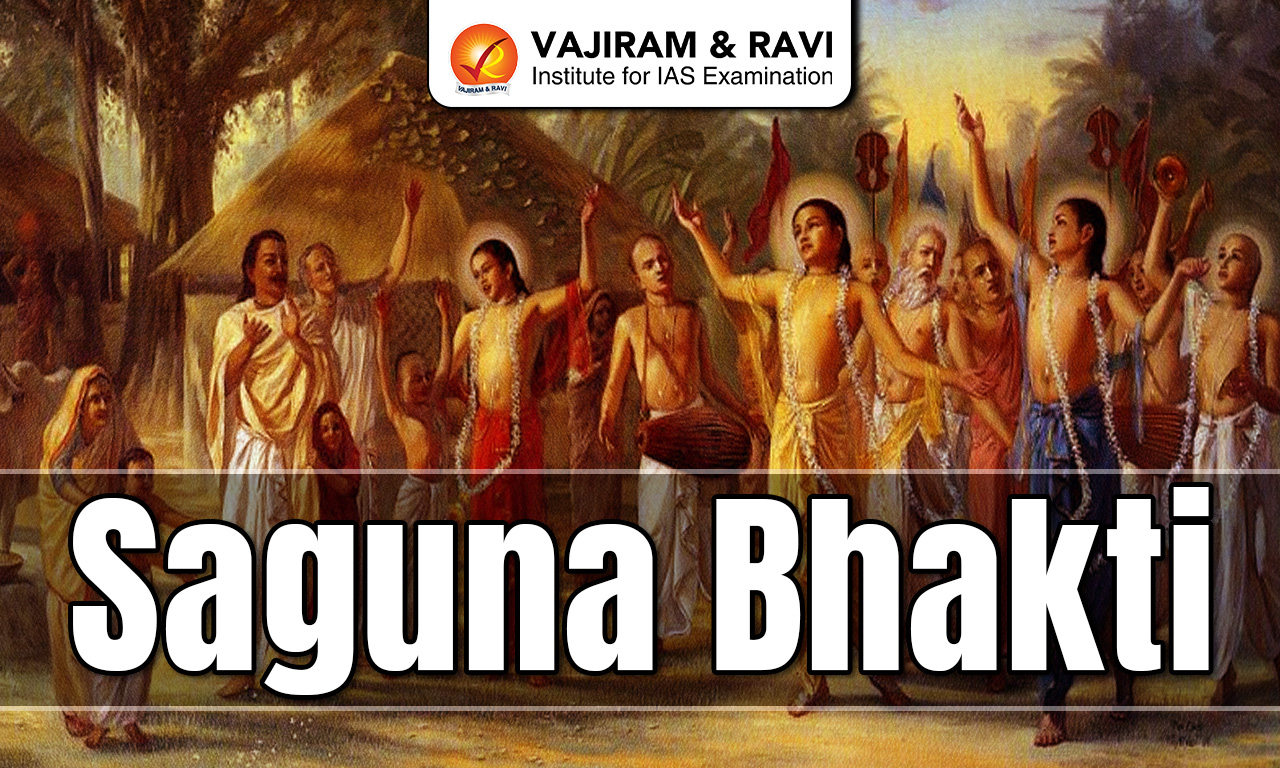
Saguna Bhakti is a form of devotion in which people worship God with a physical form and qualities, such as love, kindness, and compassion. In this path, devotees feel a personal connection with God, often imagining or seeing the divine in human-like forms like Krishna or Rama. It makes devotion more emotional and relatable, as people can express their feelings through prayers, songs, and rituals. Saguna Bhakti Key Aspects, Prominent Saints, Social Impact and the differences between Saguna and Nirguna Bhakti have been discussed in detail in this article.
Key Aspects of Saguna Bhakti
- Concept of a Personal God: Saguna Bhakti focuses on worshipping God in a visible and human-like form, with qualities such as love, kindness, and compassion. Devotees believe in deities like Vishnu, Shiva, Rama, Krishna, and Durga, who can be imagined and connected with easily.
- Worship Through Idols and Images: In this tradition, idols (murti) and pictures are important. People believe that God’s presence exists in these forms, so they worship them at home and in temples with great respect and devotion.
- Use of Rituals and Practices: Devotion is expressed through temple rituals, pilgrimages, singing bhajans, and reciting prayers or hymns. These practices help devotees feel closer to God in their daily lives.
- Emotional Connection with God: Saguna Bhakti strongly emphasizes a deep emotional bond with God. Devotees relate to God in different ways, such as a friend, parent, child, or beloved, making the relationship very personal and heartfelt.
- Belief in God’s Incarnations (Avatars): Followers believe that God takes different forms or avatars, such as Rama and Krishna, to guide and protect people. These stories make devotion more relatable and meaningful.
- Importance of Love and Devotion: The main focus of this path is pure love (bhakti) and complete dedication to God. It teaches that sincere devotion is more important than complex rituals or knowledge.
- Division into Ram and Krishna Bhakti: Saguna Bhakti later developed into two main branches – one focused on devotion to Rama (Ram Bhakti) and the other on Krishna (Krishna Bhakti), each with its own traditions and followers.
- Role of Guru and Scriptures: Followers respect the authority of sacred texts like the Vedas and believe in the importance of a Guru (spiritual teacher), who guides them on the path of devotion.
- Connection with Philosophical Ideas: Philosophers like Ramanujacharya and Madhvacharya explained Saguna Bhakti by describing God as a personal being with qualities. Their teachings helped shape this devotional path.
- Simple and Accessible Worship: Saguna Bhakti made religion easier for common people by encouraging the use of regional languages, simple prayers, and personal devotion instead of strict and complex rituals.
- Social and Cultural Influence: Some followers supported existing social systems like the caste structure, while also spreading devotion among the masses through poetry, songs, and teachings.
- Famous Saints and Followers: This tradition was followed and spread by saints like Ramanuja, Ramananda, Meera Bai, and Chaitanya Mahaprabhu, who expressed their devotion through songs and teachings.
Saguna Bhakti Prominent Saints
- Ramanuja (1060-1118 AD)
- Background and Role: Ramanuja was a Tamil Brahmin scholar and one of the most important followers of Vaishnavism. He travelled widely to spread the message of love, devotion, and surrender to God before finally settling in Srirangam.
- Philosophy – Vishishtadvaita (Qualified Monism): He introduced the idea of Vishishtadvaita, which means that God is one, but the world and souls are also real and connected to Him. Unlike pure dualism, he believed humans are closely connected to God and not completely separate.
- Belief in a Personal God: According to him, Brahman is a personal God, mainly Vishnu or his forms. He believed Vishnu created the world out of love and continues to guide and control it.
- Path to Salvation: He taught that salvation can be achieved through three paths: Karma (actions), Gyan (knowledge), and Bhakti (devotion). He especially emphasized prapatti (complete surrender to God).
- Works and Influence: His important works include Sri Bhashya and Gita Bhashya. His teachings were later spread in North India by his disciple Ramananda.
- Ramananda (1300–1380 AD)
- Role in Bhakti Movement: Ramananda was a great devotee of Lord Rama and played a key role in spreading Bhakti in North India. He is often called a bridge between the Bhakti traditions of South and North India.
- Social Reforms and Inclusiveness: He strongly opposed caste discrimination and accepted followers from all backgrounds, regardless of caste, religion, or gender. His disciples included people from different professions like Kabir (weaver), Ravidas (cobbler), and Sena (barber).
- Use of Local Language: He preached in Hindi so that common people could easily understand religious ideas. This made devotion more accessible to everyone.
- Teachings and Influence: He believed in simple devotion to Rama and love for God. Many later saints respected him as their Guru.
- Chaitanya Mahaprabhu
- Devotion to Krishna: Chaitanya Mahaprabhu was a passionate devotee of Lord Krishna. He popularized the chanting of “Hare Rama, Hare Krishna” as a way to connect with God.
- Philosophy and Worship Style: He taught the idea of Achintya Bheda-Abheda (oneness and difference with God). He promoted kirtans (devotional singing) as an important form of worship.
- Cultural Influence: He encouraged the worship of Radha and Krishna together. His teachings are still widely followed, especially in Bengal and Odisha.
- Works and Legacy: He wrote Siksastakam in Sanskrit. His life story was written by Krishnadas Kaviraj.
- Meera Bai (1498-1546)
- Background and Devotion: Meera Bai was a Rajput princess from Rajasthan who devoted her life to Lord Krishna. She saw Krishna not just as God, but as her beloved.
- Poetry and Expression: She composed beautiful bhajans in simple languages like Braj and Rajasthani. Her songs express deep love and longing for Krishna.
- Unique Spiritual Relationship: Her poetry reflects a very personal bond with God, where she imagines herself as Krishna’s devotee and beloved.
- Eknath (1533-1599)
- Religious and Literary Contribution: Eknath was a saint from Maharashtra and part of the Varkari tradition. He wrote Eknathi Bhagavat, explaining religious ideas in a simple way.
- Language and Accessibility: He translated Sanskrit texts into Marathi so that ordinary people could understand them. He also introduced a new devotional song style called Bharood.
- Social Views: He opposed caste discrimination and believed all humans are equal in God’s eyes. His ideas were influenced by both Vedanta and Sufi thought.
- Tulsidas
- Life and Background: Tulsidas was a contemporary of Emperor Akbar and a great devotee of Lord Rama. His real name was Ram Bola Dubey.
- Famous Works: He wrote Ramcharitmanas in Awadhi, making the story of Ram accessible to common people. Other works include Vinaya Patrika, Gitavali, and Kavitawali.
- Cultural Contribution: He started the tradition of Ramlila (dramatic performances of Ramayana). He also founded the Sankatmochan Hanuman Temple in Varanasi.
- Impact: His use of simple language helped spread devotion among ordinary people.
- Surdas (1478–1580)
- Early Life and Devotion: Surdas was a blind poet and a devoted follower of Lord Krishna. He left home at a young age and later became a disciple of Vallabhacharya.
- Literary Contributions: His famous works include Sursagar and Sur Saravali, which mainly describe Krishna’s childhood.
- Religious Beliefs: He followed the Pushti Marg tradition and worshipped Krishna in his child form. He was one of the most important poets among the Ashtachap (eight disciples of Vallabhacharya).
- Role in Bhakti Movement: His works played a major role in spreading the Bhakti movement among common people and strengthening spiritual awareness.


Saguna vs Nirguna Key Differences
Saguna and Nirguna Bhakti represent two different ways of understanding and experiencing the divine in Indian philosophy. While one focuses on a personal God with form and qualities, the other describes an abstract, formless ultimate reality. The key differences between them are discussed below.
|
Basis of Difference |
Saguna Bhakti (With Form) |
Nirguna Bhakti (Formless) |
|
Nature of God |
God is seen with form, qualities, and attributes like love, power, and compassion. |
God is without any form or qualities; it is pure, infinite, and beyond human understanding. |
|
Concept of Divinity |
God is personal and can be imagined in forms like Rama, Krishna, or Shiva. |
God is impersonal, abstract, and cannot be seen or imagined in any physical form. |
|
Way of Worship |
Worship involves idols, temples, rituals, prayers, and devotional songs (bhakti). |
Worship is through meditation, self-reflection, and inner realization rather than rituals. |
|
Relationship with God |
Devotees form a personal and emotional bond with God (like friend, parent, or beloved). |
There is no personal relationship; the focus is on realizing that the self and Brahman are one. |
|
Spiritual Goal |
To develop love and devotion towards a personal God and seek His grace. |
To achieve self-realization and understand the ultimate truth of existence. |
|
Level of Understanding |
Often considered easier and more accessible for common people. |
Considered more philosophical and deeper, requiring higher level of understanding. |
|
Role in Philosophy |
Seen as a step towards understanding the ultimate truth in some traditions. |
Considered the highest and ultimate reality (Para Brahman). |
|
Examples of Practice |
Bhajans, kirtans, temple visits, idol worship, and pilgrimages. |
Meditation, silence, contemplation, and inquiry into the self (“Who am I?”). |
|
Emotional Aspect |
Strong emotional and devotional connection with God. |
Focus is more on knowledge, awareness, and inner peace rather than emotions. |
|
Accessibility |
Easy to follow for the general public due to visible forms and simple practices. |
More abstract and may be difficult for beginners to understand. |
|
View of Reality |
Accepts God with form as real and meaningful for devotion. |
Sees ultimate reality as beyond all forms and descriptions. |
|
Relationship Between Both |
Acts as a starting point for many devotees. |
Represents the final stage of spiritual understanding. |
Social Impact
- Made Religion Simple and Accessible: Saguna Bhakti made religious practices easy for common people by focusing on simple devotion, prayers, and songs instead of complex rituals. People from all sections of society could now connect with God without needing deep knowledge of scriptures.
- Use of Regional Languages: Devotional songs and teachings were written in local languages rather than Sanskrit. This helped ordinary people understand religious ideas better and increased participation in spiritual practices.
- Strengthened Emotional Faith: It encouraged people to build a personal and emotional connection with God. This brought comfort, hope, and a sense of belonging, especially during difficult times.
- Growth of Temple Culture: Saguna Bhakti promoted idol worship and temple rituals, leading to the development and importance of temples as social and cultural centers where people gathered regularly.
- Promotion of Music and Literature: The movement gave rise to a rich tradition of bhajans, kirtans, and devotional poetry. Saints expressed their devotion through songs and writings, enriching regional literature and cultural heritage.
- Encouraged Community Participation: Activities like group singing (kirtans) and festivals brought people together, creating a sense of unity and shared spiritual experience within communities.
- Spread of Bhakti Movement Across India: Saguna Bhakti played a major role in spreading the Bhakti movement to different parts of India, influencing religious practices and beliefs across regions.
- Role of Guru and Spiritual Guidance: It emphasized the importance of a Guru, who guided followers on the path of devotion and helped them understand spiritual teachings.
- Support for Traditional Social Structure: In some cases, Saguna Bhakti followers supported existing social systems like the caste structure and Brahminical authority, maintaining traditional hierarchies.
- Balance Between Ritual and Devotion: While it supported rituals and idol worship, it also highlighted that true devotion and faith are more important than mere external practices.
- Cultural Integration: Saguna Bhakti helped blend religion with daily life, festivals, music, and art, making spirituality a natural part of people’s routine.

 Last updated on Oct, 2026
→ UPSC 2027 Notification will be released on 13 January 2027 at upsconline.nic.in.
→ Check Nobel Prize 2026 Winners List here.
→ Download PIB PRiSM Monthly Magazine 2026 here.
→ Check UPSC Monthly Current Affairs Magazine The Recitals here.
→ Check out the latest UPSC Syllabus here.
→ Download UPSC Model Answers for Mains 2026
→ UPSC Mains Question Paper 2026 is out now for Essay & GS Paper 1, 2, 3 & 4.
→ UPSC Calendar 2027 has been released.
→ Enroll in Vajiram & Ravi’s UPSC Mains Test Series 2027 for structured answer writing practice, expert evaluation, and exam-oriented feedback.
→ Join Vajiram & Ravi’s UPSC Mentorship Program 2027 for personalized guidance, strategy planning, and one-to-one support from experienced mentors.
→ Go through the UPSC Mains Previous Year Papers to enhance your preparation.
→ UPSC has released UPSC Toppers List 2025 with the Civil Services final result on its official website.
→ Also check Best UPSC Coaching in India
Saguna Bhakti FAQs
Q1. What is Saguna Bhakti?+
Q2. What are the key features of Saguna Bhakti?+
Q3. Who are the main saints of Saguna Bhakti?+
Q4. What is the difference between Saguna and Nirguna Bhakti?+
Q5. How did Saguna Bhakti impact society?+
Tags: art and culture art and culture notes saguna bhakti