


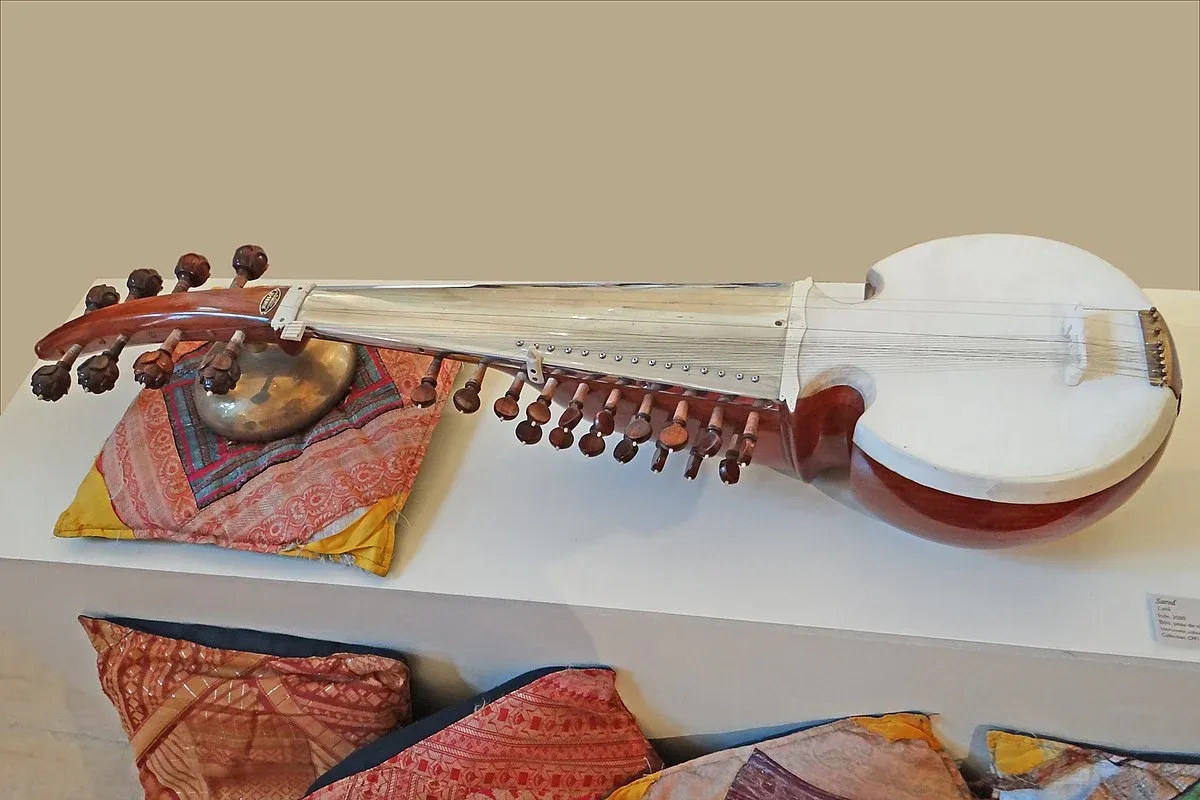
About Sarod:
- It is a stringed instrument in the lute family and one of the most popular instruments in Hindustani classical music.
- It is often accompanied by the tabla (drums) and tambura (drone lute).
- It is an adaptation of the Afghan rabab, which arrived in India during the 16th century.
- The modern form of the instrument was designed in the 19th century.
- Design:
- The sarod is 100 cm long and has a body made from hollow teak, sagwan, or tun wood.
- High-quality instruments have a body, neck, and peg box made from a single piece of wood.
- The resonator has a stretched membrane (usually goatskin) and a bridge made from horn where the strings rest.
- The bridge is very thin, like that of a violin. The melody strings are stretched across the bridge, and the sympathetic strings run through holes drilled into the bridge.
- The strings were traditionally made from gut or silk, but today areusually made from steel or bronze.
- The neck of the instrument does not have a fretboard, but rather a polished, steel plate.
- Playing:
- One who plays the sarod is called a sarodiya, and the word sarod is Persian for song or melody.
- The seated player holds the instrument across his lap.
- The strings of the sarod are plucked using a triangle-shaped plectrum called a jawa, usually made from coconut shell, ebony, or horn., while the fingernails of the left hand press the strings.
Two prominent Indian schools of sarod playing are those of Ghulam Ali Khan and Allauddin Khan, each with its own playing style, type of sarod (e.g., size, shape, and number of strings vary), and tuning system.
Q1: What is tambura?
The tambura or tanpura is a plucked drone instrument used to accompany instrumental or vocal performances. It has a hollow neck, measures about 40–60 inches (102–153 cm) in length, and usually has four metal strings tuned.It resembles the tanbur, the Middle Eastern lute from which it derives.
Source: Sarod maestro Pandit Rajeev Taranath passes away


 Last updated on Oct, 2026
→ UPSC 2027 Notification will be released on 13 January 2027 at upsconline.nic.in.
→ Check Nobel Prize 2026 Winners List here.
→ Download PIB PRiSM Monthly Magazine 2026 here.
→ Check UPSC Monthly Current Affairs Magazine The Recitals here.
→ Check out the latest UPSC Syllabus here.
→ Download UPSC Model Answers for Mains 2026
→ UPSC Mains Question Paper 2026 is out now for Essay & GS Paper 1, 2, 3 & 4.
→ UPSC Calendar 2027 has been released.
→ Enroll in Vajiram & Ravi’s UPSC Mains Test Series 2027 for structured answer writing practice, expert evaluation, and exam-oriented feedback.
→ Join Vajiram & Ravi’s UPSC Mentorship Program 2027 for personalized guidance, strategy planning, and one-to-one support from experienced mentors.
→ Go through the UPSC Mains Previous Year Papers to enhance your preparation.
→ UPSC has released UPSC Toppers List 2025 with the Civil Services final result on its official website.
→ Also check Best UPSC Coaching in India








