


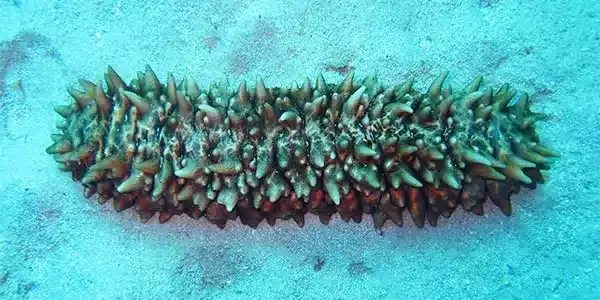
About Sea cucumbers:
- Sea cucumbers are marine animals that belong to the class Holothuroidea, which is part of the phylum Echinodermata.
- They are found in saltwater environments worldwide, primarily on or near the seabed, and are characterized by their soft, leathery skin and elongated bodies.
- Sea cucumbers are the janitors of tropical seas.
- Just as a vacuum cleaner consumes dirt and fills up its bag, sea cucumbers consume bacteria and decaying organics from the seafloor and convert this into sea cucumber body mass, reducing the “food” available to support the growth of microbial pathogens.
Appearance and Habitat:
- Size and Colors: Sea cucumbers come in various sizes, ranging from 0.75 inches to 10 feet long, and display a wide array of colours, including brown, red, orange, yellow, white, blue, and patterns.
- Body Structure: They have bumps on their bodies and lack eyes and a brain but have evolved clever ways to navigate, defend themselves, and forage for food.
- Threat: Sea cucumbers are preyed upon by various marine animals and are also consumed by humans. Overfishing is a significant threat to their populations, with more than 70 species being exploited for profit.
Symbiotic Relationship: Some species of sea cucumber have a symbiotic relationship with the star pearlfish, which uses the sea cucumber’s body as shelter.
Q1: What are echinoderms?
Echinoderms are named for the spines or bumps covering the outer surface of the bodies of many of them. Examples of echinoderms include sea stars, sea urchins, sea cucumbers, brittle stars, and feather stars (Fig. 3.83). Although they may appear very different, echinoderms all have two major defining characteristics that set them apart from all other animals: a water vascular system and five-sided radial symmetry.


 Last updated on Oct, 2026
→ UPSC 2027 Notification will be released on 13 January 2027 at upsconline.nic.in.
→ Check Nobel Prize 2026 Winners List here.
→ Download PIB PRiSM Monthly Magazine 2026 here.
→ Check UPSC Monthly Current Affairs Magazine The Recitals here.
→ Check out the latest UPSC Syllabus here.
→ Download UPSC Model Answers for Mains 2026
→ UPSC Mains Question Paper 2026 is out now for Essay & GS Paper 1, 2, 3 & 4.
→ UPSC Calendar 2027 has been released.
→ Enroll in Vajiram & Ravi’s UPSC Mains Test Series 2027 for structured answer writing practice, expert evaluation, and exam-oriented feedback.
→ Join Vajiram & Ravi’s UPSC Mentorship Program 2027 for personalized guidance, strategy planning, and one-to-one support from experienced mentors.
→ Go through the UPSC Mains Previous Year Papers to enhance your preparation.
→ UPSC has released UPSC Toppers List 2025 with the Civil Services final result on its official website.
→ Also check Best UPSC Coaching in India








